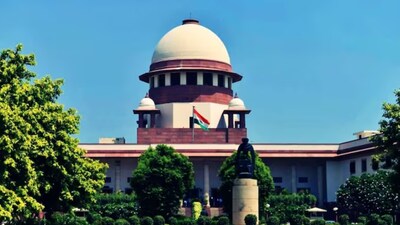
Can the Supreme Court become an interim Parliament?
This month the Supreme Court will hear a matter examining the scope of Article 141 of the Constitution which says that the law declared by the apex court shall be binding on all courts. The underlying issue centers on a test of legitimacy of legislative power or the Supreme Court’s power under Article 141.

Salute the understated commitment to fiscal rectitude which enables a favourable macroeconomic environment
Key budget announcements like support for gig workers, global capacity centres, and startups will unleash entrepreneurial talent. The Finance Minister’s fiscal discipline is praiseworthy, as India moves towards private sector-driven growth.
To leverage AI, India needs a robust regulatory mechanism
Sanghnomics: India is developing its own generative AI model, set for release in 2025. The Economic Survey highlights potential job losses due to AI, particularly in service sectors. Regulatory frameworks are evolving, but ensuring timely legislation remains a significant challenge
A budget that scores on four of five essential criteria
Budget does well on transparency, diluting intrusiveness in taxation, fiscal prudence and laying down a roadmap for more consolidation. It could have been more ambitious in its goals but the global uncertainty triggered by US policy could have nudged the government to err on the side of caution
The tariff trouble starts with oil
And weak sales of big-ticket items
India’s Middle Class Boom: How PM Modi’s budget is reshaping economic prosperity
At a single stroke, 70 million taxpayers have been wholly unburdened by the budget and the middle class has seen a substantial increase in its post-tax income. This will spur a consumption boom, pushing India’s GDP to an 8% range.
Corporate effective tax rate stabilises at higher levels, larger companies in better shape
Companies with above Rs 500 crore PBT have seen their effective tax rate decline in 2022-23 compared to those in the Rs 50-500 crore PBT range
Delhi’s ‘freebie’ anchored political campaigns pose fundamental questions
‘Freebies’ are a counter to the conventional mobilization around caste blocs, which upended national politics after the release of Mandal Commission report. However, freebies raise questions about fiscal sustainability and the trade-offs involved for economic performance. As Delhi continues to set a precedent, the debate over the merits and demerits of freebies versus caste politics is likely to shape the future of Indian democracy
Chart of the Day| Are Indian markets still over-valued?
On a forward PE basis Nifty 50 stocks are around 20 times now, with the long-term mean at 17.2 times and one standard deviation above the mean is at 21.7 times.
With sustained infra focus, Budget marks a shift to emerging sectors
Significant investments are planned to promote AI research, establish centres of excellence, and integrate AI across sectors like agriculture, healthcare, and manufacturing
Marking a new anchor: Budget seeks higher structural strength for the economy
The government has sought to address the credit needs of the lower segments of the population and possibly the still unbanked category
The Eastern Window: China’s innovation cookbook
Behind the success of Chinese scientists and tech companies, there is a well-organised educational and support system to foster the growth of scientific and technological talent
The Budget empowers the consumer -- and the patient investor
The best course is to stay invested to reap the benefits of a consumption boost
A new Trump tariff era could benefit China, disadvantage US
Canada, Mexico and China will feel the heat from Trump’s tariff war, but the US will not be left unscathed either, in a conflict that threatens to envelop the world
Crunching the Numbers: Does Budget 2025 really boost consumption?
The share of GDP the government takes in taxes out of total income is expected to go up. That in turn means the share available for households for consumption or saving or investment is slightly lower than what it is in the current fiscal year
Challenges lie ahead on the path of fiscal consolidation
Budget for FY26 tries to offset a decline in expenditure as a share of GDP by focussing on quality of spending and deficits. However, the path of fiscal consolidation outlined in terms of debt-to-GDP ratio will not be easy
Budget floats on some risky bets
The budget identifies trade as an engine of growth. That engine is likely to stall, under the assault on global trade that the newly elected US president Donald Trump is rolling out. India would need to make other engines tick.
Defence budget signals pursuit of gradual reforms
The primary structural problem of salaries and pension squeezing fiscal space for capital acquisition remains. However, the pattern of allocation on armaments sends a clear signal that the domestic industrial complex is prioritised and will be encouraged
Fiscal fortitude: India’s debt-to-GDP record dwarfs shaky G7
Budget marks a significant shift from a qualitative goal to a specific, measurable target to 50 per cent by 2031. Since 2013, India's average central government debt-to-GDP ratio has been 49.03 per cent. The USA’s central government debt-to-GDP ratio has remained above 100 per cent since 2020, as also Japan’s, Italy’s and UK’s (barring 2022, when it was marginally lower)
Union Budget 2025 boosts consumption in urban and rural India
The Union Budget 2025 focuses on stimulating private consumption in both urban and rural India. By revising tax slabs, increasing rural support, and boosting agriculture and food processing industries, it aims to enhance growth, consumption, and farmer incomes
Union Budget 2025 is fiscally prudent, job-centric, and growth-driven
The 2025 budget prioritises fiscal prudence, consumption, job creation, and self-reliance, with key focus on MSMEs, agriculture, healthcare, and manufacturing. It offers tax relief for the middle class, boosts infrastructure, and simplifies business processes to attract multinationals
Budget focusing on achieving the Viksit status, 50-75 bps repo rate cut in FY26 likely
Budget focusing on achieving the Viksit status: Consequently, along with an anticipated 50-75 bps cut in the repo rate by the RBI in FY26, Indranil Pan see the 10-year G-sec yield in a range of 6.30-6.50% in FY26.
Budget targets 9 sectors to stimulate economic growth
The FY2025-26 Union Budget presents a clear path toward consumption-driven growth, supported by strategic sectoral measures, continued fiscal discipline, and targeted investments in infrastructure, energy, and healthcare.
Budget exceeds primary expectation of boosting consumption demand, while sticking to fiscal path, says Sachin Gupta of CareEdge
In addition, Sachin Gupta sees this budget focusing on three key areas – Ease of Doing Business (EODB), focus on labour-intensive sectors and continued focus on infrastructure investment.
Budget brings big cheer for middle class with no tax up to Rs 12 lakh income, upward revision in tax slabs, says Suresh Soni
From the market perspective, it is a positive budget which seeks to boost consumption and inclusive growth while maintaining fiscal discipline.