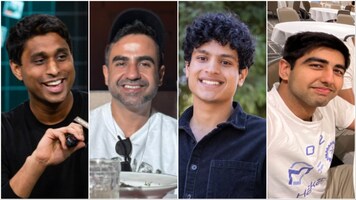
The controversy surrounding Professor Ali Khan Mahmudabad continues to intensify further, with Sanjeev Bikhchandani, co-founder of Ashoka University, recently voicing his growing disillusionment with the institution following the professor's arrest over a social media post last month.
Bikhchandani, in an internal email that has now come to light, has described the university as “too much of a headache” and stated that he and fellow co-founders Pramath Raj Sinha and Ashish Dhawan have seriously considered stepping away from their roles.
"Pramath, Ashish, and I have seriously discussed the option of walking away. Ashoka is too much of a headache. Is it worth the effort?" Bikhchandani announced on his email.
The email was in response to an alumnus who had questioned the university’s silence on Mahmudabad’s arrest and its perceived lack of institutional support, as per a News18 report.
Professor Mahmudabad, who heads the Department of Political Science at Ashoka University in Sonipat, was arrested on May 18 following his remarks on Operation Sindoor in a social media post.
While lauding the outcomes of the Indian armed forces' precision strikes, he had also raised concerns over "symbolic optics" and the perceived marginalisation of minorities. The post, made on May 8, quickly went viral and drew legal complaints, leading to two FIRs against him.
In his email, Bikhchandani has strongly rejected the notion that the university was obligated to defend Mahmudabad's personal views.
“You are a grown-up adult. You are responsible for your actions and any consequences thereof,” he wrote. “Ashoka is not obliged to support you for political opinions you express in your personal capacity. You did not seek Ashoka’s consent before posting on social media; you cannot now present Ashoka with a fait accompli and expect support," writes Bikhchandani.
Further arguing, he noted that social media activity does not fall under the ambit of academic freedom.
“A political opinion expressed on Facebook or Twitter (X) or Instagram is not academic scholarship… If a regulator or the government or law enforcement goes after you for a social media post, it is not an infringement of academic freedom. It might be an infringement of freedom of speech, for which there are constitutional remedies,” said Bikhchandani.
Professor Mahmudabad made the social media post on May 8, on the use of women officers in official media briefings. The post sparked widespread backlash and resulted in the filing of an FIR under various sections of the Bharatiya Nyaya Sanhita, including those pertaining to inciting communal disharmony.
The Supreme Court, on May 21, granted Professor Mahmudabad interim bail but declined to stay the ongoing investigation. The bench court extended his bail and directed the Special Investigation Team (SIT) probing the matter to submit a status report. The top court had also clarified that while Mahmudabad's right to free expression remains intact, he must refrain from commenting publicly about the case.
Later, the National Human Rights Commission (NHRC) also intervened, taking suo motu cognisance of media reports surrounding the arrest. The Commission observed that the allegations suggest a prima facie violation of the professor’s civil liberties.
Discover the latest Business News, Sensex, and Nifty updates. Obtain Personal Finance insights, tax queries, and expert opinions on Moneycontrol or download the Moneycontrol App to stay updated!
Find the best of Al News in one place, specially curated for you every weekend.
Stay on top of the latest tech trends and biggest startup news.