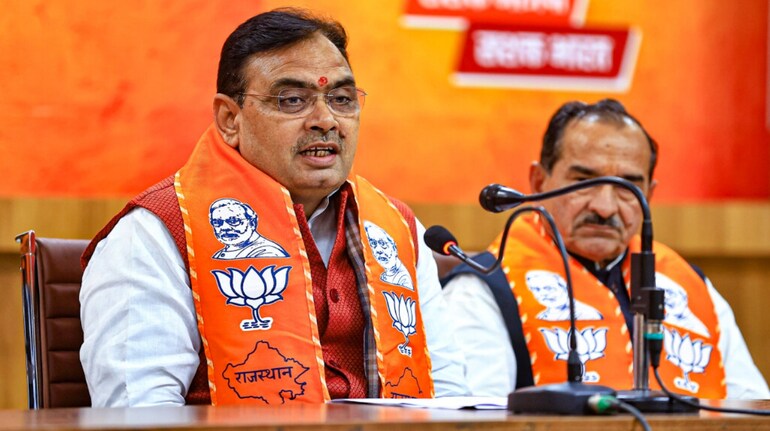
The Rajasthan Prohibition of Unlawful Conversion of Religion Bill, 2025 was introduced in the ongoing Budget Session of the state Assembly on Monday. It was introduced by Health Minister Gajendra Singh Khinvsar and will be considered for passage by the House following a debate during the session.
Religious conversion by misrepresentation, force, undue influence, coercion, allurement or by any fraudulent means or by marriage has been made an offence in the Bill.
The offence under the anti-conversion bill will be cognisable and non-bailable and triable by a court. The Bill is aimed at prohibiting unlawful conversion from one religion to another and has provisions for imprisonment of up to 10 years and a fine of up to Rs 50,000.
Key provisions of the Bill
· The Bill prohibits religious conversions carried out through misrepresentation, force, undue influence, coercion, allurement, or fraudulent means, including through marriage.
· Individuals who desire to convert their religion are required to give a declaration in the prescribed form at least 60 days in advance to the District Magistrate.
· The burden of proof that a religious conversion was not done through unlawful means rests on the person who has "caused" the conversion.
· The court may grant appropriate compensation to victims of unlawful conversion, which may extend to a maximum of ₹5 lakh.
· Repeat offenders may face double the punishment provided under the law for each subsequent offense.
· Marriages done for the sole purpose of conversion will be deemed invalid by family courts.
Punishment and penalties
· The Bill provisions imprisonment for a term not less than one year but it may extend to five years with a fine of Rs 15,000.
· Those who violate the rules in respect of a minor, a woman or a person belonging to the Scheduled Caste or Scheduled Tribe shall be punished with imprisonment for a term of two years which may extend to 10 years along with a fine of Rs 25,000.
· The bill provisions three years of jail extending up to 10 years and a fine of Rs 50,000 in case of mass conversion.
· Marriages done for the sole purpose of conversion will be deemed invalid by family courts.
Challenges Ahead
· Critics argue that the law violates Article 25 of the Indian Constitution, which guarantees freedom of religion.
· There are concerns that it could be misused to harass religious minorities and restrict interfaith marriages.
· The law requires prior approval for religious conversion, which some believe infringes on individual rights.
· Critics argue that shifting the onus on the accused contradicts the legal principle of “innocent until proven guilty.”
According to the aims and objectives of the Bill, the Constitution of India guarantees religious freedom to all people which reflects the social harmony and spirit of India. The objective of this right is to sustain the spirit of secularism in India.
"In the recent past, many such examples have come to light where gullible persons have been converted from one religion to another by misrepresentation, force, undue influence, coercion, allurement or fraudulent means.
"The law related to the right to religious freedom already exists in various states of the country but there was no statute on the said subject in Rajasthan. In view of the above, it was decided to enact a law to provide for prohibition of unlawful conversion," the Bill states.
Once passed, Rajasthan will become the 12th state to have an anti-conversion law. The 11 other states are Odisha, Arunachal Pradesh, Gujarat, Chhattisgarh, Karnataka, Jharkhand, Haryana, Uttarakhand, Himachal Pradesh, Uttar Pradesh and Madhya Pradesh.
Discover the latest Business News, Sensex, and Nifty updates. Obtain Personal Finance insights, tax queries, and expert opinions on Moneycontrol or download the Moneycontrol App to stay updated!
Find the best of Al News in one place, specially curated for you every weekend.
Stay on top of the latest tech trends and biggest startup news.