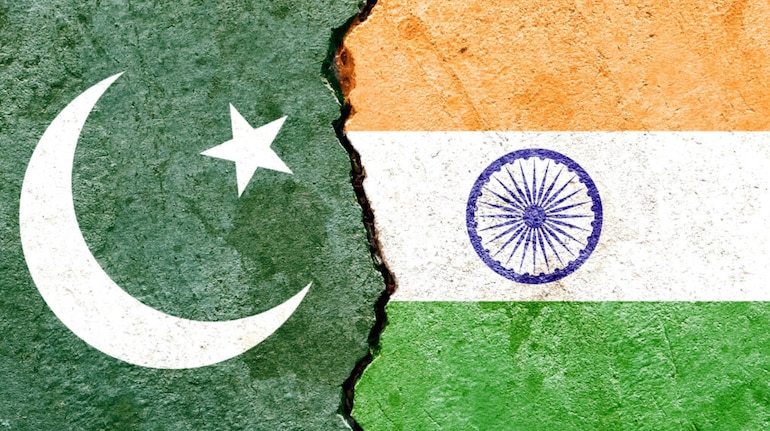
Amid heightened border tensions between India and Pakistan, New Delhi reportedly struck Islamabad, Lahore and Sialkot late on Thursday after thwarting multiple attacks on Indian cities, including Jammu, Jaisalmer and Pathankot, among others.
Multiple regions across Jammu and Kashmir, Punjab, Gujarat and Rajasthan plunged into darkness after blackouts were enforced in the aftermath of the latest attacks. The administrations of Rajasthan's border districts also sounded a red alert.
Catch India-Pakistan tension news live
The attacks and counter attacks between the two nations came after India on Wednesday unleashed 24 missiles in 25 minutes on nine terror bases in Pakistan and Pakistan-Occupied Kashmir (PoK) in response to the terror attack in Jammu & Kashmir's Pahalgam that claimed 26 lives on April 22.
The recent developments have raised the question if India and Pakistan are already at war or on the brink of it.
What is war?
War is loosely defined as a violent conflict between states or nations. Nations go to war for various reasons. According to various definitions, a nation goes to war primarily for economic, religious, and political reasons.
Difference between war and conflict
War typically refers to a large-scale, prolonged armed conflict between nations, while conflict is a broader term encompassing any type of disagreement or struggle.
India’s rules to declare war
The Indian Constitution does not have a specific article or procedure solely dedicated to the “declaration of war". The provisions related to National Emergency under Article 352 are invoked in situations of war.
According to the Constitution, the power to declare war resides with the President. However, the President’s nod is based on the advice of the Union Council of Ministers led by the Prime Minister.
According to Article 53, the executive power of the Union shall be vested in the President.
Without prejudice, the supreme command of the Defense Forces of the Union shall be vested in the President and the exercise thereof shall be regulated by law. However, Article 74 specifies that the President acts in accordance with the advice of the Council of Ministers, led by the Prime Minister. Any formal declaration of war or peace by the President is made solely on the Cabinet’s advice.
Role of Union Cabinet
The Ministry of Defence, Ministry of External Affairs, and National Security Council provide crucial advice to the Cabinet in this process. The Cabinet also takes k input from military chiefs, intelligence agencies, and diplomatic channels before taking the final decision. The Prime Minister heads the Cabinet. According to the 44th Amendment Act of 1978, the President can only declare a war only based on a written recommendation from the Cabinet.
Parliament’s powers
Parliament is not constitutionally obligated to declare or pre-approve war. The Article 352 procedure is a form by which the Parliament, expressing the will of the electorate, ratifies and supports the executive action. Parliament can debate military actions and hold the government accountable. During prolonged military engagements, the government is expected to inform Parliament and seek political consensus. After President declares war on the advice of the Cabinet, it must subsequently be presented to both Lok Sabha and Rajya Sabha for approval.
The declaration will cease to operate after one month unless approved by resolutions passed by both Houses with a special majority.
A special majority means a majority of the total membership of the House, plus a majority of not less than two-thirds of the members present and voting.
Once approved by Parliament, the emergency remains in force for six months. The President can revoke a Proclamation of Emergency at any time through a subsequent proclamation. According to the 44th Amendment, the President must revoke the emergency if the Lok Sabha passes a resolution disapproving its continuation.
What happened during earlier engagements with Pakistan?
A formal declaration of war, in the traditional sense, was not made during any of India's military conflicts.
India-Pakistan War of 1947-48: This war began with the invasion of Kashmir by tribal militias and Pakistani forces.
India-China War of 1962: This war started with a large-scale Chinese offensive along the disputed border. There was no formal declaration of war from either India or China. China withdrew after about a month.
India-Pakistan War of 1965: This war escalated from border skirmishes and Pakistan’s Operation Grand Slam in Kashmir. The conflict ended with a UN-brokered ceasefire and the Tashkent Declaration.
India-Pakistan War of 1971 (Bangladesh Liberation War): This war stemmed from the political crisis and humanitarian crisis in East Pakistan (now Bangladesh). India intervened in support of the Bengali liberation movement. Pakistan initiated air strikes on Indian airfields, which led to India’s full-fledged entry into the war.
Kargil War of 1999: This conflict began with the infiltration of Pakistani soldiers and terrorists in the Kargil region. India responded with ‘Operation Vijay’, which was a limited conflict.
Discover the latest Business News, Sensex, and Nifty updates. Obtain Personal Finance insights, tax queries, and expert opinions on Moneycontrol or download the Moneycontrol App to stay updated!
Find the best of Al News in one place, specially curated for you every weekend.
Stay on top of the latest tech trends and biggest startup news.