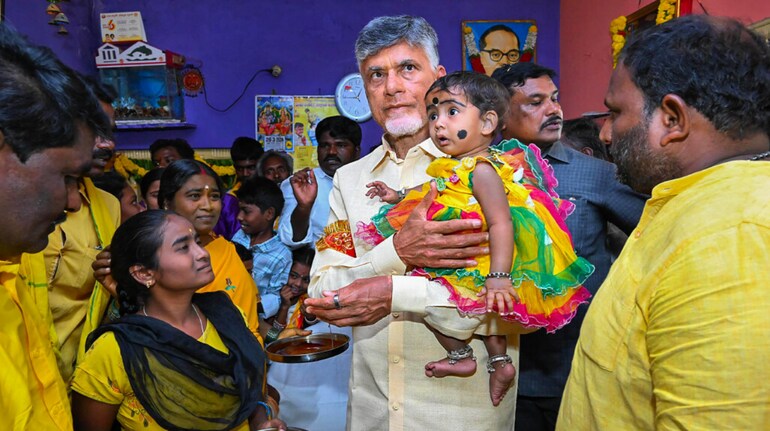
In remarks backed by concern over the ageing population in southern states, Andhra Pradesh Chief Minister and chief of the ruling Telugu Desam Party, Chandrababu Naidu on Saturday urged people in his state to have more children. Concerned over Andhra Pradesh losing the benefits of the demographic dividend after 2047, Naidu said that his government plans to bring legislation that would propose allowing only those candidates who have more than two children to contest in local body elections.
"We are thinking of providing incentives to families with more children, encouraging couples to have more children...We have repealed the earlier law barring people with more than two children from contesting local body elections...We will bring in a new law to make only those with more than two children eligible to contest,” Naidu said.
In August this year, the state Cabinet led by CM Naidu abolished the two-child policy, which disqualifies individuals with more than two children from contesting elections in the state’s rural and urban local bodies. The cabinet agreed to amend the Andhra Pradesh Municipal Corporation Act-1955, AP Municipalities Act-1965, and AP Panchayat Raj Act-1994.
The idea mooted by Naidu stands in contrast with similar laws in place or being mooted by other states. Here’s a look:
Assam: In 2019, the Assam government approved a policy that would bar individuals with more than two children from government jobs from January 2021. This was a follow-up to a resolution passed by the Assembly in 2017 on the Population and Women Empowerment Policy of Assam.
The state government has also tied certain financial benefits to the number of children of beneficiaries. The BJP government's Mukhyamantri Mahila Udyamita Abhiyaan also sets a cap on the number of children among other conditions for rural women entrepreneurs. While women from general and OBC categories cannot have more than three children if they wish to avail of the scheme, the limit is four children for women from Scheduled Tribes (STs) and Scheduled Castes (SCs).
Rajasthan: The Rajasthan Various Service (Amendment) Rules, 2001 bar candidates who have more than two children from seeking government jobs. The Rajasthan Panchayati Raj Act 1994 also says that a candidate with more than two children will be disqualified from contesting election as a panch or a member.
In February this year, the Supreme Court upheld the two-child eligibility criterion of the Rajasthan government for seeking public employment, ruling that it is not discriminatory and does not violate the Constitution.
Madhya Pradesh: The two-child norm has been in existence in the state since 2001 under the Madhya Pradesh Civil Services (General Condition of Services) Rules. The norms make an individual ineligible for government service and judicial services if the third child was born on or after January 26, 2001.
In August last year, a school teacher in the state's Bhind district was sacked for concealing information about his third child while securing the job. Earlier in 2022, a show-cause notice was issued to 954 employees of the school education department in MP's Vidisha district for violating the same norm. In 2016, three Madhya Pradesh government employees posted at Damoh district court were sacked after they were found violating the two-child norm.
Telangana: Section 19 (3) read with Sections 156 (2) and 184 (2) of the Telangana Panchayat Raj Act, 1994, says a person with more than two children shall be disqualified from contesting election. However, if a person had more than two children before May 30, 1994, he or she will not be disqualified. The rule was repealed for urban local body elections in Telangana in 2019.
Earlier this month, the Revanth Reddy-led Telangana government said it is all set to abolish the two-child policy that bars individuals with more than two children from contesting gram panchayat elections as well. As the Legislative Assembly and Council are not in session now, the state government plans to use an ordinance to abolish the rule, media reports citing government sources said.
Gujarat: In 2005-06, the Gujarat government led by then Chief Minister Narendra Modi amended the Municipal Act of 1963 to prohibit anyone with more than two children from contesting elections to local self-government bodies such as panchayats, municipalities, and municipal corporations.
The Gujarat government amended the Gujarat Local Authorities Act in 2005, effectively amending three acts: the Bombay Provincial Municipal Corporations Act, the Gujarat Municipalities Act, and the Gujarat Panchayats Act, to bring the new norms into effect.
Maharashtra: The Maharashtra Civil Services (Declaration of Small Family) Rule of 2005 defines a small family as wife, husband and two children and holds a person with more than two children after 2005 as ineligible for a Maharashtra government job.
The set of norms came into force in Maharashtra as Maharashtra Civil Services (Declaration of Small Family) Rules on March 28, 2005. The rules mandate filing a small family declaration at the time of applying for a government job. The definition of child under these rules does not include adopted children.
Uttarakhand: In July 2019, the Uttarakhand government implemented a two-child policy for candidates in panchayat elections in the state through an amendment in the Uttarakhand Panchayati Raj Act 2016. Section 8(1)(r), as inserted by the 2019 amendment in Uttarakhand Panchayati Raj Act 2016, stipulates that a person “shall be disqualified for being appointed, and for being a Pradhan, Up-Pradhan and a member of the Gram Panchayat, if he has more than two living children…”
However, the same year, the Uttarakhand High Court read down the provisions and said that the amendments for the panchayat elections will not be applicable to those candidates who have given birth to over two children before July 25 this year when the new law regarding this came into force. The two-child norm was eventually applied to only those who contested the elections of zila panchayat and block development committee membership.
Uttar Pradesh: A similar policy has been mooted in the past in UP, though the Yogi Adityanath-led government has not implemented any such norm in the state yet. A draft bill of a new population control law proposing the two-child policy to the state government was submitted by the Uttar Pradesh State Law Commission. However, the draft Bill was never brought to the state Assembly for passage or discussion.
Odisha: The Odisha Zilla Parishad Act bars those individuals with more than two children from contesting. The two-child norm for the rural local body polls was brought in 1993.
Discover the latest Business News, Sensex, and Nifty updates. Obtain Personal Finance insights, tax queries, and expert opinions on Moneycontrol or download the Moneycontrol App to stay updated!
Find the best of Al News in one place, specially curated for you every weekend.
Stay on top of the latest tech trends and biggest startup news.