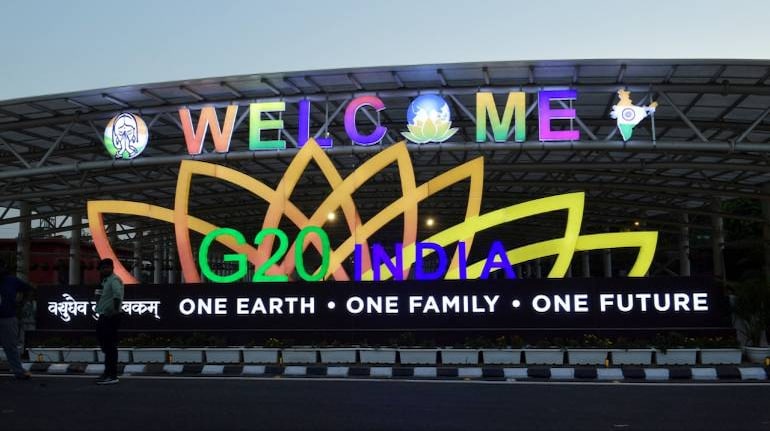
Leaders of Group of 20 nations plan to warn that “cascading crises” have posed challenges to long-term economic growth and call for coordinated macroeconomic policies to support the world economy, according to a person familiar with a draft of the final communique.
The group, which is meeting in India this weekend, plans to say that uncertainty on the economic outlook remains high and the balance of risks is tilted to the downside, the person said. They see global economic growth as uneven and below the long-term average, the person said, adding to the need for well-coordinated fiscal and monetary policies.
Also See | G20 Summit 2023 LIVE Updates
The leaders also plan to say G-20 central banks remain strongly committed to achieving price stability, the person said, adding that governments would prioritize targeted measures to help the poor while maintaining fiscal sustainability over the medium term. They will warn that recent bank turmoil shows the need for policymakers to remain agile, and commit to closely monitor the risks posed by developments in crypto assets, the person said.
G-20 leaders are meeting as the world economy faces challenges from a possible US recession, China’s slowdown and elevated inflation eating into purchasing power across the globe. The International Monetary Fund warned in April that its outlook for global growth over the next five years was the weakest in more than three decades, and urged nations to avoid economic fragmentation caused by geopolitical tension.
Those tensions were evident in the run-up to the two-day summit in Delhi that officially begins on September 9, without Chinese President Xi Jinping, who is staying away.
UK Prime Minister Rishi Sunak earlier singled out China for blocking efforts to achieve consensus, telling Bloomberg News on the plane to India that the preparatory negotiations on climate and Russia’s war in Ukraine had been “challenging.”
Also Read | G20 summit: UK PM Rishi Sunak says he’s eager to visit ‘mandir’ in India
Fruitful Outcomes
Still, with many G-20 leaders yet to arrive, people familiar with the discussions said that nearly all of the communique text has been agreed apart from a section dealing with geopolitics, primarily referencing Russia’s invasion of Ukraine.
China appears to have dropped its initial opposition to language on Ukraine and Russia, a key diplomatic ally of China, as well as measures on climate, some of the people said.
“We would like to work for fruitful outcomes of the New Delhi Summit,” Chinese Foreign Ministry spokeswoman Mao Ning said earlier Friday at a regular press briefing in Beijing. “On climate change, the Chinese side hopes that all parties can take each others’ concerns into consideration and jointly work for solution of climate change.”
Climate Action
Leaders are expected to call for effective actions to limit the global temperature increase compared to pre-industrial levels to 1.5°C, including though international support via finance and technology. While committing to a peaking of emissions by 2025, they plan to acknowledge that not all countries would do so within this time frame, given differing developing circumstances and efforts at poverty eradication.
They also plan to pursue efforts to triple renewable energy capacity globally and to support reliable and diversified supply chains to aid the energy transition, including for critical minerals and semiconductors.
Another issue in meetings in the lead-up to the summit was the financial contributions from rich countries to developing ones to help cover the green transition. The leaders plan to recommit to mobilize $100 billion per year, with developed countries expected to meet that goal for the first time this year.
The leaders also plan to recognize the importance of blended finance to address climate issues, a recognition that public money isn’t sufficient and that businesses are unlikely to invest in situations in which their returns are uncertain. This approach includes risk-sharing facilities, in which money from governments or development banks helps shield investors from unforeseen events like climate disasters.
Discover the latest Business News, Sensex, and Nifty updates. Obtain Personal Finance insights, tax queries, and expert opinions on Moneycontrol or download the Moneycontrol App to stay updated!
Find the best of Al News in one place, specially curated for you every weekend.
Stay on top of the latest tech trends and biggest startup news.