






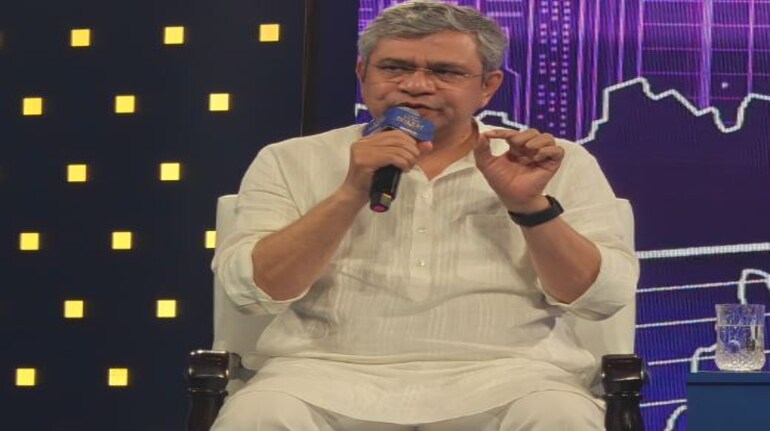
Anchor: We will be in conversation with Chandra Shrikant and Nalin Mehta for a session that's titled Future Perfect, starting up for New Bharat.
Interviewer 1: Good evening ladies and gentlemen, our guest tonight Mr. Vaishnaw is one of the government's key technocrats, alumnus of IIT Kanpur and Wharton, handles some of the government's key economic ministries and very important initiatives like those on AI, semiconductors, Vande Bharat, electronics. And Mr. Vaishnaw you had a very busy day today, there's been a cabinet meeting, a cabinet briefing and I'm told you're coming straight from the Rail Bhavan with meetings with railway officials. Thanks very much for making time for Rising Bharat, sir. Mr. Vaishnaw, let me begin with what's occupying the minds of many people which is around AI. There's a huge debate around AI around the world, around deep tech. You have said that our foundational AI model for India will be ready in say next five or six months. Are we on track for that, sir?
Ashwini Vaishnaw: Absolutely, we are on track. If you look at the talent concentration that we have in our country, among the highest talent nations is India. When we look at how we are democratizing the access to AI GPUs, compute power, our model has been today appreciated by everybody, right? So we have already got 14,000 GPUs empaneled and another round getting soon. So combine these two, the talent as well as the compute power which is available for many people to use, this has given us a very good edge to our developers and our startups and it's going very well. I must say I recently read a tweet from I think Sam Altman tweeted, the way our country has adapted AI, it's phenomenal. It's really, really huge enthusiastic adoption of AI.
Interviewer 1: So also on the first Made in India chip, you would put a deadline of September, October this year. How realistic is that and is that happening?
Ashwini Vaishnaw: Oh, that's very much on track. All the five units construction going on very well. The plants are now getting set up. At some places the validation of the machinery is going on. So it's absolutely on track to have the first Made in India chip roll off this year.
Interviewer 2: Right. So you said that, we are going to have a foundational model very soon. Are we late in the game? There is this whole debate that if China could come from behind, produce DeepSeek that has totally shaken Silicon Valley. Why couldn't India do that with a fraction of the cost considering we have the best tech talent in the world? So, do you think we are late in the game? Secondly, sir, where do you stand on this whole debate on whether India should look at models? Should India look at use cases? Because Nandan Nilekani has often said, let the big boys in the valley spend all the money. We will build the best AI applications on top of it. Where do you stand?
Ashwini Vaishnaw: See, this is just the first chapter of the AI book. This is just the beginning of what AI can do, what it is going to do in coming years. In the industrial world, we have been using AI for almost 20 years now. Lots of maintenance work, lots of machine, lots of industrial plants, where it was not called AI, it was called machine learning and large data, big data kind of things. Lot of IOTs, lot of sensors, lots of those things were already happening in the industrial world. Now it has come to a B2C kind of consumption, kind of a new setup where practically everybody is using AI.
So, I wouldn't say that we are late. I would say that since this is just the beginning of this entire new industrial revolution as many people call it, we are very much in the race and we will be among the top few countries who have that ability to harness the power of this new technology. Foundational models would be needed. They would be needed for two different reasons. First reason is your ability to have control over as a country, not just as government but more as a country, your ability to have control over this very key technology is very, very important. Just like it is very important to have your own telecom stack. Just like it is very important to have your digital infrastructure. Just like it is very important to have your own semiconductor manufacturing and design capabilities. Similarly, we must have the LLM within our ecosystem.
Second reason is biases. Biases can be very dangerous. They can really play very negatively, play out very negatively. So, it is very important to have the bias-free diversity embracing, understanding the cultural context of our country, making sure that so diverse a country as we are, we should be able to have the AI understand that and be free from those biases. That is why it is important.
Interviewer 1: So, on social media, sir, there are issues around fake news and there is also the DPTP bill which has been passed. It was passed by your government under your tenure. What is the time frame for operationalizing those rules and when will we see the rubber hitting the road as it were?
Ashwini Vaishnaw: See, the approach that we have followed, there are two things that we have meticulously followed. One, we decided not to make either the rules or the act very prescriptive. We wanted it to be very principles-based. Now, that's a very different approach from what the western governments took, that approach. Their approach was very prescriptive, identifying the number of hours and all that kind of stuff. So, we wanted it to be very principles-based. Same thought process we are following in the rules.
The second thing that we always followed was we wanted the entire process to be very consultative. And because of that consultative process, for example, when we were drafting the law, I think we had more than 35,000 inputs from various stakeholders and we used all those inputs to finally draft our bill. Same process we are following now. The consultation process is in its final laps. Most of the inputs that we wanted have already been received and we should now be in a position to do the final draft.
Interviewer 2: In the last week, sir, there has also been this huge debate and discussion in the Indian startup ecosystem on the type of entrepreneurship that is coming out of India. There is a view that India has done very well for itself. It's one of the biggest startup ecosystems in the world. But is there enough depth? Is there enough deep tech being built? Or are we stuck with gig workers, delivery apps, fancy cookies and ice creams? What is your view on this?
Ashwini Vaishnaw: I think in our economy and our country, there is a space for practically everything. I must share with you that some of these startups are really working on very good, very key, very difficult technologies. For example, there is a startup, I won't take the names, which is working on developing a chip. It's basically software. It's a fabulous company. And their chip will be used in mobile. There are other companies which are working on a variety of different semiconductor as well as AI technologies. There are more than 100 startups in IIT Madras itself which are deep tech startups. So I think there is a space for all. Ultimately, what does a startup or an entrepreneur try to do? They try to solve a problem. So solving a problem in every space is required. Every sector is required. So I think in our economy, there is a space for all.
Interviewer 1: So what can the government do to encourage the startup ecosystem? What is your view on the issues people are facing?
Ashwini Vaishnaw: Look, the government has played a very important role. Ten years ago, there were only 300-400 startups. Today, there are more than 1.5 lakh. The government has created an environment through which India has become the third largest startup ecosystem. It's everyone's role. Everyone has to make an effort. And I say that today's startups have that energy, that enthusiasm, that passion to work. And I am very happy with the way our startups are working on a variety of problems that they are trying to solve.
Interviewer 2: If I can slip in a question here about Elon Musk. You know, on the one hand, the government has sort of rolled out the red carpet with respect to Starlink. But on the other hand, we are also seeing a very fierce battle where Elon Musk's ex has sued the Indian government in court because of the Sahyog Portal. As the nodal minister, where do you stand on this?
Ashwini Vaishnaw: Listen, this is not the first time that social media platforms have filed cases or suits against government. It's a very common thing. And ultimately, every company, whichever company, has to work within the framework of the constitution and the framework of the laws that are passed by the parliament.
Interviewer 2: Talking about social media, sir, do you think the scope of the broadcast bill needs to be widened to also look at influencers, content creators, considering what happened recently with the whole Ranveer Allahbadia and Samay Raina episode?
Ashwini Vaishnaw: See, end of the day, we must understand that we are all living in a society. We are all living in a particular cultural context. We are all having friends, neighbours, children, everybody is connected with each other. So, we must, as users of technology, whether we are content creators or we are consumers of technology, we should understand what is our responsibility, and I would say, as a citizen or as a user, we should try and see what my own boundaries should be. I should be able to define that and work within that. Making, let's say, if you are living in a-- if you are in your own living room, 4-5 persons, those jokes would be very different from a platform where you are basically broadcasting to the entire world what you want to say. Then we must understand that we are living in a social context, and I would say that we should understand that as a social responsibility.
Interviewer 1: Ashwini ji, your government has put a lot of pressure on Make in India. Right now, there is a period of instability in the global markets and there is a lot of instability and uncertainty regarding many things. The issue of shifting supply lines from China to India, China plus one strategy, India, according to you, how well placed is India to benefit from the current situation or with the shifting of supply lines from China to India?
Ashwini Vaishnaw: If you look at the journey of the last 10 years, then you get the answer. In 10 years, electronics manufacturing has grown 5 times. Electronics exports have grown 6 times. 5 times, i.e. 17% CAGR has grown in 10 years. Despite the two COVID years, I am saying. Exports, 20% plus CAGR growth has occurred. And it is increasing at the same pace or at a faster pace. Recently, we announced the electronics component scheme. Before this, hardware, mobile phone, and the ecosystem is deepening so well, what gives more satisfaction is that many of the manufacturers are now setting up their design houses.
There is one manufacturer who has set up a design team and that design team has designed a laptop which they showed to me recently. Then I showed that laptop to one of the big IT companies' CO. And that CO basically said that this is, he didn't believe that this is made in India. This is made in Taiwan, is what he said. And that is the kind of quality that people are manufacturing and designing today. So, that thing is, that's a reality today. And that's going to grow. More than 400 companies are there which are there in the, I am saying the major ones. There are many more smaller MSME units which are there, which are part of the ecosystem.
So, combine our stable policies that our Prime Minister has shown us, a clear vision, the availability of design talent, and our focused way of implementing that policy, we are bound to grow in the coming days.
Interviewer 1: Mr. Ashwini, you mentioned the scheme for electronic components. The union cabinet last week approved about 22,000 crores of PLI for electronic manufacturing. Overall, as I understand it, across 14 sectors, about 1.6 lakh crore of investment is coming on through the PLI route. But how do you react to criticism by those like Raghuram Rajan who argue that the PLI scheme essentially just subsidizes a whole bunch of foreign investors?
Ashwini Vaishnaw: See, I always take any criticism which comes very constructively. But what I would like to share with you is, every country which got into electronics manufacturing, every country, take any name, they all started the same process, whether it is South Korea, it's Vietnam, it's China, it's Japan in the early phases, after the Second World War. Most countries had a similar phase, and especially in the last 30-40 years. You start with manufacturing of the finished goods, then you go to the modules, then you go to the components, and we are exactly following that same trajectory. We started with finished goods, and we already do modules, now we are already in the component stage.
The highest possible domestic value addition that any country has shown is in the range of 38% after 30-40-35 years of working in that sector. Within a very small time span of 10-11 years, we have already reached 20% plus. And we are going to double this in the coming 5 years.
So, it's a very systematic, methodical journey. And to the critics, I would like to point out, electronics manufacturing is today giving good, meaningful employment to 25 lakh people. And a large number of this employment is for young women coming from rural areas with very little education, but very good, strong determination to make a difference, to work in sophisticated technologies.
I like to give an example where I visited one of the factories, one of the plants. The girl was from a village of Bihar, and she said that when she goes back to the village, she gets more respect than the village head. Because when she says that she is a mobile phone manufacturer. It's a very touching human thing.
Interviewer 2: That's an amazing anecdote, Mr. Vaishnaw. I just wanted to also ask you about phone manufacturers, right? So, some of the biggest phone manufacturers in India are Chinese makers like Oppo and Vivo, more than Apple in India sales. So, would they be eligible for PLI? There have been reports that the government has encouraged these companies to enter into joint ventures with Indian companies. How is this going to work?
Ashwini Vaishnaw: Listen, any country or any company which wants to come and work in India, they have full freedom to work, and companies generally prefer joint venture mode when they want to go up the learning curve at a faster pace.
Interviewer 1: Ashwini ji, the Katra-Srinagar Vande Bharat will be inaugurated by the Prime Minister in the next 9-10 days or so. How symbolic is this in the idea of India? And also, on the Vande Bharat project overall, at last count, around 136 Vande Bharat have been run. How far will this number go?
Ashwini Vaishnaw: No, no, already 118 or more services are already running. Where are the 36?
Interviewer 1: 136.
Ashwini Vaishnaw: Yes, 136 are already running. Manufacturing is continuously happening. So, I think that's… and people like it. Some of the parameters, Vande Bharat is actually better than some of the best trains in the country, as you are aware on the acceleration, noise level inside the train, the vibration levels, that's because the design has been done with lot of thought in it. See, connecting Kashmir and Jammu, Srinagar and Jammu, connecting them by rail is a big dream of the country. And Prime Minister Narendra Modi, with his very strong resolve, this is a project which required tremendous tenacity, tremendous design work, lots and lots of engineering inputs were there. It's a very difficult project, but this is the Prime Minister's political willpower, political clarity, because of which this project could be completed.
Interviewer 1: Ashwini ji, let me ask you about safety. Because, as far as the Kavach system is concerned, and this is discussed many times, when the first test was done, you were sitting in that engine with the Railway Board officials till the last minute. You sat there yourself. When do we expect the Kavach system to be implemented across the country and us to go to zero accident rates?
Ashwini Vaishnaw: A lot of significant progress has been made, compared to the period ten years before. We have already reduced the number of incidents by almost 80%. That is the improvement which has happened in the last ten years. And that improvement is now significantly moving forward in a big way. Kavach, that particular thing was the time when it was in its preliminary design phase. That was version 3.2. Obviously, when people are looking at a new technology and that too a technology on safety matters, people have some doubts. That's why I said, let me take that as a personal example and take that risk and do that experiment, do that pilot myself. That's why I did it. And the result was also good, because that gave a lot of confidence to the teams which were working on the Kavach project. And there is good progress. Right now, work is being done to cover 10,000, about 15,000 kilometers. Many of the rich countries, they took about 20 years to cover their networks. And I think we should be able to do that in six years.
Interviewer 1: Mr. Ashwini Ji, last question, we are running out of time. The Prime Minister speaks about his vision for Viksit Bharat in 2047. Let me ask you, as a subset of that, your vision and the Prime Minister's vision for Indian railways, what kind of railways will be built in India after five years?
Ashwini Vaishnaw: In railways, Prime Minister Narendra Modi has kept such a clear focus and all its requirements, especially about funding, about safety, about bringing technology, about changing processes, he has given a very good direction, he has given a very good leadership, because of which we are already in a very, I mean, railway is actually transforming. In the coming five years, two major things, three major things will happen.
First, from where we are today, safety will improve even more significantly. We have already reduced the number of incidents by 80%. I think there will be a further reduction of 80% going forward. Second, the capacity is going to increase substantially. This year, we became the second largest cargo-carrying railway in the world. We left, I mean, now it's basically top two countries already. And that will again further go up, because railways is the most environment-friendly mode of transportation. That will go further. Third, lot of new technology trains, beginning with what Vande Bharat did, Namo Bharat train, Amrit Bharat train, Bullet train is coming. So all these will be totally new technology trains. Fourth, the infrastructure will improve substantially, with the stations getting rebuilt. Today we are doing the world's largest station redevelopment program, 1,200 stations. As we speak, work is going on. And within a month's time frame, Honorable Prime Minister will be inaugurating 100 stations in one go. So that kind of work is going on.
Interviewer 2: If you can, two quick questions. How do you use AI every day? Is there an AI chatbot that you like? What kind of questions do you ask?
Ashwini Vaishnaw: Bad question to ask. You ask OpenAI, how does Ashwini use it?
Interviewer 1: So let me ask you another question. I'm told you work a very long day. From 9 o'clock till 11, 12 at night. What does your staff think about this idea of a 90-hour week?
Ashwini Vaishnaw: I think you should ask the staff.
Interviewer 1: What do you think about it?
Ashwini Vaishnaw: I think our Prime Minister has set a very good example before us. He works very hard. And when we have to take our country to a totally new level, there is no option but to... and it's a personal choice. Each one should make, each company, each one, each organization should make their own choices. For me, I think there is no substitute to hard work.
Interviewer 1: So Ashwini ji, coming back to railways, in terms of the AC class, the numbers show that the percentage of...
Ashwini Vaishnaw: No, no, it's very clear. Throughout our history, it has been a two-third, one-third. History as in the recent history of 20-25 years. Two-third, one-third is the ratio of AC and non-AC. That ratio has actually increased now. Now it is 70% non-AC coaches, 30% AC coaches. When you look at the number of seats which are available, it is 82% non-AC and 18% AC. Look, do not go into the negative narrative what the opposition party makes. Look at the data. I have placed this data before the parliament also.
Railway is very clear. Railway is in the entire income pyramid, very clearly low income, middle income. That is where our focus is. For low income and middle income families, to provide a good, affordable, and we are the most affordable railway service in the entire world. Compared even to our neighbours Pakistan and Bangladesh and Sri Lanka, we are at least half or sometimes one-fourth the price that they charge. So providing affordable and safe transport to our middle income families and to our low income families, that is what our priority is. Very clear. Absolutely laser sharp focus.
Interviewer 1: Thanks very much Mr. Vaishnaw. And that brings us to the end of this session. A big hand for Mr. Ashwini Vaishnaw.
Interviewer 2: Thank you very much.
Discover the latest Business News, Sensex, and Nifty updates. Obtain Personal Finance insights, tax queries, and expert opinions on Moneycontrol or download the Moneycontrol App to stay updated!
Find the best of Al News in one place, specially curated for you every weekend.
Stay on top of the latest tech trends and biggest startup news.









