People across Bihar now wait for Friday, when the counting of votes begins and the verdict on whether JD(U) supremo Nitish Kumar will secure what would be his fifth term as chief minister becomes clear, or whether the state will see a change in government. The elections for the 243-member assembly, conducted in two phases on November 6 and 11, witnessed a turnout the state has called “historic” at 67.13 per cent. The votes will start being counted at 8 am, with trends and results expected to start trickling in by 9 am, and 46 counting centres have been arranged across 38 districts.
What is the journey of EVMs?
Before ballots reach that crucial moment of counting, their journey begins much earlier. For those eligible for postal ballots -- service voters, electors above 80 years of age, individuals with benchmark disabilities, Covid-19-infected or suspected voters, those under preventive detention, and polling staff — the process starts with applications and forms. Once cleared, the Returning Officer (RO) sends their postal ballots by post, while voters on election duty receive them at facilitation centres.
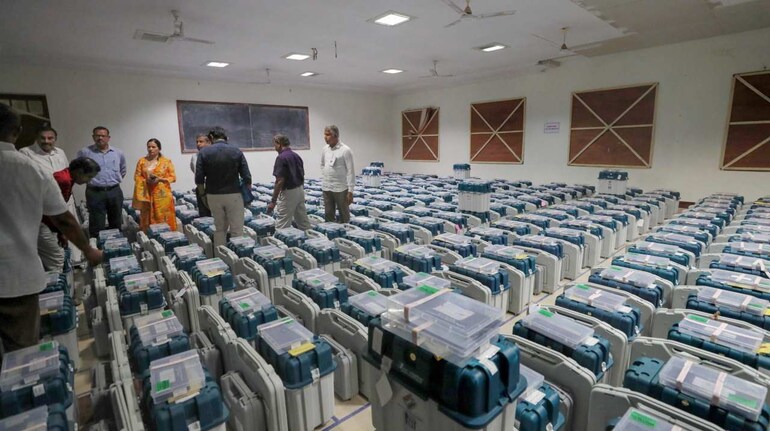
The path of EVMs begins after first-level checks and randomisation exercises are completed. Only then are the machines handed over to Returning Officers (ROs) under armed police escort. According to the EC’s latest manual, they must be kept inside air-conditioned strong rooms in the presence of representatives from political parties. These strong rooms remain sealed and under watch until polling day.
Once votes are cast, the machines move again. In large, multi-phase elections or when several state polls overlap, the gap between polling and counting can extend for weeks. After voting ends, EVMs and VVPATs are escorted back to reception or collection centres and placed once more in strong rooms. Candidates must be informed of this process, and they may send their representatives to observe the security arrangements.
In Bihar, the EC has stressed that EVMs and VVPATs used in the polls have been sealed inside strong rooms with a double-lock system. The Commission added that "under the presence of central observers and agents deputed by candidates, the entire process will be videographed."
Two-tier security protects these centres: the “inner tier” is manned by central armed paramilitary forces while “state police have been deployed at the outer rung,” along with round-the-clock CCTV coverage.
A control room has also been established inside each strong room campus, staffed by senior district officials. District election officers and returning officers have been instructed to “frequently inspect the strong rooms.”
Meanwhile, 7.45 crore electors determined the fate of 2,616 candidates in this high-stakes contest. Exit polls have largely projected an NDA sweep, much to the annoyance of the INDIA bloc.
Tejashwi Yadav dismissed these forecasts, asserting that Mahagathbandhan would form the next government “with a thumping majority.”
The NDA’s key contenders include JD(U) and BJP, each of which contested 101 seats, while the INDIA bloc fields candidates from RJD, Congress, CPI(ML) Liberation, other Left parties, and VIP. Prominent figures in the race include Samart Choudhary, Vijay Kumar Sinha, Tejashwi Yadav, Tej Pratap, and Rajesh Kumar.
With inputs from PTIDiscover the latest Business News, Sensex, and Nifty updates. Obtain Personal Finance insights, tax queries, and expert opinions on Moneycontrol or download the Moneycontrol App to stay updated!
Find the best of Al News in one place, specially curated for you every weekend.
Stay on top of the latest tech trends and biggest startup news.