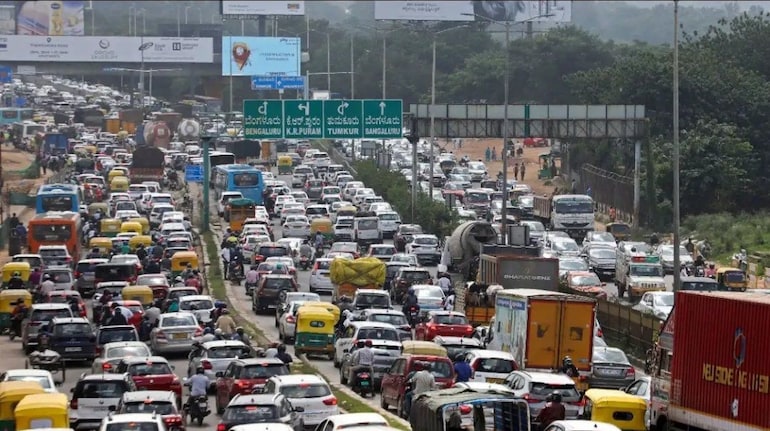

Bengaluru, ranked the world’s second most congested city after Mexico City in 2025 by the Traffic Index released by Dutch location technology firm TomTom,, is set to get a new Comprehensive Mobility Plan (CMP).
Directorate of Urban Land Transport (DULT) has invited bids to select a consultant to prepare a revised CMP for the Bengaluru Metropolitan Region, officials said.
Why CMP is being revised
DULT officials told Moneycontrol that existing CMP was approved in 2020 and is based on data collected in 2014-15.
“Since then, rapid urban expansion and major transport infrastructure additions have significantly altered travel patterns, necessitating a comprehensive revision,” an official said.
According to Union housing and urban affairs ministry's CMP guidelines, cities are required to revise their mobility plans every five years to remain eligible for central funding and ensure alignment with long-term transport goals.
Also read: Bengaluru second most congested city globally in 2025 after Mexico City: TomTom report
Metro expansion, new policies reshape mobility
Officials said several large-scale developments have reshaped Bengaluru’s mobility landscape over the past decade. The operationalisation of Namma Metro Phase-1 extensions and Phase-2 corridors has led to a sharp rise in ridership. Bengaluru Metro Rail Corporation Ltd (BMRCL) has also prepared a metro master plan till 2045, which will need to be integrated into the revised CMP.
In parallel, the state government has rolled out major policy frameworks such as Parking Policy 2.0 and the Transit-Oriented Development (TOD) Policy, both of which are expected to significantly influence travel behaviour and land-use patterns.
Road projects, airport expansion
Major road infrastructure projects, including Satellite Town Ring Road (STRR), new arterial roads, grade separators and tunnel road proposals under Greater Bengaluru Authority (GBA), will also be examined for sustainability under CMP revision.
The opening of Terminal 2 at Kempegowda International Airport has added a new mobility node. T2 handles around 1.6 crore passengers annually, with plans to expand the terminal by an additional 2.78 lakh square metres. Once complete, the combined capacity of T1 and T2 is expected to exceed 8.5 crore passengers a year.
Aligning transport with land-use planning
Officials said the CMP revision will be undertaken alongside the revision of the Bengaluru Master Plan, enabling integration between land-use and transport planning.
“The objective is to manage rapid regional growth, reduce congestion, improve public transport usage, promote non-motorised and low-carbon mobility, and ensure coordinated planning across agencies such as the GBA, BMRCL, BMTC, K-RIDE, BDA and the traffic police,” the official said.
Roadmap for the next 20 years
The revised CMP will serve as a long-term mobility roadmap for the next two to three decades, guiding investments in metro rail, buses, suburban rail, road networks, pedestrian and cycling infrastructure, parking management, and emerging mobility technologies.
Officials said the plan will rely on fresh data, updated travel demand modelling, and extensive stakeholder consultations to address Bengaluru’s increasingly complex mobility challenges.

Discover the latest Business News, Sensex, and Nifty updates. Obtain Personal Finance insights, tax queries, and expert opinions on Moneycontrol or download the Moneycontrol App to stay updated!
Find the best of Al News in one place, specially curated for you every weekend.
Stay on top of the latest tech trends and biggest startup news.