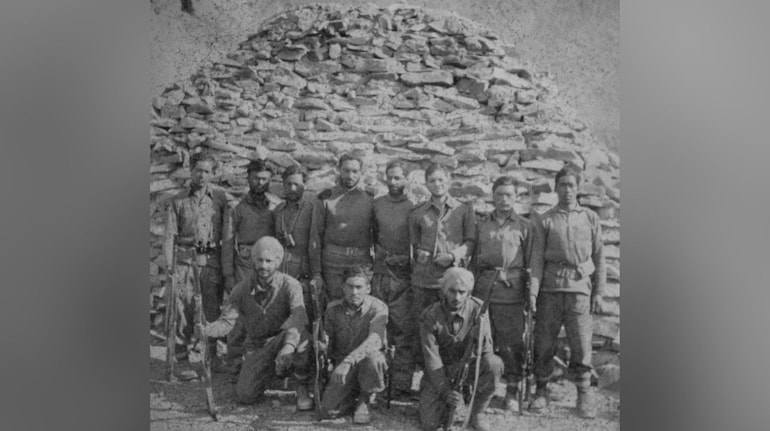
In the popular memory of the 1962 war, the eastern theatre is often reduced to a footnote, eclipsed by the drama and trauma of Ladakh and the central Himalaya. But along the Lohit river valley in what is now Arunachal Pradesh, Indian troops fought a campaign that was tactically complex, brutally under-resourced, and fought at the end of a long, fragile logistics chain. Walong was not a single “last stand” moment. It was a sequence of holding actions, counter-attacks, and withdrawals, carried out in punishing terrain where every casualty was hard to evacuate and every round of ammunition had to be husbanded.
At the centre of that story sits 6 Kumaon, one of the battalions tasked with defending the Walong bowl and the approaches that ran along the Lohit. Their fight matters not because it “changed the outcome” of 1962, but because it shows what determined infantry can do even when strategy, intelligence, and supply are all working against them.
Why Walong mattered
Walong lies near the eastern extremity of India’s land frontier, where the Lohit valley offers a relatively direct corridor from the border areas into the interior. In 1962, the Indian posture in the North-East Frontier Agency relied on widely dispersed posts and thinly held lines, with limited road connectivity and severe constraints on reinforcement and resupply. In such a setting, geography becomes destiny: a valley axis like Lohit turns into both a route for pressure and a trap for defenders if higher ground on the flanks is lost.
Walong also mattered politically. Positions here symbolised presence in remote borderlands. But symbolism cannot substitute for depth, reserves, and reliable communications. The troops on the ground, including 6 Kumaon, were asked to do all three jobs at once: hold territory, delay a larger force, and preserve fighting strength for what came next.
The conditions: terrain, weather, and logistics
To understand Walong, start with the map and the footpath. The valley floor and riverine approaches demanded constant patrolling. The dominating heights had to be held or at least contested. And supply depended on precarious routes, often involving porters and air drops whose accuracy and regularity could not be guaranteed.
In these circumstances, “strength” is not just numbers on paper. It is the ability to keep sections fed, warmed, and supplied with ammunition; to move the wounded; to rotate men out of exposed posts; to maintain a signal link that does not collapse under weather and distance. When any one of these fails, tactics become reactive. Walong in 1962 frequently forced Indian units into that reactive posture.
6 Kumaon at the Lohit: holding, probing, and paying for ground
Accounts of Walong emphasise that fighting unfolded in phases rather than as a single dramatic climax. Units in the sector were required to defend posts, watch multiple approaches, and respond to infiltration and probing attacks aimed at turning positions from the flanks. One consistent theme across serious reconstructions is that Chinese operations in the east sought advantage through manoeuvre, pressure on the shoulders of the valley, and forcing withdrawals by making posts untenable rather than by frontal assaults alone.
Within this broader pattern, 6 Kumaon’s experience reflects the infantryman’s reality of 1962: contact on difficult ground, repeated orders to hold or regain tactically meaningful features, and the need to keep cohesion even as the tactical picture shifted.
A detailed contemporary military-journal reconstruction of Walong describes the fighting as evolving through “Phase I” and “Phase II,” with the defenders compelled to respond to widening pressure and changing Chinese tactics as the battle developed.
The battle rhythm: counter-attacks and the problem of the heights
A valley defence is only as strong as its ability to contest the ridgelines. In Walong, Indian troops repeatedly faced the problem that an enemy who holds or infiltrates the heights can observe movement, interdict supply, and make even well-sited positions untenable. This creates a brutal cycle: troops are ordered to counter-attack uphill to restore a feature; they do so with limited artillery support and thin reserves; even success comes at a cost that is hard to replace; and the next pressure point emerges elsewhere along the line.
For 6 Kumaon, the tactical requirement was not merely to “stay put,” but to keep the enemy from achieving a clean breakthrough into the bowl, and to buy time for broader dispositions. The unit’s actions must be read as part of a wider brigade-level fight in which local successes could still be overwhelmed by the overall balance of force and the cumulative attrition of men and material.
Leadership, morale, and the small-unit fight
Walong also illustrates how leadership expresses itself at platoon and company level: choosing where to dig in, when to conserve ammunition, how to pull back without panic, and how to keep men moving when exhaustion and cold are doing as much damage as enemy fire. These are not cinematic moments. They are decisions taken in minutes, often with incomplete information, and with consequences that are immediate and irreversible.
Several later profiles and remembrances of the 1962 eastern theatre underline the long tail of these battles: the way units carried reputations forward, how individual soldiers’ stories became part of regimental memory, and how the state gradually built commemorative infrastructure in the region.
What Walong did and did not achieve
It is tempting to frame Walong as either “heroic but futile” or “a forgotten victory.” Both are too neat.
What Walong did achieve was time and disruption. A stubborn defence, combined with local counter-attacks, complicates an attacker’s timetable, forces them to commit more resources to securing ground and lines of communication, and delays the consolidation that makes deeper thrusts easier. That matters in any campaign, even if the eventual strategic outcome is shaped elsewhere.
What Walong did not achieve was a reversal of the war’s larger trajectory. The eastern battles were fought within a system of strategic and logistical weakness: thin deployment, limited reserves, inadequate infrastructure, and a political-military decision cycle that left frontline units without the depth they needed. Infantry can delay. It cannot, by itself, create missing roads, missing guns, missing winter clothing, or missing operational clarity.
Why the Walong story still matters
Walong’s value is not only historical, it is also instructional. First, it demonstrates the unforgiving linkage between terrain and force design. If a valley axis is strategically important, it demands a posture that can hold the heights, sustain the troops, and reinforce quickly. Second, it illustrates the limits of “presence” without depth: posts can signal sovereignty, but they also become liabilities if they cannot be supported. Third, it underscores why the Indian Army’s later approach to the eastern theatre placed such emphasis on infrastructure, forward connectivity, and improved logistics.
Walong is also a reminder that “overshadowed” does not mean “less fierce.” The men of 6 Kumaon and the other units in the Lohit sector fought an infantry battle in its starkest form: cold ground, steep climbs, uncertain supply, and an enemy trying to turn the line rather than break it head-on.
And that is precisely why the Walong fighters deserve to be read back into the 1962 narrative, not as an appendix, but as one of the war’s clearest accounts of what the Indian soldier endured and attempted under impossible constraints.
Discover the latest Business News, Sensex, and Nifty updates. Obtain Personal Finance insights, tax queries, and expert opinions on Moneycontrol or download the Moneycontrol App to stay updated!
Find the best of Al News in one place, specially curated for you every weekend.
Stay on top of the latest tech trends and biggest startup news.