Arguably, the biggest question about the US economy right now is whether consumers can maintain their pace of spending. Student loan payments resume in October. Pandemic-era excess savings are expected to run out as soon as this quarter. The personal savings rate, which was around 9 percent prior to the pandemic, was 3.5 percent in July, not far from the all-time lows set in the mid-2000s.
If there’s one reason to remain optimistic on household spending, it’s that the “excess savings” framework doesn't capture the full picture of household balance sheets. Adjusted for income, household net worth
remains near a record high. That's driven, importantly, by the surge in home values and home equity levels during the pandemic. Additionally, there’s no reason to think consumers will shift back to the caution and elevated savings rates of 2019 — activity patterns in 2023 are closer to what we should expect going forward.
The capacity of households to spend doesn’t stop when savings built up during the pandemic dwindle back to the pre-pandemic trend. Overall household wealth matters too. In the second quarter of 2023, household net worth stood at 7.75 times the level of disposable personal income, from 7 times in the fourth quarter of 2019, according to last week’s Financial Accounts of the United States report released by the Federal Reserve. Relative to income levels, households are wealthier now than they were at the peak of the dot-com bubble in the spring of 2000 or the peak of the subprime mortgage housing boom in the mid-2000s.
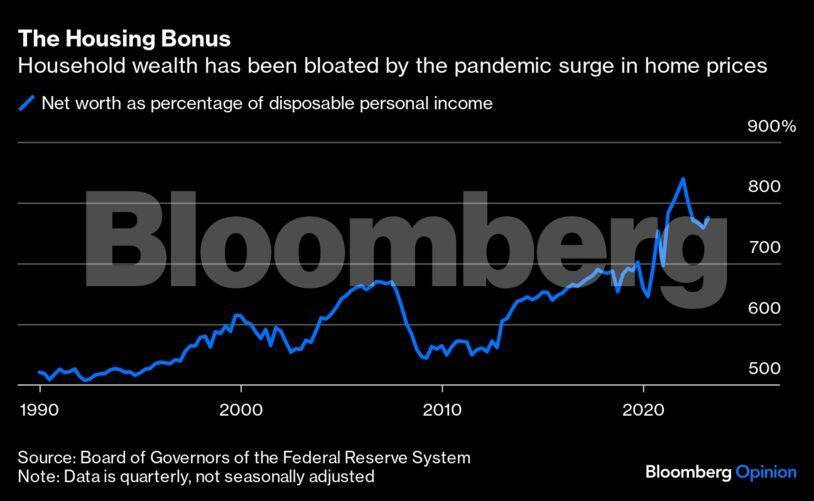
Most of this increase has been driven by the surge in home equity during the pandemic — home equity as a percentage of disposable personal income is above the highs seen in the mid-2000s, and is rising again as home values recover after a brief decline in late 2022.
Unlike stocks, which are held primarily by the wealthy, home equity is a middle-class phenomenon with two-thirds of American households owning their homes. And while home price expectations grew pessimistic last year in response to rising interest rates and worries about a housing market decline, they have been on the rise again this year, according to the New York Fed’s Survey of Consumer Expectations. Households have a lot of housing wealth and feel confident that their homes will continue to appreciate in the future.
This helps explain the low savings rate. Even if people aren’t using their homes as ATM machines, in part because mortgage rates are so high, they believe that their housing wealth is real, and don't feel the need to save as much as they did in the aftermath of the 2008 financial crisis when their balance sheets were weaker.
Neil Dutta of Renaissance Macro Research LLC noted last week that from the 1980s to the 2000s, there tended to be an inverse relationship between household net worth as a percentage of disposable personal income and the personal savings rate. As households became wealthier, the savings rate fell. This shifted in the 2010s because of the need to repair balance sheets. But even after accomplishing that by the mid-2010s, the savings rate continued to rise up until the pandemic, perhaps because post-crisis savings habits had become ingrained.
But the pandemic’s disruption, forced savings, stimulus payments, and housing wealth surge have returned households to their normal historical patterns. Households, in the aggregate, are just about as wealthy as they’ve ever been. As a result, they're comfortable spending more and saving less than in the 2010s. Even modest declines in home values from here would leave housing wealth well above 2019 levels — for home equity as a percentage of disposable personal income to return just to 2019 levels, home prices nationwide would have to drop by nearly 20 percent.
Housing wealth would cover the 66 percent of households who own their homes and tend to be wealthier, but lower-income consumer spending has remained strong as well. Goldman Sachs Group Inc. said in a note this week that retailer same-store sales have risen by 5.6 percent year-over-year for companies whose stores tend to be in lower-income communities, likely due to lower-income workers getting the biggest raises in this tight labor market.
It’s the labor market that is the wild card in this framework — if workers start losing jobs en masse, consumption will slump. But while employment growth and the number of job openings have cooled in recent months, so too have initial jobless claims and the number of people receiving unemployment benefits. Labor market churn has fallen and the job market isn't as hot as it was a year ago, but wage growth remains above pre-pandemic levels.
In other words, worries over the health of the consumer feel premature. The dramatic increase in housing wealth experienced by Americans over the past few years should continue to support consumption growth, which in turn should keep overall economic growth resilient. While there are reasons to believe economic growth will slow from its torrid third-quarter pace, that still looks more like a normalisation than a recessionary slump.
Discover the latest Business News, Sensex, and Nifty updates. Obtain Personal Finance insights, tax queries, and expert opinions on Moneycontrol or download the Moneycontrol App to stay updated!
Find the best of Al News in one place, specially curated for you every weekend.
Stay on top of the latest tech trends and biggest startup news.