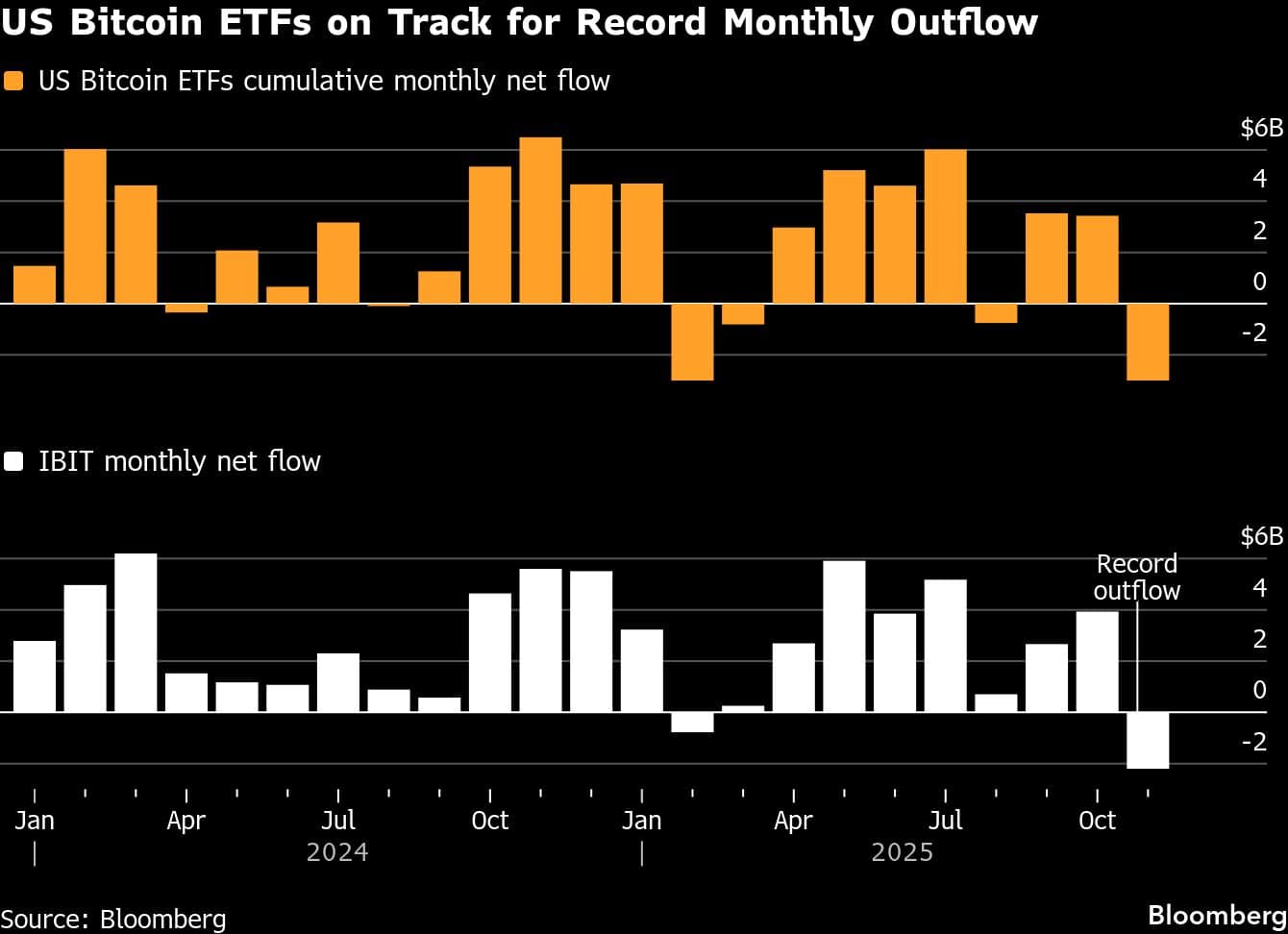
Exchange-traded funds investing in Bitcoin are heading for their worst month of outflows since launching nearly two years ago, piling yet more pressure on a jaded crypto market.
Investors have pulled $3.5 billion from the US-listed Bitcoin ETFs so far in November, almost equaling the previous monthly record for outflows of $3.6 billion set in February, according to data compiled by Bloomberg. BlackRock Inc.’s Bitcoin fund IBIT, which accounts for about 60% of the group’s assets, has registered $2.2 billion in redemptions in November, meaning it will slump to its worst month barring a sharp reversal.
The outflows come with Bitcoin itself set for its worst monthly performance since the crypto industry collapse of 2022, a daisy chain of corporate failures punctuated by the downfall of Sam Bankman-Fried’s FTX. The wider crypto market has contracted sharply in recent weeks, despite registering policy wins in the US and beyond throughout the year.
The IBIT outflow confirms “that the euphoria from earlier this year has been fully exhausted,” said Nick Ruck, director at LVRG Research.
Bitcoin fell to as low as $80,553 on Friday before regaining some ground over the weekend. It was trading at $86,998 as of 8:00 a.m. in London on Monday, still down 7% year-to-date.
Spot Bitcoin ETFs have become synonymous with crypto sentiment since their debut in January 2024, reshaping how capital moves into — and out of — the asset class. They have also become self-reinforcing feedback loops: inflows tend to accelerate when prices rise, while outflows amplify declines when prices fall.
Citi Research quantified this phenomenon: For every $1 billion that’s pulled from Bitcoin ETFs, prices see a roughly 3.4% drop. The same is true in reverse. This dynamic helps explain Bitcoin’s recent pullback, according to Citi’s Alex Saunders, who recently set a bear-case target of $82,000 for year-end, assuming zero inflows. Instead, roughly billions have been pulled from the ETF cohort, suggesting scope for further downside.
“In the first half of the year, spot ETFs were the driving force behind Bitcoin’s record highs, so the reversal of institutional capital flows into continuous outflows has negatively impacted prices,” said Linh Tran, market analyst at XS.com.
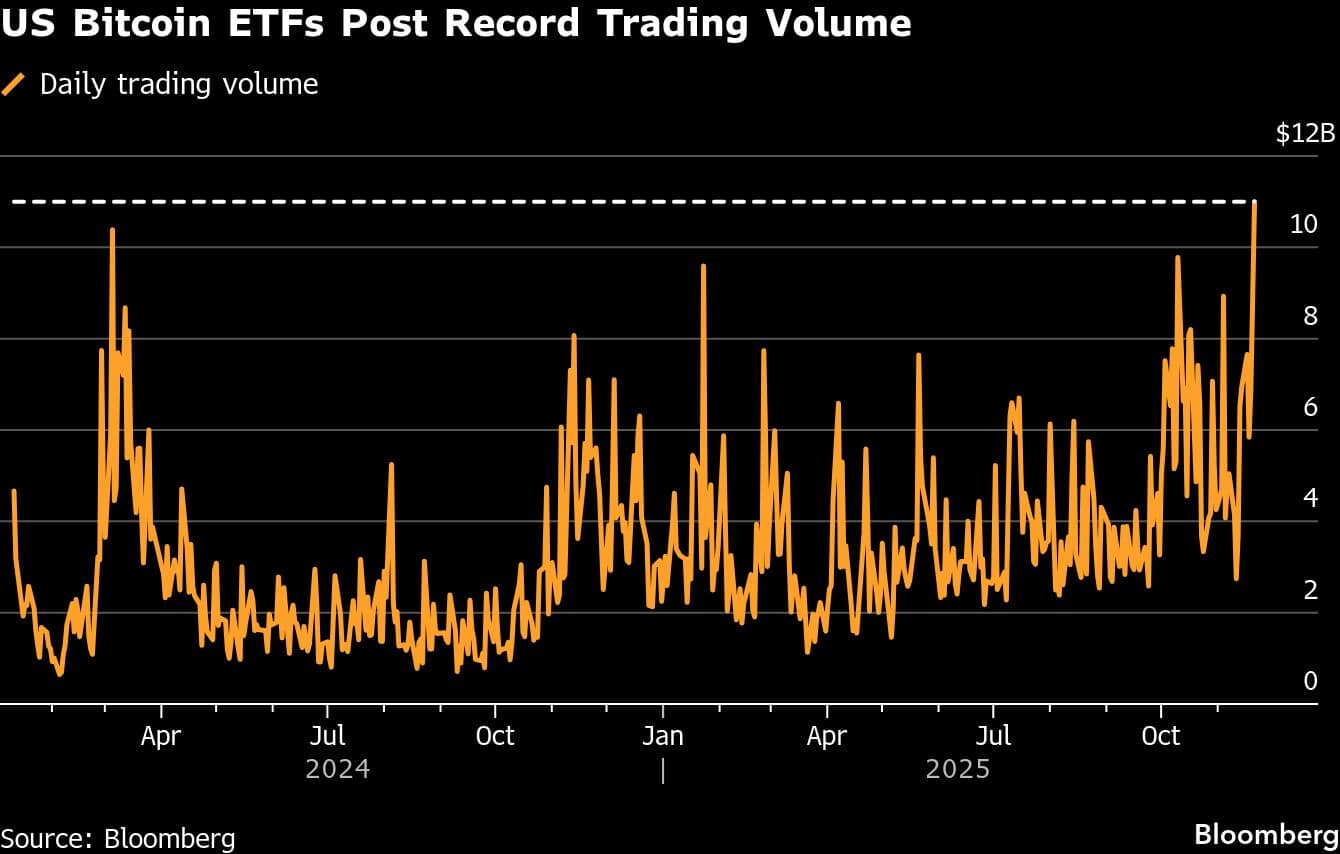
Friday also saw the Bitcoin ETFs register record trading volumes of $11.5 billion, according to data compiled by Bloomberg. BlackRock’s IBIT alone accounted for $8 billion, and recorded outflows of $122 million.
While those volumes “offered a brief hint of demand,” the IBIT redemptions highlight “a meaningful shift in institutional preference away from the category leader, signaling that confidence has not yet fully returned,” said LVRG’s Ruck. BlackRock declined to comment.
To be sure, the riskiest trades in finance from AI stocks to meme names and high-octane momentum bets have all been slipping. The S&P 500 for instance is poised for its worst month since March. And the short-term correlation between Bitcoin and tech stocks hit a record earlier this month, according to data compiled by Bloomberg.
“The choppy trends in Bitcoin since the summer have been something we’ve interpreted as a sign of fatigue,” wrote Lori Calvasina, head of US equity strategy research at RBC Capital Markets, in a note. “While it’s not clear to us exactly what’s causing Bitcoin to drop, stabilization in this corner of financial markets would likely help to calm some nerves within US equities as well.”
Discover the latest Business News, Sensex, and Nifty updates. Obtain Personal Finance insights, tax queries, and expert opinions on Moneycontrol or download the Moneycontrol App to stay updated!

| 1W returns-0.17% |
| 1W returns-0.95% |
| 1W returns-1.39% |
| 1W returns-3.00% |
| 1W returns-5.47% |
| 1W returns-7.81% |
| 1W returns-9.16% |
Find the best of Al News in one place, specially curated for you every weekend.
Stay on top of the latest tech trends and biggest startup news.