
Indian government bond yields traded in 2025 only about 30 basis points (Bps) lower even as the Reserve Bank of India (RBI) delivered cumulative repo rate cuts of 125 bps during the year, underscoring how markets often move ahead of policy and are shaped by global and domestic cross-currents beyond rate action alone.
The benchmark 10-year government bond yield eased from around 6.85 percent at the start of the year to nearly 6.55 percent by December, despite aggressive monetary easing. Market participants said a large part of the rally had already played out well before the actual rate cuts, limiting the scope for further downside in yields once the RBI acted.
Rally came before the cuts
Bond yields began falling early in 2025 as investors anticipated a start of rate cutting cycle by the central bank amid easing inflation and concerns over growth. Following the RBI’s 25 bps rate cuts each in February and April, the 10-year yield slipped sharply from about 6.85 percent to nearly 6.24 percent.
“In 2025, the bond market rallied well ahead of the actual rate cuts, anticipating aggressive easing. This early rally significantly limited further yield compression once the rate cuts were implemented,” said Mataprasad Pandey, vice-president at Arete Capital Service.
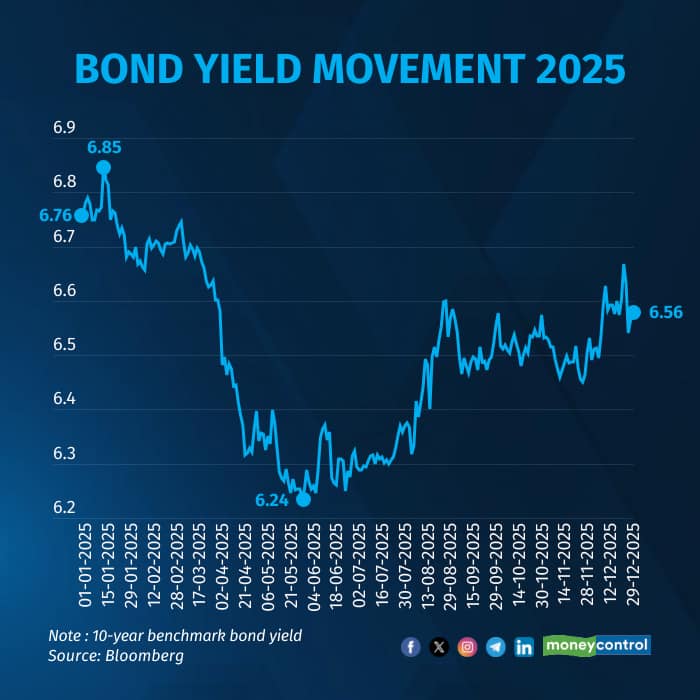 Bond yield movement
June surprise triggers sell-off
The turning point for the bond market came after the June monetary policy, when the RBI delivered an unexpected 50 bps rate cut and shifted its stance towards neutral. Instead of extending the rally, the move triggered profit-booking across the curve, as investors began to factor in a prolonged pause in policy easing.
Following the June decision, the 10-year bond yield jumped from around 6.25 percent to nearly 6.60 percent and stayed elevated for several months.
“The front-loading of a 50 bps cut, along with a shift in the neutral stance in June, prompted investors to book profits,” Pandey said.
Growth, rupee and global yields weigh
Domestic macro data also played a role in reversing sentiment. Better-than-expected GDP growth prints through the year reduced expectations of further rate cuts, reinforcing the view that most of the easing cycle was already behind.
At the same time, global factors added pressure. Hardening global bond yields, particularly in the US, reduced the relative attractiveness of Indian debt. Adding to the strain was a sharp depreciation in the rupee after the US imposed 50 percent tariffs, which triggered risk-off sentiment and intensified selling in domestic bonds.
India’s economy extended its strong run for a third consecutive quarter, growing at a six-quarter high of 8.2 percent in July–September (Q2FY26) compared with 7.8 percent in the previous quarter, helped by robust manufacturing and a buoyant services sector, especially financial, real estate and professional services, according to official data released on November 28.
Further, the local currency has been under pressure in the last few months, especially due to the delay in the trade deal, which led to the currency hitting fresh record lows. On the other hand, the limited intervention by the RBI was also adding to the pain.
In the last three months, the rupee has been trading in the range of 88.20-91.03 against the US dollar.
“GDP growth came in stronger than expected, reducing expectations of further yield softening. A sharp depreciation of the rupee, driven by the imposition of 50 percent tariffs by the US, further intensified selling pressure,” Pandey said.
As a result, the bond market was unable to fully benefit from the cumulative 125 bps of rate cuts delivered by the RBI in 2025.
What will drive yields in 2026?
Looking ahead, experts believe bond yields in 2026 will be influenced less by domestic rate actions and more by global trends and fiscal dynamics at home.
Additionally, bond market will also look out for government borrowing numbers in the Union Budget and its tenure, and also fiscal deficit target. These factors will also shape up the bond yield in the coming months, experts said.
“With most of the rate cuts already implemented in 2025, bond yields in 2026 are likely to be driven more by global bond yield movements and domestic demand–supply dynamics,” Pandey said.
Fiscal factors will be closely watched. Lower GST rates and recent tax cuts have already led to a moderation in GST collections, making government revenues a key variable for the bond market.

Discover the latest Business News, Sensex, and Nifty updates. Obtain Personal Finance insights, tax queries, and expert opinions on Moneycontrol or download the Moneycontrol App to stay updated!
Find the best of Al News in one place, specially curated for you every weekend.
Stay on top of the latest tech trends and biggest startup news.