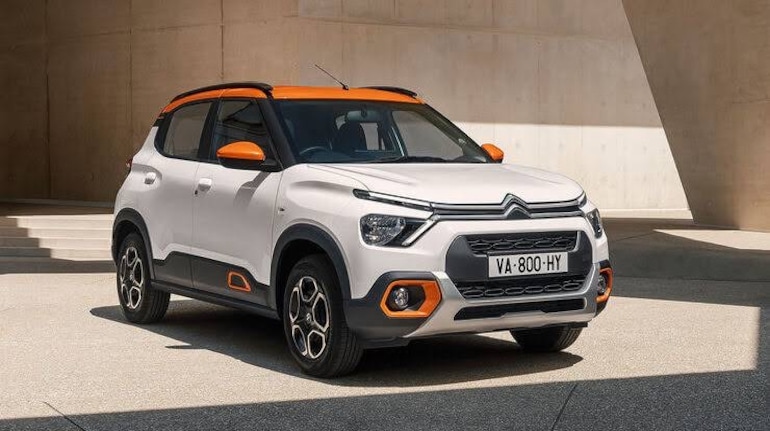
Multinational automotive company Stellantis has joined the electric vehicle race in India and plans to launch its first EV through Citroen.
While Citroen has had a rough start in India, with only one premium sports utility vehicle (SUV)—the C5 Aircross—the PSA Group intends to capture a bigger share of the market with its upcoming compact crossover hatch the C3, expected to be launched next month.
Stellantis, which was formed in 2021 through the merger of France's PSA with Fiat Chrysler, sells Jeep and Citroen brands in India.
Citroen is targeting the all-important low-cost EV space, which still remains a no-go. Stellantis CEO Carlos Tavares has confirmed that the EV would be based on the same platform as the sub-4 metre C3 and would be engineered in India under its “C-cubed programme” put in place to produce EVs built on the common modular platform (CMP).
EVs will include not only sub-4 metre compact models but also MPVs and CUVs, Tavares said in a virtual interaction with Indian media on May 17. The C3 platform is a modular one and will also be used to create.
Though he didn’t share the details, Tavares did get everyone curious as EVs is a rapidly developing space but no one has been able to crack the affordable segment yet, not even local players like Tata Motors or Mahindra and Mahindra.
Also read: MC Drives: Tata Nexon EV Max
The battery challenge
The biggest challenge in manufacturing a low-cost EV continues to be battery localisation. While India-specific models continue to be heavily localised for both Stellantis’ Jeep and Citroen brands, the carmaker does not have an immediate plan to locally source battery cells, though it will do so in the coming years.
Stellantis isn’t the only one. Maruti Suzuki, India’s biggest car manufacturer, has pushed its EV plans to 2025 when its joint-venture with Toshiba and Denso for a battery plant in Gujarat would begin showing results.
Also read: Five things you should know about the Tata Nexon EV Max
Battery localisation also allows manufacturers to engineer cells that are better suited to local temperatures. At present, all lithium-ion cells in India are imported. While they undergo rigorous temperature tests, local R&D would allow firms not only to make batteries more durable but also less likely to lose charge in extreme temperatures.
The recent heatwave, which sent the mercury rocketing to new highs in several parts of the country, has shown how battery electrics in India are exposed to extreme temperatures that make them lose charge.
The size of the battery is also an issue. Entry-level petrol hatchbacks promise frugality and range that a small sub-4 metre EV would struggle to match.
The only way to add range to an EV is to increase the size of the battery. With a smaller car, the room to play with is limited.
Also read: EV fire case: All testing norms for batteries, battery management and cells are being revised
The Tata Tigor, the least expensive of the EVs in the country, costs Rs 12.49 lakh. And still it isn’t Tata Motors’ best-selling EV, which is the Nexon, which comes with a price tag of Rs 13.99 lakh.
The price difference between the Tigor EV and the Nexon EV isn’t much when you take the added battery size and range into account—the Tigor EV packs a 26kWh battery, while the Nexon EV comes with a 30.2kWh battery.
To make a compact, low-cost EV not only would the battery cost have to come down dramatically but batteries would also have to be more densely packed, which can affect the way the cells breathe.
For a relatively small battery pack to have a long range, battery technology needs to be more effective.
At present, the cheapest EV in the world is manufactured by Changli in China. It’s not much bigger than a golf car and does roughly 36 km on a single charge.
In the US, the cheapest EV is the Nissan Leaf, which works out to Rs 21 lakh in the Indian currency. A globally popular, low-cost EV with a sub-200km range is something manufacturers are yet to crack.
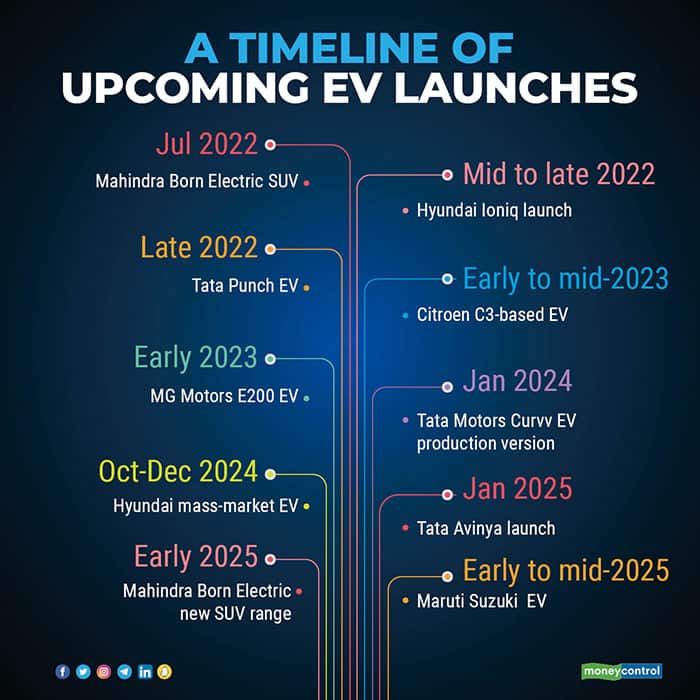
Frontrunners in the low-cost EV race
Tata Motors’ Product Line Head for Passenger EVs Anand Kulkarni recently said the company intends to bring more of its internal combustion cars into the EV fold.
These will include the likes of the Tata Punch, which is built on a powertrain agnostic ALFA platform. Its EV version will likely be powered by Tata’s proprietary Ziptron high-voltage EV architecture with a possible 25kWh battery sending power to a front axle-mounted electric motor.
Mahindra & Mahindra, having discontinued the e-Verito, hasn’t come out with a new offering in the EV space. Not when the demand for the XUV700 and Thar is through the roof with prolonged waiting periods.
However, in February, Mahindra & Mahindra announced it will unveil its EV platform under its “Born Electric Vision” banner.
The teaser showcased a trio of concept SUVs, ranging from a compact, mid-size to an SUV coupe. By 2027, however, Mahindra aims to launch four more SUVs under its “Born Electric Vision” banner.
MG Motors, whose ZS EV has met with resounding success, is looking to crack the low-cost EV segment, potentially with the E200 prototype it showcased at the Auto Expo.
MG is looking to launch an EV in the Rs 10-15 lakh category. And then there’s Hyundai which will invest Rs 4,000 crore and launch six EVs by 2027, including a mass-market EV, an SUV, and an electric sedan.
Hedging its bets is Maruti Suzuki that aims to launch its first electric vehicle in 2025 and follow it up with more such cars. Without mentioning the price bracket, Maruti Suzuki has said it wants the EV space to be more populated before it joins in.
Discover the latest Business News, Sensex, and Nifty updates. Obtain Personal Finance insights, tax queries, and expert opinions on Moneycontrol or download the Moneycontrol App to stay updated!
Find the best of Al News in one place, specially curated for you every weekend.
Stay on top of the latest tech trends and biggest startup news.