






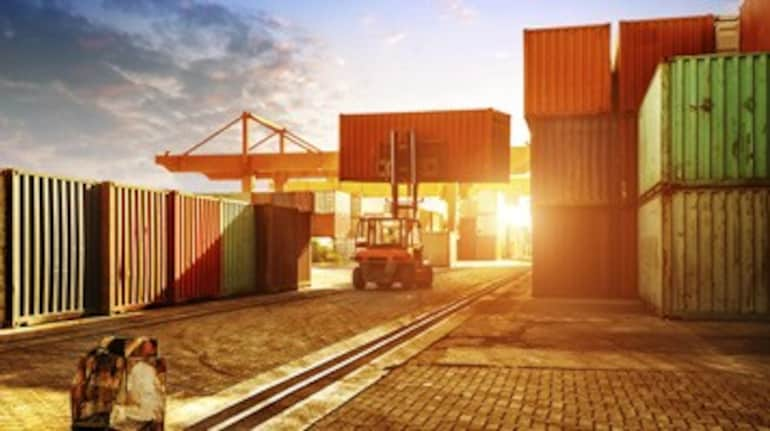
Even as India’s broader infrastructure sector faces significant challenges, its ports and logistics companies have remained a bright spot.In a 57-page report, analysts at Citi discussed prospects for the sector, and outlined three stocks – Adani Ports and SEZ, Container Corporation of India and Gujarat Pipavav – that they believe could be potential beneficiaries of an expected economic turnaround.“These companies offer high return-on-capital-employed, strong cash flows and competitive advantages. India’s broader infrastructure sector, in contrast, is mired in debt, delays, low profitability, and legal and regulatory issues,” Citi analysts wrote.Excerpts from the report:- India has 200 non-major and 12 major ports along its 7,517-km. Of the non-major ports, only some are well developed and offer all-weather berthing facilities (in FY14, only 61 were reported to have handled cargo traffic). But unlike major ports, whose pricing strategy is controlled by the government, non-major ports are free to decide their own tariffs based on market forces.- Over the past four years (FY10-FY14), cargo volume grew at 3.6 percent, the worst when compared to any five-year period since 1981. In fact, cargo volume has been shown to have some correlation with GDP growth (0.51) and this suggests that should GDP growth rebound, volumes should recover too.- Minor ports have been increasing their market share, accounting for 43 percent of cargo volume in FY14, compared to 7 percent in FY90. In fact, in FY10-14, volumes for major ports de-grew 0.3 percent compared to 10.3 percent growth for minor ports.- Capacity utilization for major ports and minor ports ranges from 70 percent and 80 percent and any rebound in volume growth (which has increased at 9 percent between FY95 and FY10) would mean ports should face significant capacity constraints.- The Eleventh Five-Year Plan (which ended in FY12) had envisaged an increase in the capacity of major ports to ~1017m tonnes, compared to 505m tonnes at the start. But at end-March 2013, the cargo handling capacity of major ports was only ~800million tonnes.- The new government, which took office in May 2014 has repeatedly highlighted port-based development as one of the priority areas. Ministry of Shipping has prepared a time bound action plan based on its presentation to the PM.- By freeing up tariffs at major ports to market forces (like tariffs at minor ports), these ports can increase attractiveness to private port developers for PPP projects several notches.- India’s merchandise trade as percent of GDP has grown to about 42 percent in 2012 from 20 percent in 2000. Further, share of containerization has been growing. The share of container traffic at major ports has grown to 21 percent in FY14 from 11 percent in FY01.- Around 55-60 percent of India’s freight is transported via roads v/s 37 percent for US and 22 percent for China. This is due to lack of investment/capacity constraints and railways’ pricing strategy of cross-subsidizing passenger fares from freight fares. In 1950, railways used to carry about 90 percent of the country’s freight.- The west (Mumbai-Delhi) and east (Kolkata-Delhi) dedicated freight corridors, being built at a cost of Rs 90,000 crore, are expected to be completed by 2017-2019. The DFC, apart from implementation of GST, will significantly add volumes.- Adani Port and SEZ’s (APSEZ) flagship asset, Mundra (a non-major port), remains by far the best infrastructure asset and port, in our view, particularly for its first-mover advantage (~11 percent of India’s cargo), location (deep natural draft, waterfront and proximity to the northern hinterland), well-established connectivity and, most importantly, pricing freedom.- APSEZ has risen 87 percent/79 percent over the past year/six months, outperforming the Sensex. Despite this outperformance, we continue to rate APSEZ a Buy for its resilient business model, huge competitive advantage in ports, scale of operations, execution, potential benefits from a recovery in GDP and trade, and most importantly, improving return ratios and cash flows. - We are, however, keeping an eye on the loans and advances extended by APSEZ to related entities and its inter-corporate deposits (ICDs). While the amount is large, it is not large enough to upend our Buy thesis on the business and it has declined recently. Further, the stock is trading at a discount to its long-term average multiple.- We increase our target price on APSEZ to Rs337 on a higher FY16E EV/EBITDA of 18x (from 15x) to account for are-rating in market multiples and improved business prospects. Our target multiple is supported by anFY14-17E EBITDA CAGR of 23 percent and adjusted RoCE of ~14 percent.- CONCOR, the dominant container train operator in India (75 percent plus market share), stands to be a major beneficiary of 1) a revival in domestic capex and industrial activity 2) completion of DFC by CY17E, which will provide a step-jump to asset turns, volumes and margins 3) introduction of GST over next 2-3 years which will provide a major boost to domestic logistics business and 4) a bounce-back in India’s trade and an improved trade balance. - Given strong structural tailwinds and CONCOR’s dominant market position, we believe that premium valuations (outperformance v/s Sensex of 44 percent in past 1 year) will sustain and stock will continue to outperform.- Our target price of Rs1600 for CONCOR is set at 20x March 16E EV/EBITDA, supported by 16 percent EBITDA CAGR over FY14-FY17E, 16 percent ROCE, net cash balance sheet, and huge market dominance.- Gujarat Pipavav (GPPL) has successfully scaled up its business despite its small size. 1HCY14 revenue / EBITDA / PAT grew 22 percent/48 percent/80 percent YoY and, as a result, concerns have faded about competition from larger ports and customer churn.- On top of a substantially improved business performance, GPPL offers a rare mix (at least in the India infrastructure space) of a transparent business model, clean and healthy cash flows, and a balance sheet that should soon turn net cash.- GPPL’s EBITDA margin expanded to 56.2 percent in 2QCY14, from a low of 41 percent in 2QCY12. This sharp expansion is on the back of efficiency gains and the inherent operating leverage in the port business. Given continuing traction in the business, we expect the margin to continue to expand, to about 62 percent by 2016.- We expect GPPL’s total cargo/container cargo to grow at 12 percent/14 percent CAGs over 2013-16. Revenue/EBITDA/PAT should grow at 18 percent/28 percent/40 percent CAGR over the same period. - We are increasing target price to Rs 185 (from Rs104): We increase our target EV/EBITDA multiple for GPPL to 18x (from 15x) given a re-rating of market multiples and substantial improvements in the business.
Discover the latest Business News, Sensex, and Nifty updates. Obtain Personal Finance insights, tax queries, and expert opinions on Moneycontrol or download the Moneycontrol App to stay updated!

Find the best of Al News in one place, specially curated for you every weekend.
Stay on top of the latest tech trends and biggest startup news.




