



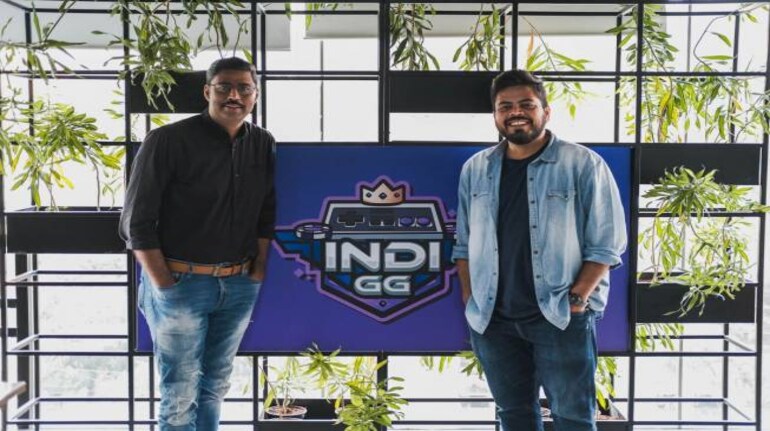
Kratos Studios, a community-based gaming platform that operates under the IndiGG brand, is foraying to Brazil as the company ramps up its international footprint.
"Given Brazil's vibrant gaming population, reverence for local gaming heroes, and its status as a burgeoning market, our expansion aligns seamlessly with our overarching ethos," Kratos Studios founder Manish Agarwal told Moneycontrol.
Kratos Studios helps gamers convert their skills and time into income through a range of tasks on its decentralised platform. It also provides game developers with a curated list of engaged gamers across the game lifecycle.
Agarwal said that Brazil has a significantly higher proportion of PC gamers than India, and that the average revenue per user (ARPU) from a typical gamer in the South American country is six times higher than that of their Indian counterparts.
"Gaming is a mainstream culture there. Also, Brazil is 95 percent Portuguese (speaking users) which poses an interesting challenge for global mobile games. They can't just put a game there and be successful. You need the help of the local community to solve their problems," Agarwal said.
Kratos Studios has a team of about 12 people in Brazil, including community builders and business developers. The company currently employs over 60 people in total.
"The way we are looking at our expansion is that there will be a centralised product tech stack, global business development, and local communities that will keep feeding their inputs to the product team so that we keep evolving our offerings," Agarwal said.
The platform's early success in India has led to its global expansion. In the past six months, the company claims to have disbursed Rs 5 crore to 150,000 gamers. Top players have generated an average income of Rs 40,000 per month. These earnings are completely funded by game developers and publishers.
The move to Brazil could lead to a four-fold increase in the community income generated on the platform, the company said.
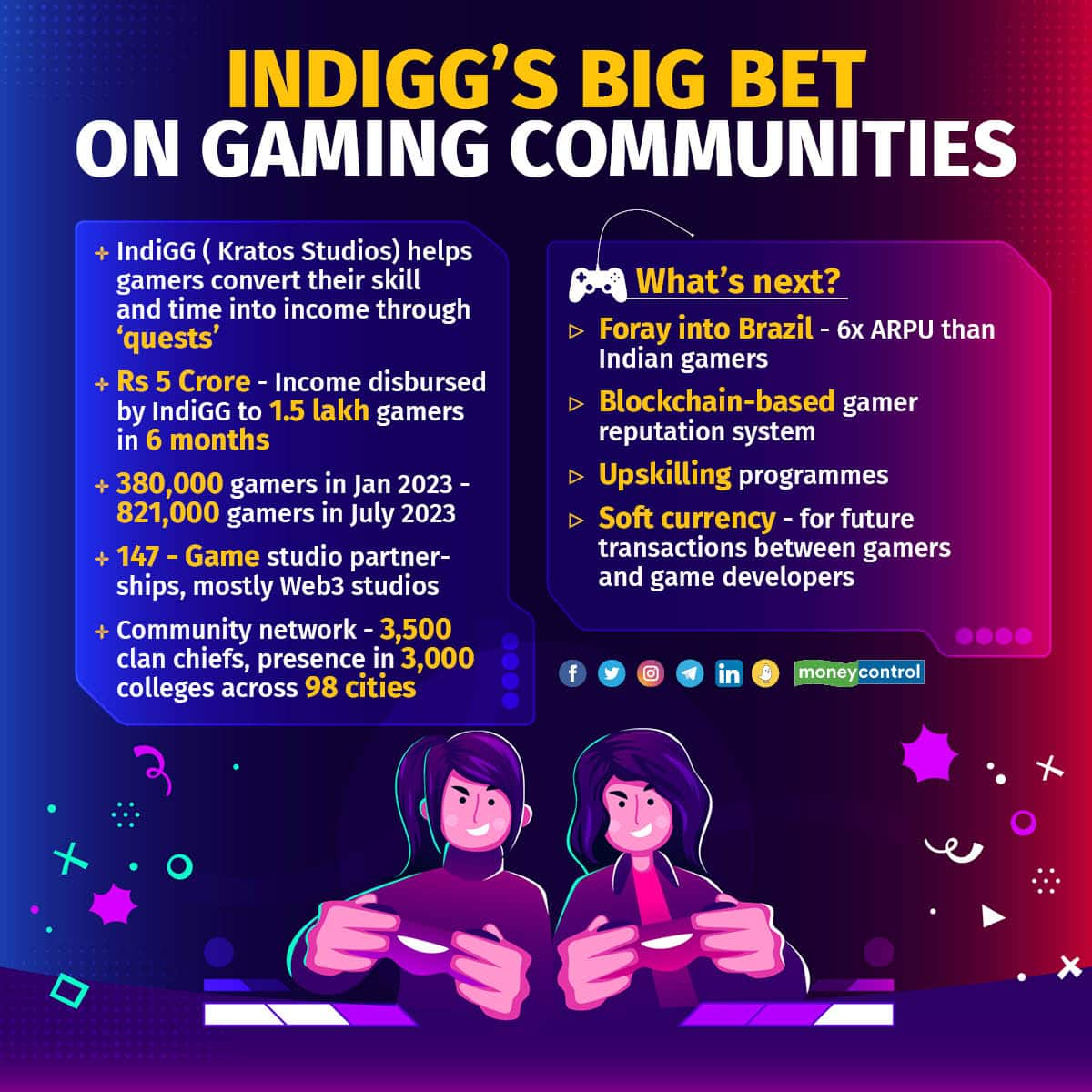 IndiGG help gamers convert their skill and time into income through 'quests'
Kratos Studios currently takes a 20-25 percent cut of game developer spending. However, Agarwal said they plan to reduce this to 10 percent once they reach a certain "high scale" in the future.
The platform claims to have a player base of 821,000 as of July 2023, up from 380,000 in January 2023. These gamers are aged 14 to 21. Agarwal said that this growth has been achieved through word-of-mouth publicity only, and that the company has not spent any money on customer acquisition to date.
This growth comes at a time when India has been dubbed as the fastest-growing games market in Asia, both in terms of revenue and gamers, with its mobile and PC gaming revenue projected to reach $704.5 million in 2022, according to Niko Partners, a market research and consulting firm that covers video games, e-sports, and streaming in the continent.
The Indian gaming market is projected to grow at a compound annual growth rate (CAGR) of 21.1 percent over the next five years, reaching $1.4 billion in 2026. This does not include revenue generated by real money games (RMGs). In 2022, about 34% of gamers in India spent money on non-RMG titles, the firm said.
India's overall gaming industry revenue increased from $2 billion in FY21 to $2.6 billion in FY22. It is expected to expand at a CAGR of 27% to $8.6 billion in FY27, according to a report by Lumikai.
Agarwal also said that the adoption of blockchain-based gaming is "far ahead" in Asia than in other continents, both in terms of developers as well as consumers.
The genesis
Agarwal, who was previously the CEO of Nazara Technologies, co-founded Kratos Studios with angel investor Ishank Gupta earlier this year after acquiring Polygon Labs-backed IndiGG.
In February 2023, Accel led a $20 million investment in the company, with participation from investors such as Prosus Ventures, Courtside Ventures, Nexus Venture Partners, and Nazara Technologies.
Kratos Studios works with game developers and publishers to list a variety of tasks, which the company calls "quests," on the IndiGG platform. These tasks may range from tournament operators, game testers, Discord managers, community support, streamers, or in-game activities such as reaching a certain game level, participating in or winning a certain number of games, or making it to the game's leaderboard. Each quest will have a limited number of slots based on the company's requirements.
Agarwal said that gamifying engagement will result in a much lower customer acquisition cost (CAC) for gaming companies, unlike traditional channels where they pay a fixed cost to drive customer installs. For example, the game may allocate $800 for 100 slots on the leaderboard. However, it is possible that about 300-500 players will play the game in an attempt to reach the leaderboard.
Companies can also list multiple quests with increasing difficulty and income levels to drive further retention in their games.
"This creates a win-win situation for game publishers and gamers. Game publishers benefit from lower CAC and better lifetime value (LTV), while gamers earn money for their time and skill" Agarwal said.
Clan chief model
The company also has a "Clan Chief" initiative, catering to people who run gaming micro-communities. Clan chiefs can motivate people in their community to complete quests on the platform to earn a cut of the revenues or host esports tournaments (also known as Clan Bash) to earn money. IndiGG claims to have over 3,500 Clan Chiefs at present.
"Clans are the new cafes. You can sit at home and play on PC but when you play together in a clan, the fun is different. Clans are just enabling that," Agarwal said.
This approach will enable clan chiefs to manage the entire execution of the tournament, using IndiGG's tech stack. "No grassroots communities can scale without having a decentralised mindset. When college people organise tournaments, the participation and passion is very different versus an agency doing the same," he said.
Agarwal said that people have traditionally thrown more manpower to scale in esports. Instead, they are offering a decentralised tech-led system to tackle this. "Today, we are in 3,000 colleges across 98 cities in India for anybody to execute (tournaments). We can just run a quest. The clan chiefs come in, and they run it. This is a very scalable model," he said.
He added that the collective power of "thousands or millions" of such micro-communities can create scale, thereby attracting the attention of global games.
Gaming developers and genre mix
Kratos Studios currently has tie-ups with about 147 game studios from South Korea, Japan, the United States, Europe, and Southeast Asia. Most of these studios are developing nascent Web3 games.
However, in terms of quests, 30 percent come from Web2 games and 70 percent come from Web3 games. This is because Web2 games are more mature and have larger player bases, which allows them to offer more quests through a smaller number of games.
"Web3 scale will come in two to three years. That's why going to Web2 games makes good sense. For the goal that we want to hit, one would need to have a combination of Web2 and Web3 games," Agarwal said.
This is also evident in the quest mix on the platform. While Web3 games are listing more early-stage tasks such as game testing, community support and Discord managers, Web2 games are contributing to a lot of tournament-related tasks.
In terms of genre, prominent ones include real-time strategy, first-person shooter, collectible card games, trading card games, multiplayer online battle arena games, and sports games, among others.
What's next?
Kratos Studios plans to build a decentralised reputation system using blockchain technology for every gamer on its platform in the coming months.
Agarwal said users will have the option to control the amount of information they share, both in terms of what they show and what they don't show. Their earnings will however be proportional to the information shown by the gamer, he said.
The startup also plans to offer upskilling programmes to people, enabling them to hone their skills.
"Once we have a sizable community of both gamers and developers, there are multiple ways we can start creating better economic and social impact through upskilling in various areas," Agarwal said. "Our vision is to create a social and economic impact that enables gamers to change their orbit across the emerging markets."
A soft currency is also in the works, which Agarwal said will be the sole transaction currency on the platform for both game developers and gamers. He noted, however, that their current business is not cryptocurrency-dependent, but rather they are using blockchain to "fulfill the value exchange" between a gamer and a game.
The focus would rather be on increasing the volume of transactions on the platform, which will result in higher token demand and investors making money.
"We want to get 200,000 unique earners by December 2023. So that we can at least generate $3.5-$5 per earner, which translates to about a $1 million - $1.5 million revenue run rate," Agarwal said.



Discover the latest Business News, Sensex, and Nifty updates. Obtain Personal Finance insights, tax queries, and expert opinions on Moneycontrol or download the Moneycontrol App to stay updated!
Find the best of Al News in one place, specially curated for you every weekend.
Stay on top of the latest tech trends and biggest startup news.