






At the age of 15, Prasanna Venkatesh was forced to halt his education owing to financial constraints while his friends began their grind to get into a legacy Indian tech institute.
Two years later, in 2017, Venkatesh decided to pick up from where he left off. He enrolled for a diploma in electronics and communication engineering at a polytechnic college in Chennai, his hometown, taking the first possible entry back into the game.
Realising his diploma was not enough, Venkatesh turned to upskilling for data science and artificial intelligence roles. “In the software industry, almost everything can be learned from open source or with very little fee. If you’re skilled enough, most of the companies do not care about the degree,” he told Moneycontrol.
Soon, Venkatesh landed his first internship at a startup in June 2020 earning a salary of Rs 3 lakh per annum. During this time, he gained hands-on experience developing data science and AI solutions.
Almost two years, three jobs and several experiences later, Venkatesh, today 23, earns a package of Rs 20 lakh per annum, working as a data scientist and leading the machine learning team at a business solutions startup.
Is the 23-year-old techie an outlier?
Upskilling amid downturnHiring has been put on the back burner at many companies in the last year. Startups, navigating funding winter and demand slowdown, are focused on cutting employee costs that skyrocketed in 2021.
According to a report by an executive search and talent advisory firm Longhouse Consulting, open positions at startups have dropped about 67 percent to close to two lakh openings in June 2022 to May 2023 period, compared to about 6 lakh in the same period over the previous two years.
Meanwhile, companies in the IT space have been no different, as they turned to onboarding delays for freshers hired last year.
This has also come in the age of generative AI, with many employers reassessing their workforce. Amid a bleak employment market, job-seekers across sectors are now turning to tech upskilling to stay relevant in the techade.
But the question also arises if Indian companies have moved away from traditional tech degrees.
Moneycontrol spoke to employees, HR experts and founders of upskilling startups to understand if Indian companies have grown to prioritise skills over degrees and are open to hiring non-traditional candidates with relevant prowess.
The shiftNon-traditional candidates here include high school graduates, college dropouts, individuals with non-tech degrees, or those who possess bachelor's degrees in technology without a specialisation in computer science.
"We have observed a significant shift in the hiring practices of companies in the last decade. Today, 70 percent of companies that recruit candidates through us prioritise skills over the type of degrees candidates possess,” said Hari Krishnan Nair, co-founder of Great Learning, a Byju’s-owned upskilling startup.
A growing realisation about the limitations of traditional degrees to assess employability and the democratisation of digital learning, among other factors, have contributed to this change, experts said.
According to Sekhar Garisa, CEO of talent-management platform foundit (formerly Monster APAC & ME), a shift towards skill-based hiring for such candidates has been discussed in the industry for some time but the tools for assessment were lacking.
“Now companies have adopted skill validation and verification processes, using tools such as coding challenges and aptitude tests that provide a more accurate assessment of a candidate's skills than what is written in a resume,” said Garisa.
Hence, individuals who participate in skill verification contests or coding challenges stand a better chance of cracking recruitment processes.
Today, several platforms offer calibration contests and assessments that allow techies to showcase their skills and receive verifiable skill scores that are recognised by recruiters, Garisa added.
The big breakOver the years, the enduring allure of tech careers has attracted several aspirants to either stick to ‘the road mostly taken’ early on or switch their careers to move into it, at a later stage.
“The motivation to invest in tech careers is often driven by the availability of open-source materials, the chance to gain reasonably good experience working on projects which can be created in isolation without being employed in a job, and the potential for higher pay,” said Anshuman Das, co-founder and CEO, Careernet, a talent solutions provider.
Das believes the tech industry is more democratic and disruptive, allowing individuals without formal backgrounds to work around the status quo and succeed. “Tech is a far more welcoming industry amid others where a bastion of few leading companies has scaled to a stage that now no one can come in,” he added.
While the tech career is enticing, the first battle to enter can be a tough one before the going gets comparatively easier as employees gain on-the-job training and work experience.
Das said at an entry-level college reputation plays a significant role. “In all fairness, companies are less likely to give a break to non-tech candidates due to the already abundant pool of tech professionals in the industry,” he added.
The gap is also visible in the open roles for non-traditional freshers and the compensation they draw out early on.
According to data shared by TeamLease Digital, a technology professional services company, certain roles like quality assurance, test engineer, data analyst and IT business analyst still demand a formal tech degree.
While such candidates with relevant skills can try their chances in generalist roles such as software engineer or developer, technical support executive, user interface, user experience and web designer, and technical writer among others, they are likely to be offered a lower base salary.

“Unless you are outrageously talented and able to prove it, lower pay is only logical. You need to understand that the organisation is also taking a leap of faith on such candidates. But it's just about the starting point, if you are good enough, you will cover,” said foundit’s Garisa.
As per Teamlease’s data, while candidates often start on a lower salary base compared to their counterparts with a tech degree, over time long-term prospects and advancement opportunities can vary from those who have a college degree.
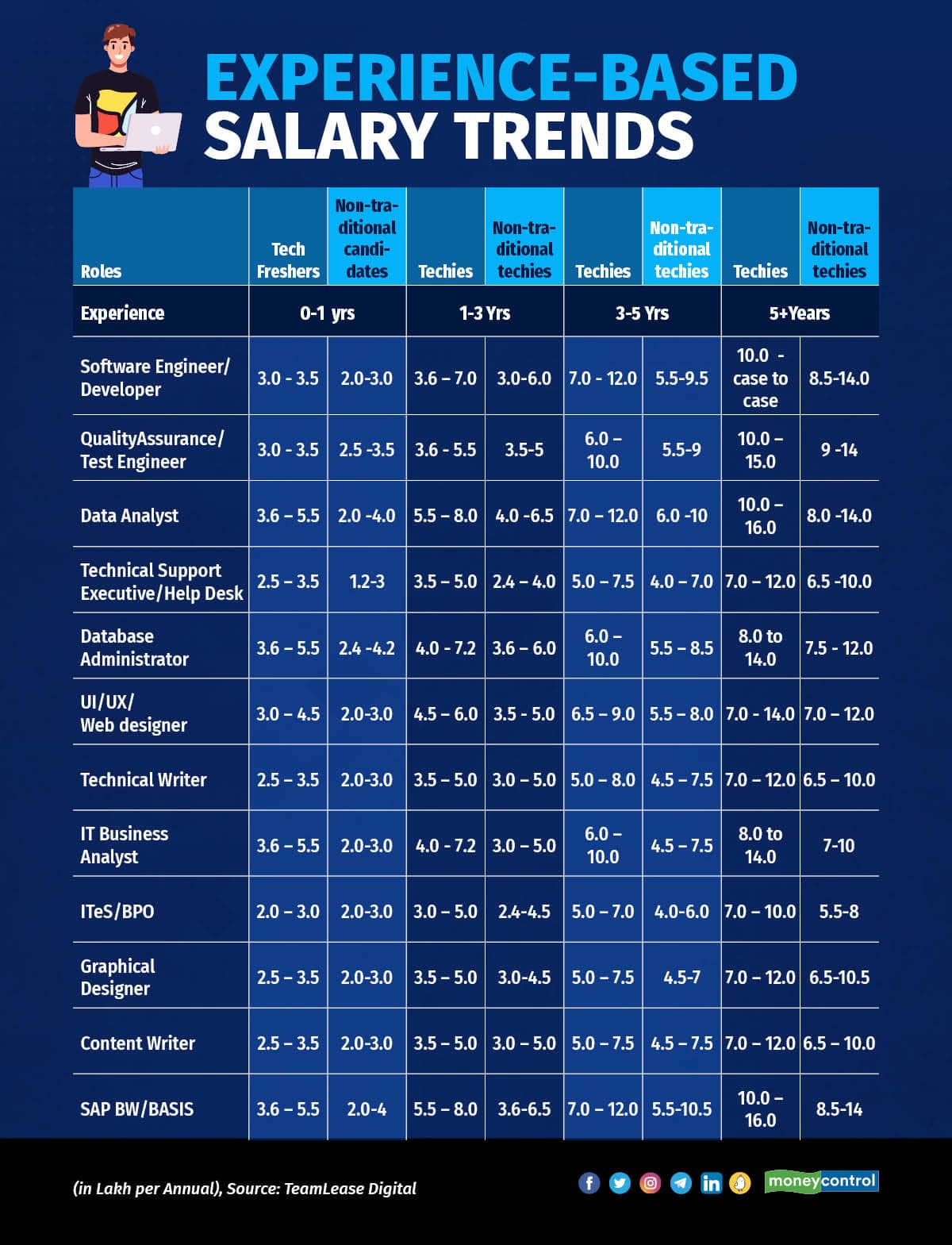 Experience based salary trend
“The career trajectory of such candidates can vary significantly based on individual competencies, such as personal skills, experience, networking, and the specific roles and industries individuals are interested in pursuing,” said Krishna Vij, Business Head, TeamLease Digital, highlighting caveats to the data.
Startups versus large organisationsIn hiring such candidates, startups seem to be holding the edge.
“Around 15-20 percent of our students are high school graduates. There are several startups, including some unicorns, which have hired these high school graduates. These students, at the age of just 19, have already found employment in the startup ecosystem,” said Prateek Shukla, co-founder and CEO, Masai School, an institute imparting tech skills.
Garisa believes startups are generally willing to take more risks and value agility and attitude, making them open to hiring based on skills.
According to Ankush Singla, co-founder and CEO, Coding Ninjas, a coding institute, within startups, product-based companies are more liberal in cases of a lack of a formal degree than service-based companies.
“Service-based companies’ focus is on selling the expertise of their employees to clients, and having individuals from top colleges makes the selling process easier. On the other hand, product-based companies are primarily concerned with the ability to build and contribute effectively to their products and less about educational qualifications,” Singla told Moneycontrol.
In deep tech fields, having a relevant educational background or degree is often necessary due to the complexity of the subject matter, Singla added.
 Industry-based salary trend
Apart from tech startups, especially product companies, industries like digital marketing, design, content creation, IT services, BFSI and consulting are also open to hiring non-traditional candidates in tech roles based on relevant skills.
“Our learners coming from non-tech backgrounds such as B.Com, BBA, B.Sc are mostly hired by companies operating in the IT, consulting, pharma and healthcare sectors,” added Great Learning’s Nair.
However, larger organisations are taking more time to adapt to this shift, Singla added. According to the data, the IT sector, the biggest employer of tech talent, weighs non-traditional candidates on a different scale offering a lower pay bracket of about Rs 2.5 - 5 lakh per annum compared to Rs 3 to 6 lakh per annum to those with a tech degree.
Garisa concurs. Large companies often rely on line managers and talent acquisition teams for hiring, who tend to be risk-averse and prioritise fitting candidates into predefined structures, he said.
“Startups, on the other hand, have decision-makers who are closely involved in the hiring process, giving them the authority and conviction to hire based on skills,” he added.
A workaroundHR experts such as Garisa said they have taken up the responsibility to educate employers on strategies employed across industries for better decision-making in such cases.
According to him, larger organisations are also implementing skill verification and using assessment platforms to identify qualified candidates. “However, biases in hiring might still creep in, as decisions are ultimately made by people who may carry preconceived notions,” he said.
To address this, some progressive companies have now started exploring the anonymisation of certain profile details that are not relevant to hiring decisions. “Masking background information, the focus remains on evaluating skills rather than making biased judgments,” he added.
According to Krishna Kumar, founder and CEO of upskilling platform Simplilearn, some companies are voicing their preference towards skills by giving differential package offers to candidates with certain skill sets or those who can ace pre-onboarding programs offered by them.
What’s in your hand?While there might be challenges along the way, experts say candidates can work towards stacking the odds in their favour.
“Some strategies to increase the exposure towards the opportunities are networking, proactive application through job boards and tech forums, and participation in multiple online tests in job fairs, coding tests and so on,” said TeamLease Digital’s Vij.
Great Learning’s Nair said that learners should work on capstone projects based on real-world application of the skills they acquire.
On another note, Careernet’s Das believes being passionate and genuinely interested in the industry is crucial for long-term success. “It's important not to be a career tourist and to fully commit to the field,” he said.
Impact on college degreesSimplilearn’s Kumar believes over a period what skill you acquired becomes more important than the degree you hold.
However, Garisa reasoned that degrees from prestigious institutes might not just yet lose all significance.
“The importance of top-tier colleges will always remain because that stands for something. It's a validation that you are good and have been consistent in what you do,” he said. Garisa added, “But beyond the top tier, mid and lower-rank colleges will definitely lose their sheen.”
Kumar agreed and said that the value of such degrees appreciates during downturns.
“Candidates from IITs or NITs that got offers from good companies have been allowed to join also because those companies don't want to impact their relationship with such colleges, whereas a lot of impacted people are the ones from tier two or three colleges,” he said.
Garisa said, “To find a house, to find a partner, to find a job, and to earn respect with your relatives and peers – degrees are useful in a lot of ways in our country.”
However, he added that while it is not advisable and ideal to skip a formal degree to get into this industry, it would not be the end of the world to not have one.
“However, if you have a degree but no skills, you will still be in trouble. You don't have a degree, you have skills, you will still be good,” he added.



Discover the latest Business News, Sensex, and Nifty updates. Obtain Personal Finance insights, tax queries, and expert opinions on Moneycontrol or download the Moneycontrol App to stay updated!
Find the best of Al News in one place, specially curated for you every weekend.
Stay on top of the latest tech trends and biggest startup news.






