






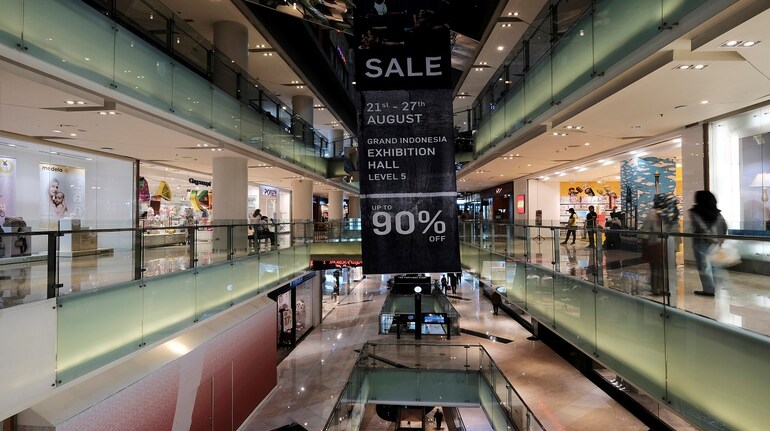
Nexus Select Trust, India's largest shopping mall operator, has asked hypermarkets to further reduce their presence in its 19 malls across 15 cities, Pratik Dantara, head of strategy and chief investor relations officer at the Blackstone-backed REIT, has told Moneycontrol.
The space vacated is being taken over by premium gourmet food and grocery outlets, as quick commerce hits the demand for large-format hypermarket stores, which often occupied up to 70,000-80,000 square feet space.
"They (hypermarkets) have been impacted significantly on account of quick commerce,” Dantara said. Four or five years ago, hypermarkets used to occupy 70-80,000 sq ft space. The company did a round of resizing immediately after COVID, as quick commerce was picking up.
“We have got them down to about 30-35 thousand square feet and now we are talking to them to do another round of resizing,” he said.
They didn’t lose productivity after the first round. “The throughputs actually improved after that and I think that also gives them the confidence that if you have to do it again, it should kind of work in their favour," Dantara said.
Gourmet over grocery
Trent, Reliance Retail and SPAR are among the companies running large-format hypermarkets in the country.
“Gourmet" outlets meet the demand of premium customers who want to experience products before making purchases, an option not available on quick commerce applications, Dantara said.
"More gourmet food is what you need in the malls rather than the regular grocery that would any which way be available on quick commerce. I'm not saying gourmet is not available on quick commerce, but typically, the average order values are lower, gourmet is more expensive. You probably want to see it, touch it, before you actually buy it, in terms of freshness," he said.
Changing consumption patterns
After a consumption slowdown in most of FY25, Dantara expects this fiscal to be better, especially as the festival season is around the corner, with consumption growth in its portfolio of around 5 percent in the first quarter.
The second half of the year is expected to be stronger due to the festival and lower GST rates, which come into effect from September 22.
"I feel we are still on the path of recovery. But I think July, August gives us reasonably good confidence that it seems to be in good shape, and trajectory-wise trending in the right direction… To some extent, fashion was impacted last year... but has come back pretty strongly with high single digit growth in July and August...We have seen quick service restaurants and food and beverage also come back, slow and steady," he said.
In the first quarter, malls in the north were impacted by the Pahalgam attacks and Operation Sindoor, which led to temporary closures, Dantara said. Despite this, Tier-2 markets saw stronger growth trends.
Over the past two years, Tier-2 markets have grown faster than Tier-1 markets. Tier-1 markets are growing in high single digits and Tier-2 in early double digits. “On a blended basis, what we are seeing is a consumption growth CAGR of approximately 8 percent," Dantara said.
Fewer screens
Despite improved multiplex footfalls, including for industry leader PVR INOX, in FY26 following a challenging FY25, Dantara confirmed that Nexus plans to ask multiplexes to reduce their footprint in malls, similar to its approach with hypermarkets.
Films such as F1 and Saiyaara helped improve footfalls this season, Dantara said.
"I think there will be a time when you probably just need about five to seven screens in a mall. You don't need 10,” he said. “It obviously impacts occupancies when you have the footfall spread over more screens. So you can concentrate them over smaller counts… We are working with them, so that as you reduce the number of screens, we kind of also work with them to upgrade the screen experience."
Service upgrades are in the form of better recliner seats, sound quality and more value for money.
Multiplexes, which drove footfall and filled spaces like upper floors, which were hard to fill, are being replaced by gaming arcades and premium food and beverage (F&B) outlets. The shift is being driven by a prolonged slump in quality film releases, particularly in North and West India.
Other mall owners and operators such as Phoenix Mills and K Raheja Corp's Inorbit Mall, too, are following Nexus’ script, setting up premium restaurants and gaming arcades to drive foot traffic to make malls a family destination.
"The avenues that a mall has in terms of general social kind of gathering now are much more, apart from just eating, shopping, and movies, it has now expanded to live events and more experiences,” he said. “As we look at entertainment as a basket for ourselves, there are two paths to entertainment.”
There are multiplexes and then there are family entertainment zones like gaming arcades. Earlier, one used to be enough, but now, maybe two family entertainment zones will do —… one for children and then you have another one for younger adults”. It balances out the overall entertainment portfolio, Dantara said.
Discover the latest Business News, Sensex, and Nifty updates. Obtain Personal Finance insights, tax queries, and expert opinions on Moneycontrol or download the Moneycontrol App to stay updated!
Find the best of Al News in one place, specially curated for you every weekend.
Stay on top of the latest tech trends and biggest startup news.









