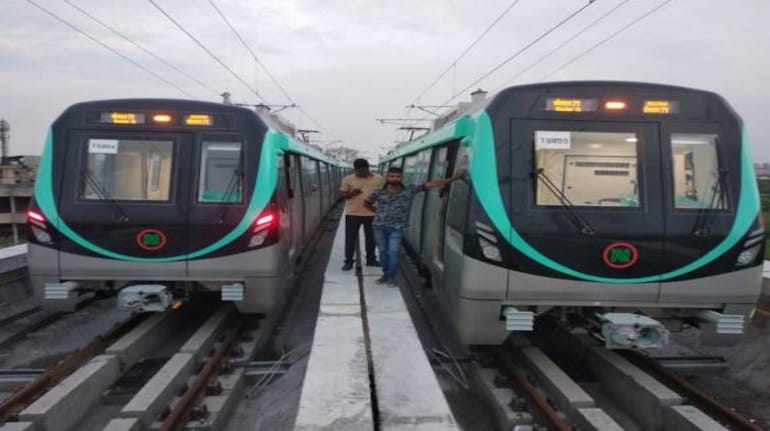
Fast trains may be deployed after ridership assessment of the newly-laid 29.8-km Aqua Line connecting Greater Noida to Noida one month after it begins operations in October 2018, officials in the Noida Metro Rail Corporation (NMRC) have said.
Currently, the metro corridor is dotted by 21 stations, with areas adjoining some of them being sparsely populated currently -- the stations have been constructed with an eye on the future.
Once the assessment is undertaken, these stations are likely to be skipped until new demand is fulfilled, thereby enhancing the speed on the corridor.
While the entire 29.8 km corridor is expected to be operational in October, some stations such as 144, 146, 147, 149 and 153 may struggle for ridership as these sectors are yet to be developed and therefore are sparsely populated.
"Trains will stop everywhere initially but there may be fast trains later depending on ridership in some stations. After operating the trains for a month if we find that ridership is less in some stations, we may decide to run fast trains and skip some stations. But initially the entire corridor will be thrown open," says executive director of Noida Metro Rail Corporation (NMRC), PD Upadhyay.
Trials were conducted on the first stretch between Greater Noida’s Depot station and Sector 149. The second stretch, from Sector 146 to Noida Sector 83, was tested in May. The third leg from Sector 83 to Sector 71 started this week. The final inspection by the commissioner for metro rail safety is likely to be done in September.
"We will complete the trials and procure all required clearances by September-end so that we may start operations in October this year. The first trail runs began in January, the second in April and the third on August 20," said Upadhyay.
The cost of the project is Rs 5,503 crore. "Around 20 percent of the project cost is to be borne by the Central government’s ministry of housing and urban affairs by equity and 30 per cent of the project cost is being taken as loan from NCR Planning Board. Noida and Greater Noida (that have a stake in the 70:30 ratio) on behalf of Uttar Pradesh have contributed Rs 339 crore that includes the land cost of the corridor," he explained.
A City One card will also be issued to commuters. This is a multi-wallet card applicable in the metro, parking area, buses and even for payment of Noida and Greater Noida utility services and shopping at malls. SBI is the concessionaire for this card.
The Noida Metro Rail Corporation (NMRC) will have QR-coded paper tickets for single journeys, unlike the tokens of the Delhi Metro, and also have an option of checking in and out using a mobile app, he said.
"This partnership is on a revenue sharing model. The entire investment is done by the SBI in return for revenue sharing," he said.
The app will be available free of cost for Android and iOS phones.
The card operates on an 'open loop system' technology, and can be used on any metro network such as the Kochi and the Nagpur metros and other upcoming metros. The service, however, is not available on the DMRC metro. The Delhi metro cards are exclusive for rail transit and recently got acceptance on the Delhi government buses.

Discover the latest Business News, Sensex, and Nifty updates. Obtain Personal Finance insights, tax queries, and expert opinions on Moneycontrol or download the Moneycontrol App to stay updated!
Find the best of Al News in one place, specially curated for you every weekend.
Stay on top of the latest tech trends and biggest startup news.