

With Finance Minister Nirmala Sitharaman leaving the new tax regime largely unchanged, the decision between the old, exemption-driven system and the new, lower-rate structure continues to come down to simple arithmetic.
The data by Deloitte India clearly shows that the decision depends on one thing: whether deductions under old tax regime are large enough to offset the lower slab rates available under the new tax regime.
At the lower end of the income scale, the choice is straightforward. For gross salaries up to Rs 5 lakh, tax outgo is zero under both regimes, as taxpayers are eligible for a 100 percent rebate under Section 87A, capped at Rs 12,500 under old tax regime for income upto Rs 5 lakh. Under the new tax regime, this rebate is significantly higher up to Rs 60,000 for income up to Rs 12 lakh, effectively eliminating tax liability within that threshold.
Between Rs 7 lakh and Rs 10 lakh, the numbers highlight a critical threshold. While the new tax regime offers lower rates, the old regime can still result in zero tax but only if deductions ranging from Rs 1.5 lakh to Rs 4.5 lakh are available.
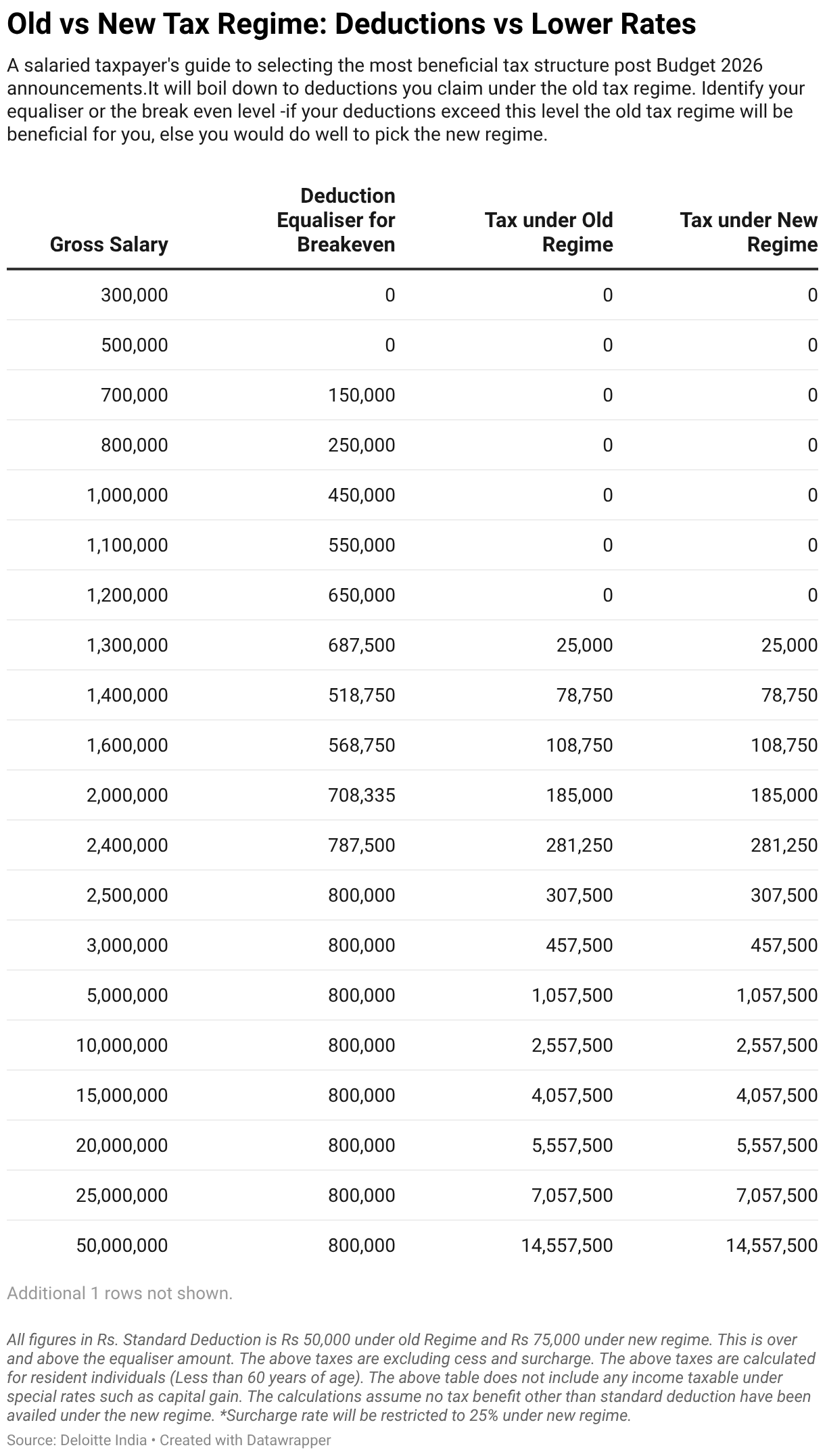
This “deduction equaliser” represents the minimum deductions required to make the old regime competitive. For instance, at a gross salary of Rs 10 lakh, deductions of around Rs 4.5 lakh are needed under the old regime to reduce taxable income to Rs 5 lakh and eliminate tax liability.
Structurally, the two regimes are designed for different taxpayers. The old tax regime works best for individuals who can claim multiple deductions, such as Section 80C investments, HRA exemptions, home loan interest on self-occupied property, health insurance premiums and other allowances. These deductions significantly reduce taxable income, allowing the old regime to stay relevant despite higher slab rates.
In contrast, the new tax regime is tailored for taxpayers without such deductions such as first-time earners, individuals without housing loans, or those who prefer liquidity over long-term tax-saving commitments. For them, the advantage comes from lower tax rates, a higher standard deduction and simpler compliance, often resulting in similar or lower tax outgo without complex paperwork.
As income rises beyond Rs 12–13 lakh, the breakeven point becomes sharper. At a gross salary of Rs 13 lakh, both regimes lead to the same tax outgo of Rs 25,000, but only if deductions of nearly Rs 6.9 lakh are claimed under the old regime. From this level onward, the data shows that unless deductions exceed Rs 7–8 lakh, the old regime offers no real tax advantage.
For income of Rs 25 lakh and above, the deduction equaliser stabilises at around Rs 8 lakh. This means taxpayers need to consistently claim deductions of that magnitude across investments, housing and insurance for the old regime to merely match the new regime. Without such deductions, the new regime clearly emerges as the better choice due to its lower effective rates and simpler structure.
At higher income levels, Rs 50 lakh and above, the comparison becomes even more rate-driven. The data indicates that tax liability under both regimes is broadly similar up to Rs 5 crore, provided deductions touch the Rs 8 lakh mark under the old regime. At Rs 6 crore, however, the new tax regime shows a lower tax outgo, as surcharge rate will be restricted to 25 percent under new regime.
The takeaway is clear. The old tax regime suits taxpayers with large, reliable deductions, while the new tax regime rewards those without them through lower rates and ease of compliance. The right choice is not emotional it is numerical.
Discover the latest Business News, Sensex, and Nifty updates. Obtain Personal Finance insights, tax queries, and expert opinions on Moneycontrol or download the Moneycontrol App to stay updated!
Find the best of Al News in one place, specially curated for you every weekend.
Stay on top of the latest tech trends and biggest startup news.