





With the US embracing protectionist policies, upending rules of commerce, and global growth slowing down, the Indian technology sector is staring at a rough ride, experts say, adding that high-flying tech funds are now at a crossroads.
US President Donald Trump's reciprocal tax plan, likely to kick in early April, is expected to target India, which has so far escaped his tariff war, and many other countries and will only add to the problem for the sector.
Slump in performance
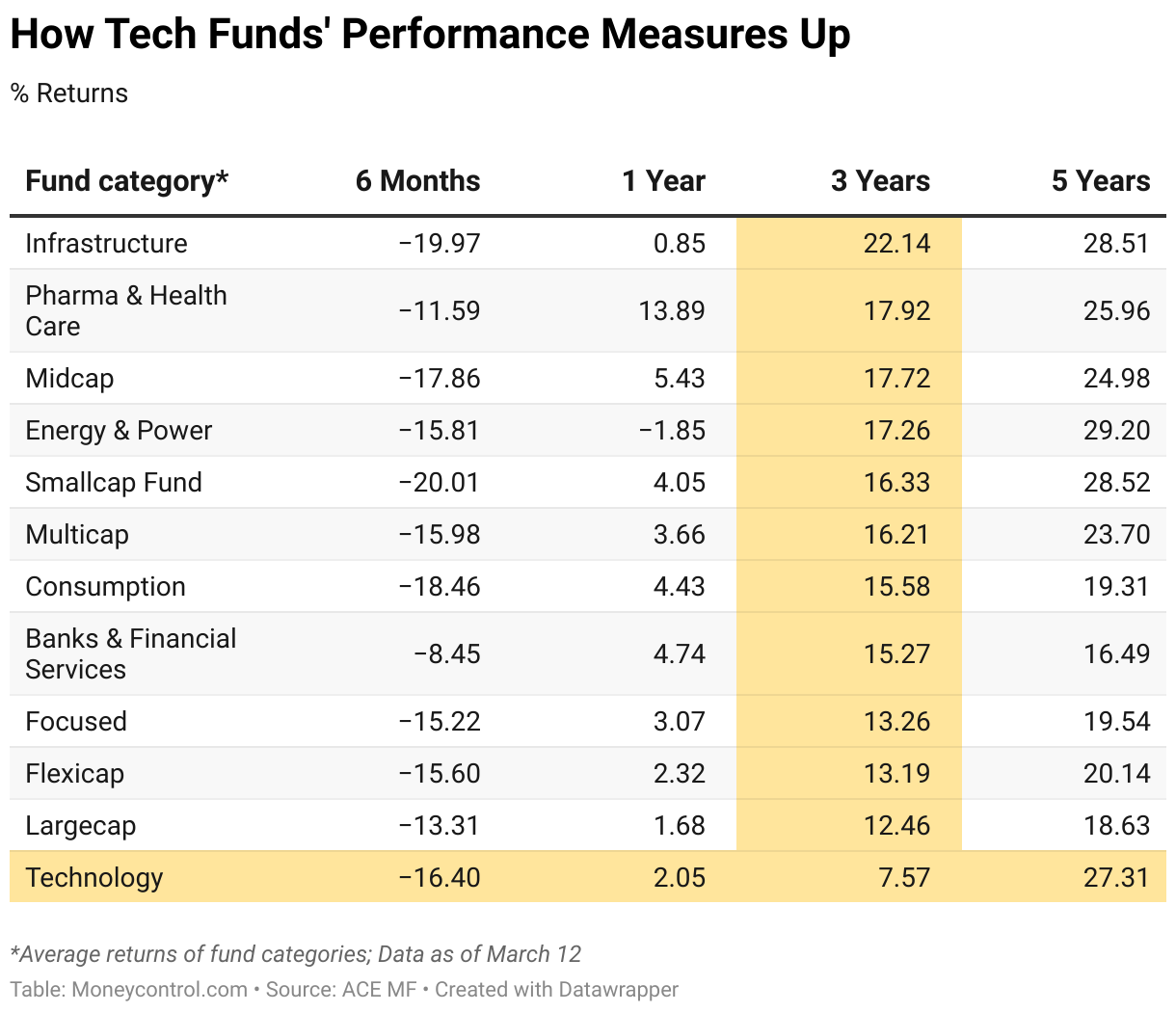
Over the long term (five years), the information technology (IT) funds have been among the top performers but returns have remained muted over a three-year period.
Over the past six months, these funds on average have slumped close to 17 percent, which is worse than other sectoral funds such as banking & financial services and pharma.
Kirtan Shah, founder of Credence Wealth, has over the past quarter advised his clients to trim exposure to the IT sector.
“Till around two and a half years back, when IT stocks were falling fast, we had suggested 20 percent allocation to IT and pharma companies to our clients. The IT sector is extremely cyclical. In the last two years, the sector played out very well,” he said.
“However, with higher valuations and changing dynamics on the policy front in the US, IT stocks may end up doing not so great. That’s why we have been suggesting the exit.”
Also read | Why UAE’s golden visa is the top choice for global millionaires
What’s ailing the sector?
Tech funds are facing a complex landscape. Trump tariffs are raising costs for key players in semiconductor and electric vehicle spaces.
US’ Nasdaq 100 index is already down around 7 percent this year, with chip maker Nvidia sliding 13 percent, as investors factor in supply chain disruptions and potential earnings pressure.
“On one hand, trade barriers could disrupt supply chains, especially for semiconductor and AI-driven companies that rely heavily on cross-border collaboration. On the other hand, inflationary pressures, with the US inflation still sticky at around 3.4 percent, could squeeze corporate margins, limiting their ability to invest in innovation,” said Trivesh D, chief operating officer, Tradejini.
The possibility of the US imposing tariffs on Indian IT services is a critical risk.
“Sustained tariffs could erode the cost advantage, forcing IT firms to rethink their operating models. Higher tariffs on services could disrupt IT services trade and accelerate AI adoption, as firms seek alternative efficiency gains," said Viram Shah, co-founder and chief executive officer, Vested Finance.
Also read | Passive funds fail to cushion market correction, active strategies outperform
The going gets tough
Resilience and long-term growth are the watchwords in the changed scenario.
“The hyper-growth days for the tech stocks may take a breather but that does not mean it is over. It is a rebalancing, shifting from a high-risk, high-reward phase to one of sustainability and strategised growth. The future for tech funds is not in growth chasing but in investing in capable, resilient firms,” said Trivesh.
While valuation compression may persist, funds focused on structural growth themes rather than short-term speculation will remain resilient.
“Protectionism may alter cost structures but it won’t derail the long-term structural growth of the tech sector. The protectionist shift is a headwind but not an existential threat — tech investors just need to be more selective,” Viram said.
Also read | Why are investors moving to focused funds amid market correction?
Silver lining
In emerging markets such as India, where tech adoption is still accelerating and GDP growth remains comparatively strong at around 6.5 percent, there is a silver lining.
Shibani Kurian, fund manager and head of equity research, Kotak Mutual Fund, said the structural opportunity for technology as a sector and India IT services players remains large.
Also read | Time to Bond: Why you should lock in & load up on fixed income assets now
“We see AI adoption resulting in a new tech cycle, which provides a long runway for growth as companies evaluate revenue and productivity gains and move forward with AI implementation as the next stage,” she said.
At the same time, Kurian admits that in the near term, there could be some uncertainty on the back of geopolitical tensions and tariff wars. “Global macro variables would need to be monitored. However, our expectation remains that discretionary tech spends, which have been muted so far, would slowly but surely improve from here on,” she said.
Investors should avoid chasing past trends and instead assess future prospects carefully. Since sectoral funds tend to perform in cycles, a diversified flexicap fund may be a better choice, as it offers fund managers the flexibility to adapt to changing market conditions across market caps.
Discover the latest Business News, Sensex, and Nifty updates. Obtain Personal Finance insights, tax queries, and expert opinions on Moneycontrol or download the Moneycontrol App to stay updated!
Find the best of Al News in one place, specially curated for you every weekend.
Stay on top of the latest tech trends and biggest startup news.