

The Finance Ministry has released the auction calendar for Government of India Treasury Bills worth Rs 3.84 lakh crore for the quarter ending March 2026.
The date of the auction has been scheduled to start from January 7 and end on March 26, 2026. The government plans to raise Rs 1.44 lakh crore through 91-day treasury bills, Rs 1.44 lakh crore in 182 days, and Rs 96,000 crore through 364-day treasury bills.
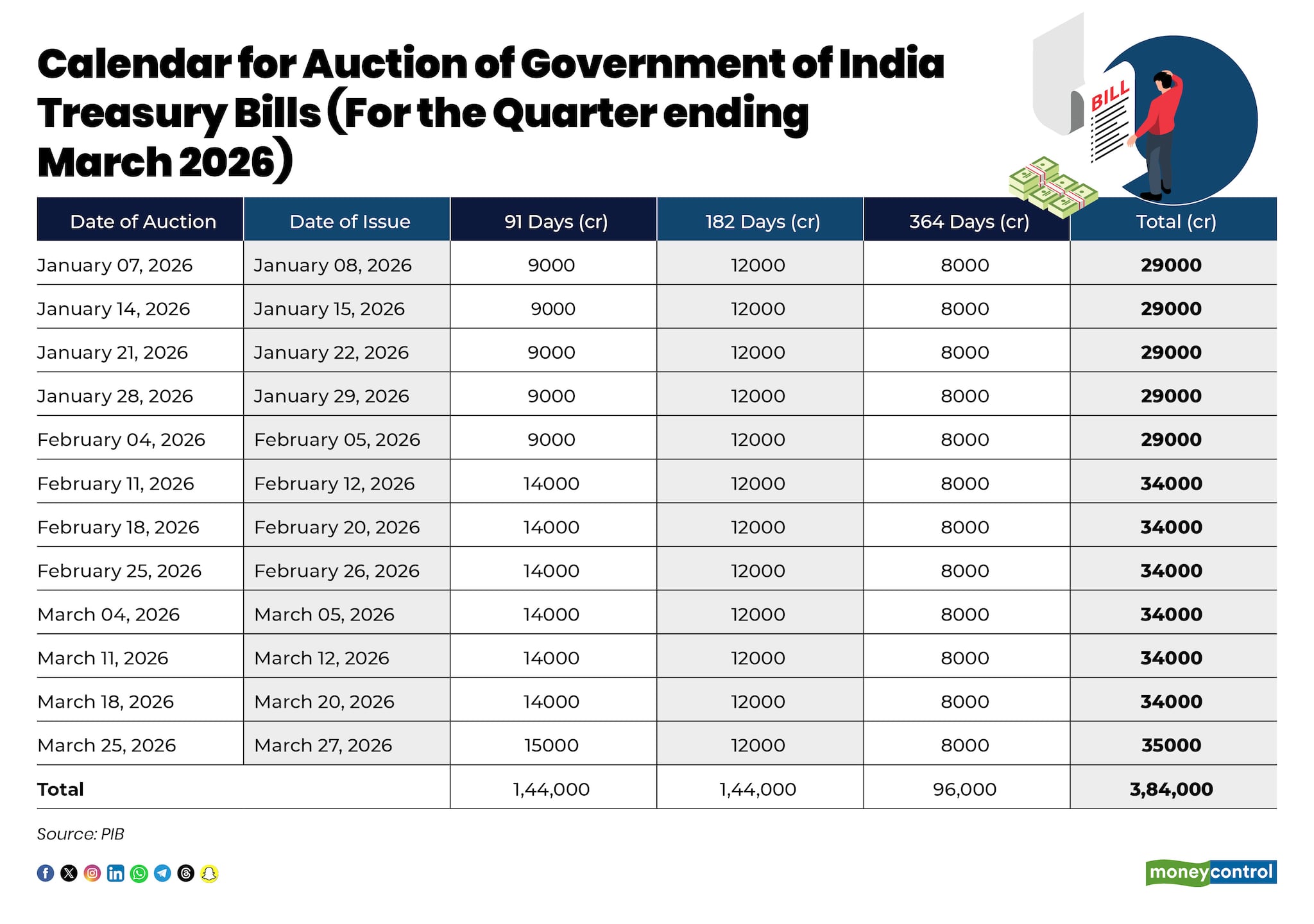
The notification issued on December 29, 2025, read that the Centre and RBI will have the flexibility to modify the indicated amount and timing for auction of Treasury Bills, depending upon the requirements, evolving market conditions and other relevant factors, after giving due notice to the market.
What are Treasury Bills?
The RBI, on behalf of the Government of India, issues Treasury Bills (T-bills) as a measure to finance immediate funding requirements for a defined period and pays assured or predictable returns on the borrowed amount. It is a debt instrument suited particularly for risk-averse investors, as it comes with a sovereign guarantee.
Investment & profit
T-bills are not an interest-generating investment instrument, but are sold at a discounted rate to their face value. Investors profit from the difference between the purchase price and the value received during the maturity period.
Here’s a calculation of T-bills of Rs 100 face value issued at Rs 95.
P = Purchase Price: Rs 95
D = Date of Maturity: 91 days
The following formula is used:
Yield = [(100-P)/P] x (365/D) x 100]
= [(100-95)/95] x (365/91) x 100]
= 21.11%
Maturity
The maturity period is typically fixed at 91, 180, and 364 days.
Minimum investment
RBI mandates that a minimum investment in T-bills should be Rs 25,000 and in multiples of Rs 25,000.
Where to buy T-bills
The primary mode of investment in T-bills is to set up a Retail Direct Gilt (RDG) account with the RBI, which is linked with an investor’s savings account for direct transactions. Investors can also buy or sell securities directly on the secondary market from the RDG account.
It can also be purchased through stock exchanges by setting up a demat account with a broker or any bank.
Taxation
Profit earned from T-bills is subject to short-term capital gains (STCG) and is taxed according to the income tax slab rates of investors.

Discover the latest Business News, Sensex, and Nifty updates. Obtain Personal Finance insights, tax queries, and expert opinions on Moneycontrol or download the Moneycontrol App to stay updated!
Find the best of Al News in one place, specially curated for you every weekend.
Stay on top of the latest tech trends and biggest startup news.