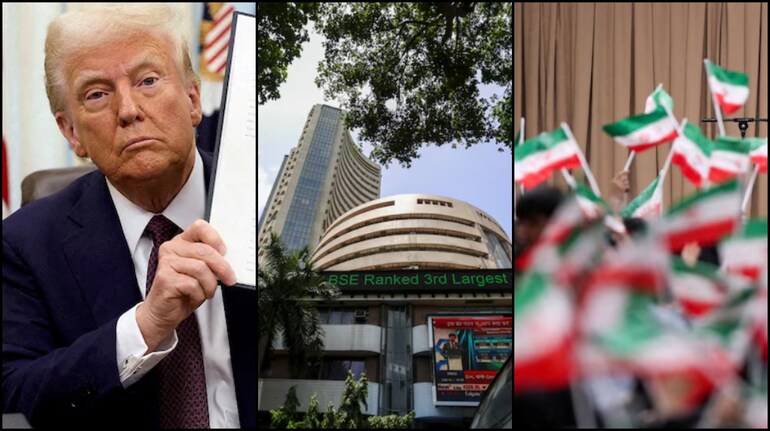

US President Donald Trump has announced that any country engaging in business with Iran will face 25 percent tariff on any trade with US. Analysts have suggested what this can mean for Indian stock markets.
Indian benchmark indices Sensex and Nifty have seen some pressure last year amid Trump’s tariff flipflops. The almost muted annual returns in 2025 came as Trump increased tariffs on Indian exports to US to 50 percent, citing New Delhi’s continued purchase of Russian oil.
Amid Iran's biggest anti-government protests in years, Trump took to Truth Social to announce his new round of tariffs. "Effective immediately, any Country doing business with the Islamic Republic of Iran will pay a Tariff of 25% on any and all business being done with the United States of America," he wrote.
"This Order is final and conclusive," Trump said without providing any further detail. No official documentation from the White House on the new round of tariffs has yet been released.
Iran, a member of the OPEC oil producing group, has been heavily sanctioned by Washington for years. It exports much of its oil to China, with Turkey, Iraq, the United Arab Emirates and India among its other top trading partners.
Sensex dropped more than 545 points (0.65 percent) to 83,328, while Nifty 50 fell 157 points (0.61 percent) to 25,632.90, as seen at 1 pm on Tuesday.
Trump’s decision to impose a 25 percent tariff on countries trading with Iran adds fresh pressure on India, which is already facing tariffs of up to 50 percent on several exports to the US. Together, this creates a potential tariff burden of as much as 75 percent on certain Indian goods.
India–Iran trade stood at $1.68 billion in FY25, and mainly comprised exports of rice, food products, medicines, tea, and spices to Iran, while imports include chemicals and dry fruits, said Abhinav Tiwari, Research Analyst at Bonanza. He noted that while the trade size is modest, the concern is that the US tariff applies broadly to countries doing business with Iran, not just to Iran related goods.
“A key strategic risk is the Chabahar Port project in Iran, which is vital for India’s access to Central Asia. While the project currently has a US sanctions waiver valid until April 2026, there is uncertainty over whether it will remain protected,” the analyst further said.
The renewed threat of a 25 percent tariff by former US President Donald Trump has resurfaced as a key macro overhang for Indian markets, but its actual economic impact needs to be viewed with perspective rather than panic, said Harshal Dasani, Business Head at INVasset PMS.
He noted that while headlines suggest a broad-based disruption, India's direct export exposure to the US remains concentrated in select segments such as textiles, gems and jewellery, leather goods and certain engineering products.
A potential 25 percent tariff threat on exports to the US is already being felt as it adds to trade tensions, which affect rupee weakness, especially in sectors that are more sensitive to exports, said Siddharth Maurya, Founder & Managing Director at Vibhavangal Anukulakara. “Although the Indian economy is more domestically oriented, stock markets related to exports can suffer short-term turbulence in stock markets due to the potential growth impact from tariffs. Investors will watch to what level of diversification can happen to avoid the negative impact due to tariffs,” he said.
“For markets, the immediate reaction has been driven more by sentiment than fundamentals. Export-linked stocks may witness near-term volatility, but India’s broader market construct today is far more domestically anchored than in previous tariff cycles. Consumption, financials, infrastructure and services continue to be driven by internal demand rather than US trade flows,” Dasani said, adding that this phase will let investors distinguish headline risk from earnings reality.
In the near term, the impact should be manageable due to low Iran trade exposure and ongoing India–US negotiations, and over the medium term, a negotiated settlement remains the most likely outcome, which would limit market damage and reduce long term risks, said Tiwari from Bonanza.
Follow all LIVE updates from the stock markets here.
Disclaimer: The views and investment tips expressed by experts on Moneycontrol are their own and not those of the website or its management. Moneycontrol advises users to check with certified experts before taking any investment decisions.Discover the latest Business News, Sensex, and Nifty updates. Obtain Personal Finance insights, tax queries, and expert opinions on Moneycontrol or download the Moneycontrol App to stay updated!
Find the best of Al News in one place, specially curated for you every weekend.
Stay on top of the latest tech trends and biggest startup news.