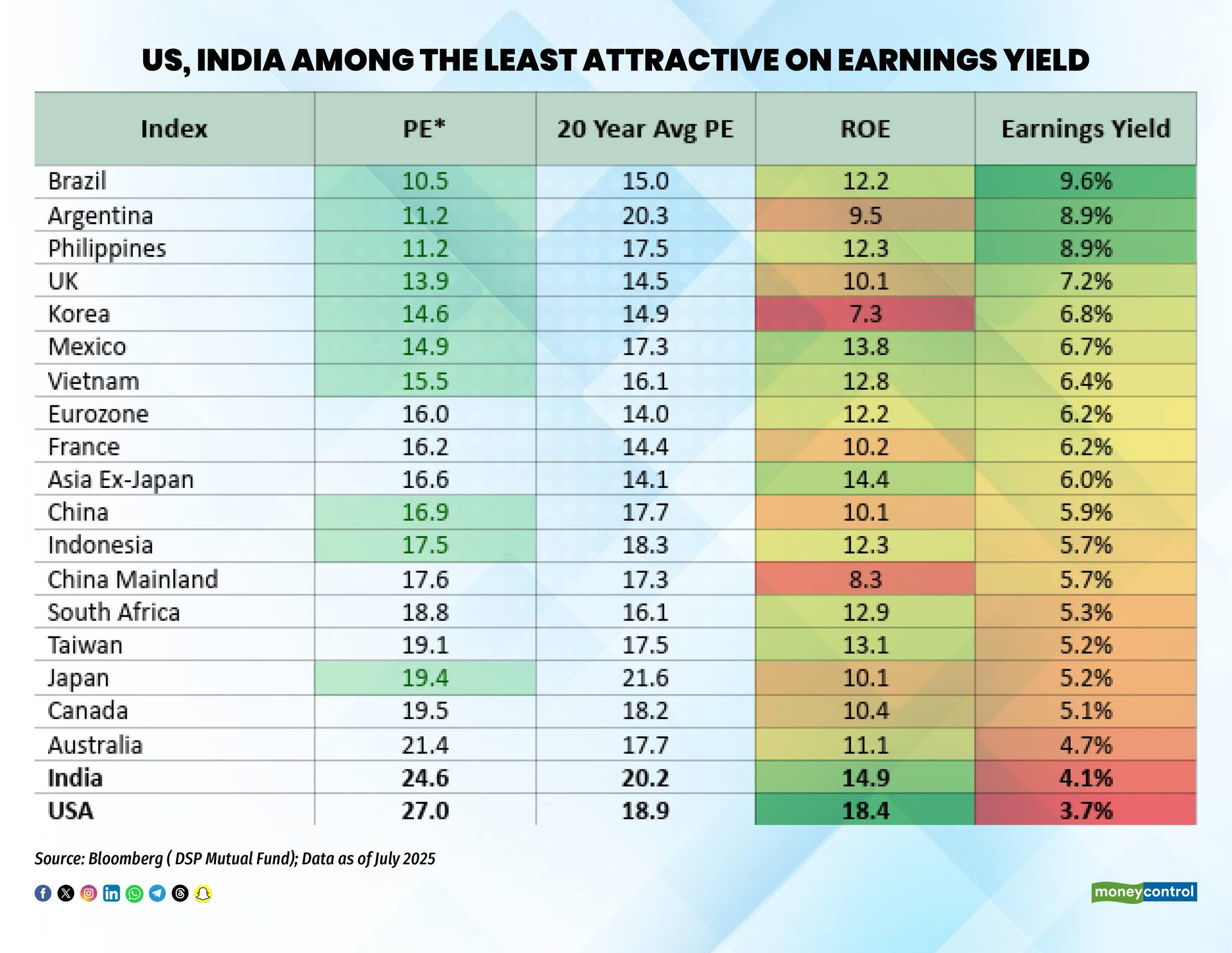
India and the United States currently offer some of the lowest earnings yields among major global markets, according to July data. While this is a reflection of elevated valuations that may limit future returns, experts say that this is not a red flag but the current environment calls for greater caution and selectivity from investors.
Data from DSP MF shows India’s earnings yield has declined to just 4.1 percent, while the US is even lower at 3.7 percent. India’s price-to-earnings (PE) ratio stands at 24.6, above its 20-year average of 20.2, supported by a return on equity (ROE) of 14.9 percent. The US, despite boasting the highest ROE among global peers at 18.4 percent, is trading at a PE of 27.
Catch all the latest market news on Moneycontrol Live Blog
“Even with India’s strong long-term fundamentals and high ROEs, investors should not ignore the math,” DSP stated in its report. “When earnings yields are this compressed, future returns tend to be modest, unless earnings growth surprises sharply to the upside,” it added.
Nirav Karkera, Head of Research at Fisdom, said the low earnings yield levels in India suggest much of the optimism around future earnings is already priced in. “This leaves limited margin of safety from a valuation standpoint,” he said.
Also Read: Trump threatens to impose ‘secondary sanctions’ after slapping additional 25% tariff on India
Karkera added that at such levels, prices tend to be vulnerable to earnings disappointments, where the risk of a de-rating and price correction outweighs the potential upside from further re-ratings. "While this holds true at the aggregate index level, selective opportunities still exist. The current yield is not a red flag, but it does demand caution, greater selectivity, and a high active share," he said,
Vikas Gupta, Chief Investment Strategist at OmniScience Capital said that earnings yield is only one part of the return equation. “What you get when you invest in a market, a fund, or a stock is a combination of yield, earnings growth during the holding period, and the valuation at exit, whether that’s a re-rating or de-rating,” he said adding that while the current valuation picture is debatable, growth is more straightforward.
Gupta pointed to India's strong macro outlook, with real GDP growth of 6.5 percent and inflation at 4 percent, translating to a nominal growth rate of around 10.5 percent. “Listed companies should grow earnings at slightly higher rates (around 12 percent). "That’s the kind of growth investors are getting in India, and to an extent in the U.S., which many other markets lack unless you search more deeply," he said adding that while India's outlook remains solid, the U.S. presents a more complex picture.
Also Read: Trump proposes 100% tariffs on imported semiconductors, exempts Apple and other US manufacturers
Despite concerns around headline valuations, Gupta emphasized that investors still have opportunities — but broad market index exposure may not be the best approach. “If you’re buying ETFs or indexes, you should be prepared for lower returns,” he said. “In India, we prefer a diversified but focused portfolio based on our scientific investing framework. We definitely see opportunities in both countries, and also in the rest of the world,” he added.
Gupta outlined preferred sectors by geography. In India, these include banks, power, logistics and railways, construction and engineering, and housing finance. In the U.S., opportunities lie in ad tech and e-commerce, AI ecosystem, fintech and payments, green tech, healthcare, and travel and leisure. For the rest of the world, he sees potential in industrials, financials, healthcare, consumer cyclicals, technology, energy, and consumer defensives.
Emerging markets show opportunities
Meanwhile, emerging markets are offering more attractive valuations overall. Brazil leads with an earnings yield of 9.6 percent, supported by a PE of 10.5 and ROE of 12.2 percent. Argentina and the Philippines follow with yields of 8.9 percent, both trading at a PE of 11.2, with the Philippines showing stronger profitability.
Among developed markets, the UK offers a relatively attractive 7.2 percent yield. Other markets such as South Korea, Mexico, Vietnam, and the Eurozone are delivering yields in the 6 to 7 percent range.
The data also highlights markets like China, with a 5.9 percent yield and PE of 16.9; Indonesia at 5.7 percent with a PE of 17.5; South Africa yielding 5.3 percent with a PE of 18.8 and ROE of 12.9 percent; and Japan at 5.2 percent with a higher PE of 19.4.
Disclaimer: The views and investment tips expressed by investment experts on Moneycontrol.com are their own and not those of the website or its management. Moneycontrol.com advises users to check with certified experts before taking any investment decisions.Discover the latest Business News, Sensex, and Nifty updates. Obtain Personal Finance insights, tax queries, and expert opinions on Moneycontrol or download the Moneycontrol App to stay updated!
Find the best of Al News in one place, specially curated for you every weekend.
Stay on top of the latest tech trends and biggest startup news.