SEBI’s final decision on the much debated mutual fund total expense ratios (TER) has come as a relief for fund houses and brokerages, as the regulator has reset the expense structure to a lower overall base and aligned brokerage caps closer to prevailing industry levels on a post-tax basis.
The decisions were taken at SEBI’s board meeting in Mumbai, where the regulator approved a reduction in mutual fund expense ratios of up to 15 basis points (bps). Following consultations with stakeholders, the effective reduction for most asset under management (AUM) slabs has been rationalised to around 10 bps.
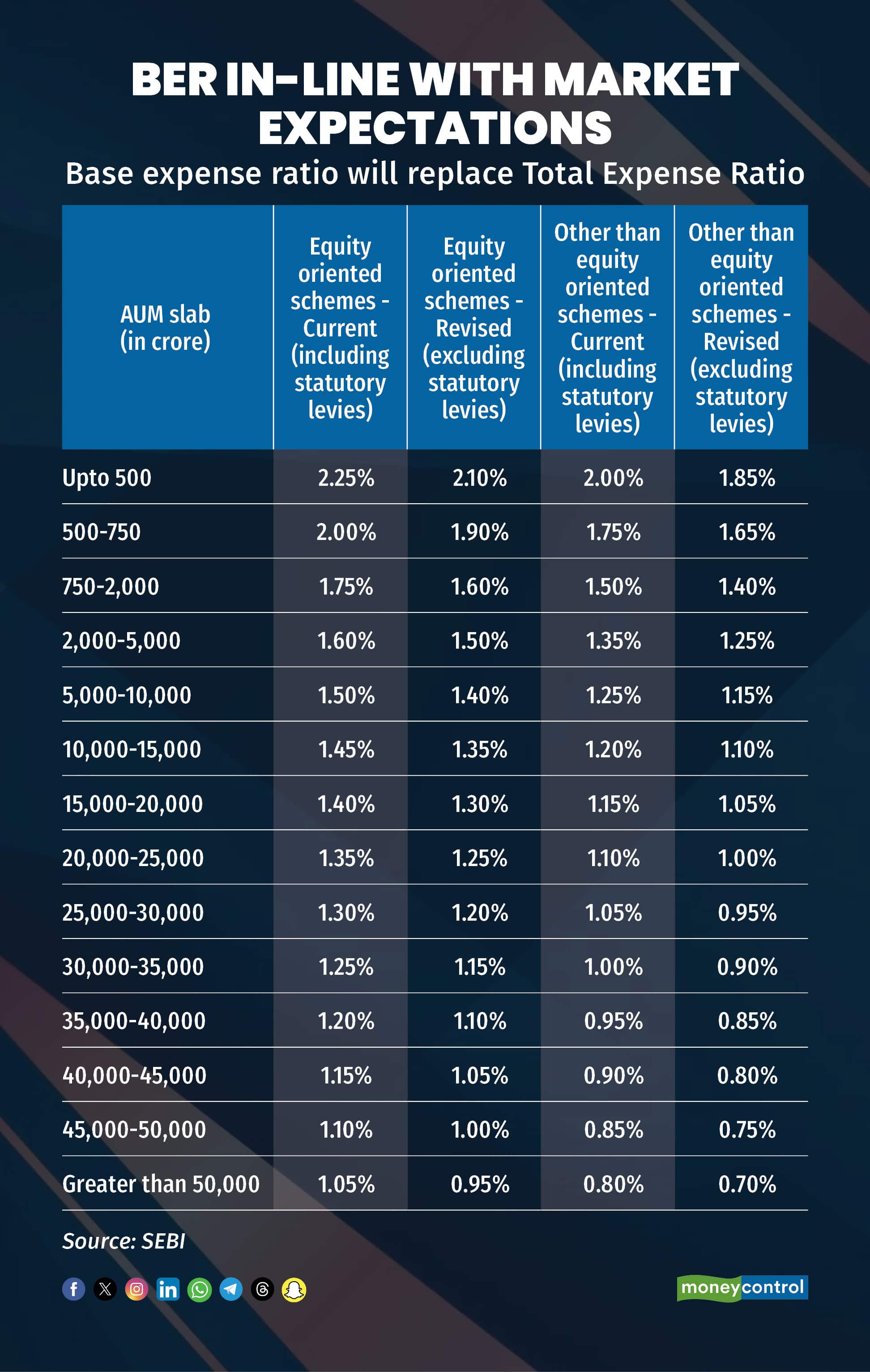
Under the revised framework, the maximum expense ratio for open-ended equity schemes with assets below Rs 500 crore has been reduced from 2.25% to 2.10%, while the ceiling for debt schemes in the same AUM bracket has been lowered from 2.00% to 1.85%. Overall, active equity funds will now operate within an expense ratio range of 0.95% to 2.10%, while fixed income funds will be capped between 0.70% and 1.85%, depending on AUM size. For schemes managing more than Rs 50,000 crore, the cap will be 0.95% for equity schemes and 0.70% for debt schemes.
BER in focus now
A key change is the replacement of the Total Expense Ratio (TER) with the Base Expense Ratio (BER). SEBI has kept external levies such as GST, stamp duty, Securities Transaction Tax (STT), Commodity Transaction Tax (CTT), and other statutory charges outside the BER. As a result, the BER will now only include fund-level costs such as management fees, distribution brokerage and RTA charges, with taxes disclosed separately.
The final framework reflects moderation from what was proposed in the consultation paper. For equity-oriented schemes, the paper had proposed lowering the base expense ratio on the first Rs 500 crore of daily net assets from 2.25% to 2.10% which was retained. Similarly, on the next Rs 250 crore, the limits were largely retained. For higher slabs, the consultation paper had proposed specific reductions: 1.60% on the next Rs 1,250 crore, 1.45% on the next Rs 3,000 crore, and 1.35% on the next Rs 5,000 crore of daily net assets.
Beyond Rs 40,000 crore, it suggested a step-down mechanism with a 0.05% reduction for every additional Rs 5,000 crore. On balance assets, the proposed caps were 1.05% for equity schemes and 0.70% for non-equity schemes. In the final framework, SEBI has moderated these reductions, resulting in a roughly 10 basis points cut across most AUM slabs, instead of the steeper, progressive cuts proposed in the consultation paper, which was around 15 bps.
This calibrated outcome comes against the backdrop of industry feedback. Moneycontrol had reported that brokerages met SEBI during the consultation phase to present their case for maintaining the status quo and raised concerns around the proposed mutual fund expense and brokerage changes.
Industry participants noted that the removal of exit-load-related charges and the rationalisation of expense cuts reflect a consultative approach. DP Singh, Joint MD & CEO at SBI Mutual Fund said the exit load has been taken away in line with what was envisaged in the consultation paper, while the originally proposed reduction of around 15 bps across slabs has, after deliberations, been rationalised to about 10 bps beyond the initial grades, partly offsetting the impact on fund houses.
“Overall, there are some slab-level changes in the base expense ratio, with taxes kept outside, so it’s not materially significant for fund houses, but brings in lot of transparency and clarity for all stake holders. We are thankful to regulators for the same,” he said.
Brokerage cap changes
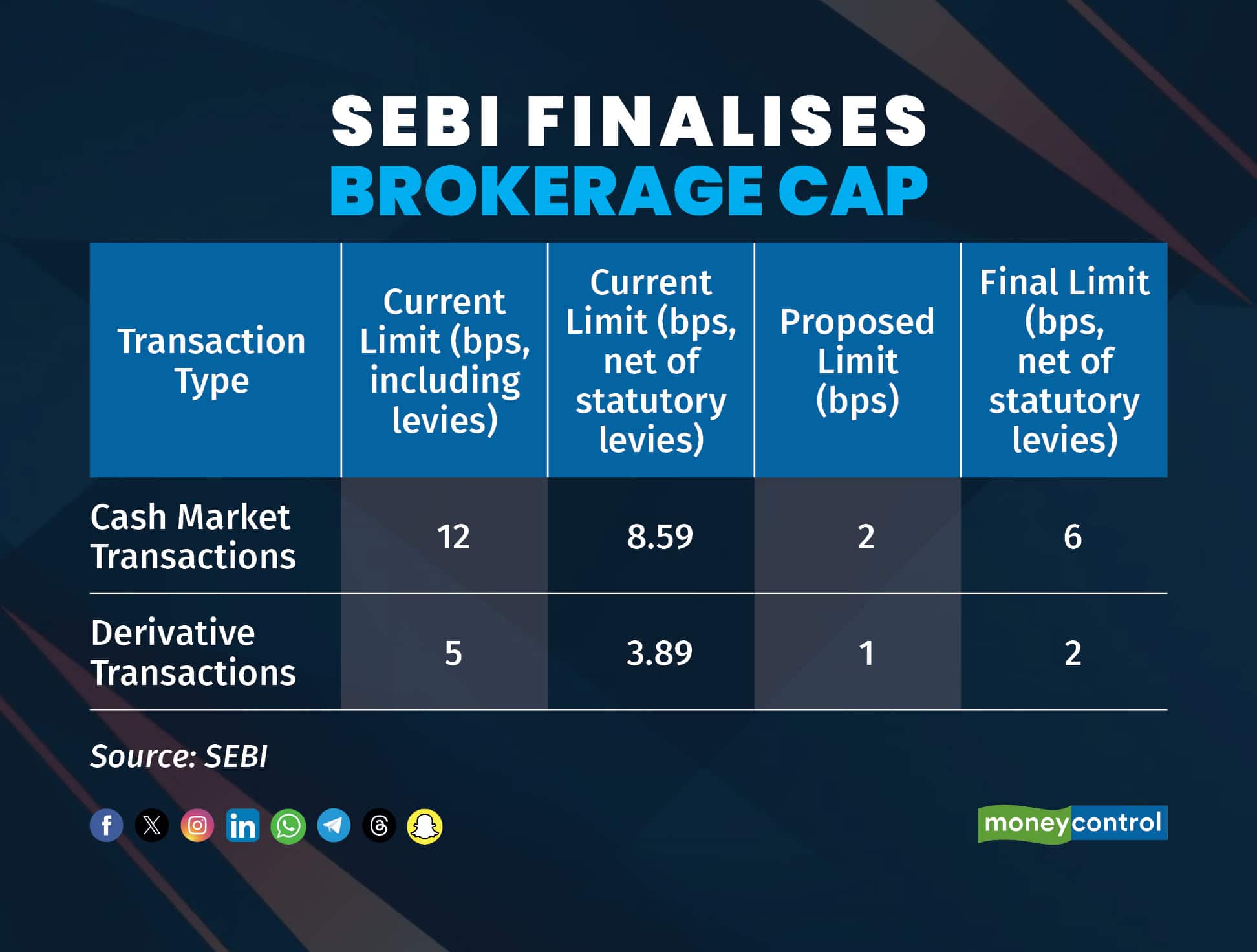
SEBI has also recalibrated brokerage caps. For cash market transactions, the existing brokerage cap of 12 bps, which included statutory levies and translated to 8.59 bps net of levies, has now been reduced to 6 bps, exclusive of levies ( the consultation paper suggested 2 bps). For derivative transactions, the earlier cap of 5 bps, inclusive of statutory levies and amounting to 3.89 bps net of levies, has been reduced to 2 bps (the consultation paper suggested 1 bps), exclusive of levies.
In addition, the regulator has reduced the BER for passive products such as index funds and ETFs from 1% to 0.90%. Close-ended equity funds will now be capped at 1%, while close-ended debt funds can charge up to 0.80%. For funds of funds, the limits have been set at 0.90% for index FoFs, 2.10% for equity FoFs and 1.85% for other FoFs. AMCs will also no longer be allowed to charge an additional 5 bps in lieu of exit loads.
Singh also welcomed these brokerage changes, noting that the final decision has been rationalised after discussions and aligns well with prevailing market rates. Neil Parag Parikh, Chairman and CEO, PPFAS Mutual Fund added that as a fund house they are already well within the limit. "hence there would be no such impact on us," he said.
Beyond expenses, SEBI has asked AMCs to reorganise and clearly define the roles and responsibilities of trustees and asset managers, removed the requirement to publish scheme changes in newspapers (subject to website disclosures), discontinued real estate mutual fund regulations due to lack of launches, and allowed annual reports and abridged summaries to be sent digitally.
Discover the latest Business News, Sensex, and Nifty updates. Obtain Personal Finance insights, tax queries, and expert opinions on Moneycontrol or download the Moneycontrol App to stay updated!
Find the best of Al News in one place, specially curated for you every weekend.
Stay on top of the latest tech trends and biggest startup news.