In a recent interview at the Bloomberg Invest New York conference, Druckenmiller, AKA “The Druck” stated that the US economy is still trying to adjust to a more restrictive climate after more than a decade of low interest rates and essentially free money. The markets veteran said that Dogecoin (DOGE), which had more than an $80 billion market cap during its rally of 2021, is a perfect example of the irrational behaviour of traders during an asset bubble.
“There’s a five-hundred-year history of asset bubbles, [it’s] well documented, and well, the US has some issues with [it] at the present time. Basically, it documents – and I had already known this about the last one hundred years but it’s going out five hundred years – every time you’ve had a significant asset bubble, economic trouble lay ahead. When you had 11 years of free money, people do stupid things. All you have to do is look [at how] someone paid $80 billion for Dogecoin, which was invented as a joke. I mean, that can only happen in the world of free money…”
Also Read: Looming US debt crisis is in a late-stage big cycle, ace investor Ray Dalio says
With the credit cycle now well into a phase of contraction, Druckenmiller says the pricier cost of capital is starting to manifest with bankruptcies and weakness in the banking system. He predicts “more shoes to drop” and hints at further corrections in risk assets after the recent collapse of Silicon Valley Bank.
Already the US Federal Reserve is facing an unprecedented situation of trying to avert a credit crunch in the economy and simultaneously keeping inflation in check. The first problem requires lowering interest rates and the fix to the second problem is raising rates or keeping them at the current elevated levels.
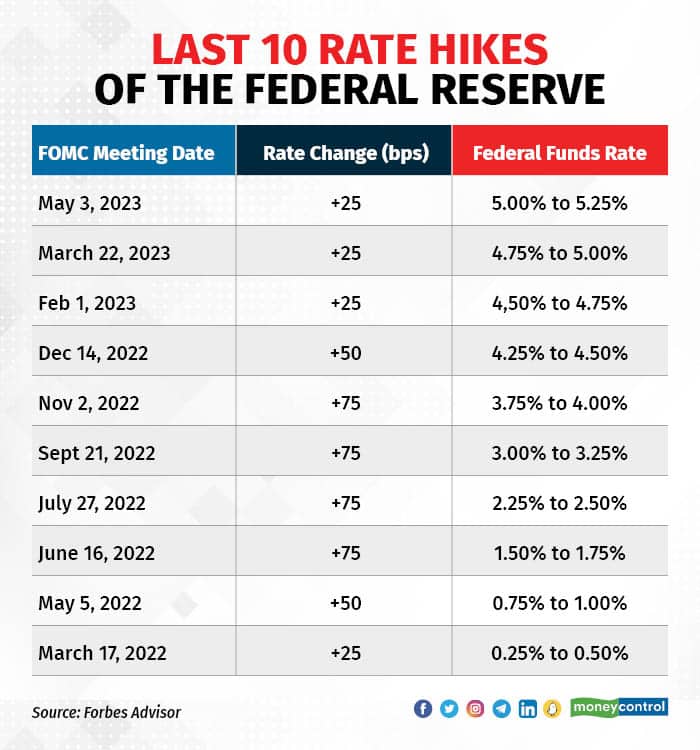 Last ten rate hikes of the federal reserve
“This was arguably the most disruptive economic period we’ve had since the late 1800s and there were no bankruptcies, apparently they’ve started in the last few weeks, tells me there’s a lot of stuff under the hood. When you go from this kind of environment, the biggest, broadest asset bubble ever, and then you jack rates up 500 basis points in a year, I think the probabilities would suggest that Silicon Valley Bank, Bed, Bath and Beyond, they’re probably the tip of the iceberg. Nothing’s guaranteed. I’ve been wrong a lot; I’ve been right a few times. But our central case is there are more shoes to drop, particularly in addition to the asset markets economically.”
Key Concerns of DruckenmillerOne of the key concerns Druckenmiller expressed was the combination of excessive money printing, soaring debt levels, and the potential for an inflationary spiral. He stressed the need to comprehend the intricate interplay of these factors, stating, "The combination of excessive money printing, unsustainable debt levels, and a potential inflationary spiral creates a volatile cocktail."
In particular, Druckenmiller emphasized the potential repercussions of inflation, cautioning, "Inflation is a real threat that cannot be ignored. The current stimulus measures could fuel inflationary pressures, eroding the purchasing power of consumers and undermining the value of investments."
Also Read: Economist and gold bug Peter Schiff sounds alarm on impending US dollar crisis
Essential for ‘investors to remain nimble’ in times of uncertaintyDruckenmiller stressed the importance of adaptability and flexibility in investing. He advised, "In times of uncertainty, it is essential to remain nimble. Investors should constantly reassess their portfolios and make necessary adjustments to mitigate risks and seize opportunities." This underscores the need for investors to stay vigilant, continually evaluating their investment choices in light of changing market conditions.
Future outlook of DruckenmillerDruckenmiller is not all gloom though. "Despite the challenges we face, there are opportunities for those who can navigate wisely and identify pockets of growth and innovation," he said.
Who is Stanley Druckenmiller?Stanley Freeman Druckenmiller (born June 14, 1953) is an American investor, hedge fund manager and philanthropist. He is the former chairman and president of Duquesne Capital, which he founded in 1981. He closed the fund in August 2010. At the time of closing, Duquesne Capital had over $12 billion in assets. From 1988 to 2000, he managed money for George Soros as the lead portfolio manager for Quantum Fund. He is reported to have made $260 million in 2008.
Discover the latest Business News, Sensex, and Nifty updates. Obtain Personal Finance insights, tax queries, and expert opinions on Moneycontrol or download the Moneycontrol App to stay updated!
Find the best of Al News in one place, specially curated for you every weekend.
Stay on top of the latest tech trends and biggest startup news.