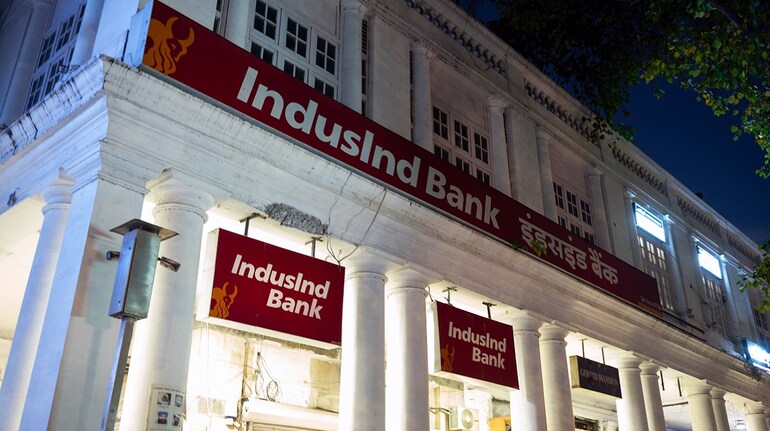
Shares of IndusInd Bank, battered lower by nearly 30% after accounting discrepancies were reported, have been put under short term Additional Surveillance Measure (ASM) - Stage 1, as per a notice by National Stock Exchange on March 13.
The decision to enhance regulatory scrutiny is initiated by the stock exchanges to safeguard the interests of investors. The framework of Stage 1 ASM is used by stock exchanges to monitor and check unusual price movements or volatility in share prices of a particular company. Once a stock is placed under ASM Stage 1, investors are required to provide 100 percent margin requirement for trade, and the shares are kept under heightened scrutiny. This means, for securities under short-term Additional Surveillance Measure (ASM) Stage 1, up to 100% of the traded value will get blocked as margin requirement.
The main objective of this move is to alert and advice investors to be extra cautious in dealing in the security. NSE's move acts as an advise to market participants to carry out necessary due diligence while dealing in these securities. Stocks under the ASM category are not allowed to be pledged.
The shares of IndusInd Bank have had a rough past few days, figuring in the list of top losers on Nifty this week, after falling more than 30 percent this week.
Separately, HDFC Mutual Fund has informed on March 13 that the aggregate holdings of schemes in Indusind Bank as on March 11, 2025 was 5.02% of the paid up share capital of the company.
IndusInd Bank is facing severe challenges threatening its governance and operations after reporting accounting discrepancies in its currency derivatives, which leading to a one-time financial hit of around Rs 1,600 crore, or 2.35% of its net worth.
The development triggered a severe reaction in the stock market with the share clocking its biggest fall ever, prompting promoter Ashok Hinduja to come out and assure investors that it is firmly behind the lender will infuse capital if needed. CEO Sumant Kathpalia assured that the bank will see profit during Q4FY25 despite the hit arising out of the discrepancies.
This issue has raised concerns about the effectiveness of the bank's internal controls and risk management practices.
The Reserve Bank of India has granted CEO Sumant Kathpalia only a one-year extension, instead of the conventional approval for a three-year term, a decision that has led to uncertainties regarding the stability at the bank. The central bank has told the board of crisis-hit IndusInd Bank to look for external candidates for the post of COO and CEO, according to a news report.
Consequently, the RBI is also scrutinizing derivatives exposures of other banks too, in order to assess the broader implications on the banking sector.
Discover the latest Business News, Sensex, and Nifty updates. Obtain Personal Finance insights, tax queries, and expert opinions on Moneycontrol or download the Moneycontrol App to stay updated!
Find the best of Al News in one place, specially curated for you every weekend.
Stay on top of the latest tech trends and biggest startup news.