China signalled more public borrowing and spending in 2025 with a shift of policy focus to consumption, in an effort to repair the economy’s weak link as looming US tariffs threaten exports.
Top officials led by President Xi Jinping vowed to raise the fiscal deficit target next year in an announcement made following a two-day huddle of the Central Economic Work Conference in Beijing, according to the state-run Xinhua News Agency. For only the second time in at least a decade, they made “lifting consumption vigorously” and stimulating overall domestic demand their top priority.
Chinese officials also vowed to strengthen the social safety net with broad promises to bolster health care and pensions. Those initiatives have long been advocated by economists as the population ages, and households squirrel away savings to cover fees in case of a medical emergency.
While the tone of the meeting was very supportive of growth, it lacked concrete details on policies, said Larry Hu, head of China economics at Macquarie Group Ltd.
“I don’t think the government will hand out money to consumers directly,” he added. “It’s more likely the government will be spending more. China will leverage up the central government and increase public spending, so that overall demand can be lifted. That’s the big strategy.”
Chinese stock futures fell, with contracts on the Hang Seng China Enterprises Index down more than 1% overnight. The Nasdaq Golden Dragon China Index gained 0.2% in US trading, while the offshore yuan was little changed on Friday, trading just under 7.28 per dollar.
The work conference traditionally only offers broad strokes of policy focus and direction without revealing much details. Specifics such as the growth target or the government’s budget will only be unveiled in March during the annual legislative sessions. Concrete steps are more likely to be introduced by relevant ministries.
Thrifty Population
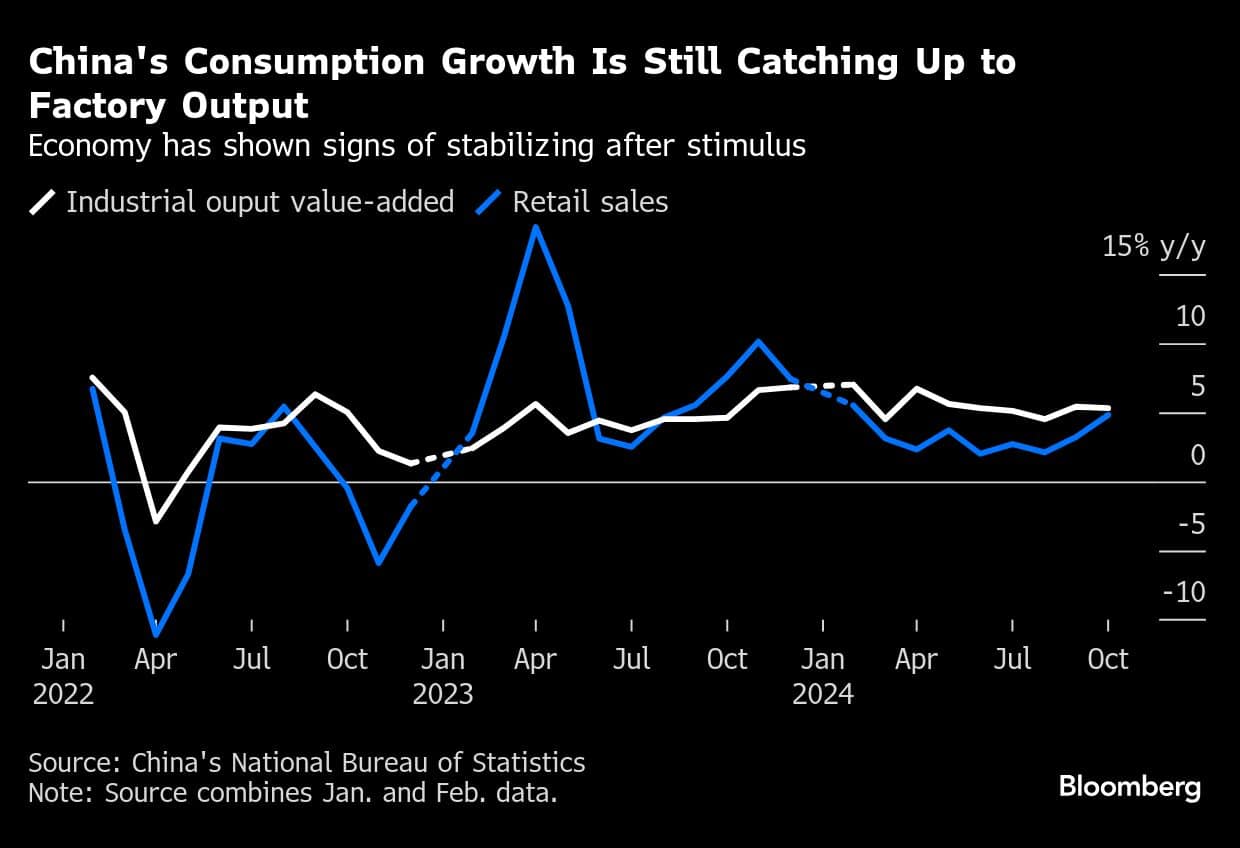
Consumer spending growth has lagged industrial production since the pandemic. While an increase in overseas orders for Chinese goods helped to offset the domestic drag, Beijing now faces a pushback from countries worried over the impact of a flood of cheap exports.
Senior US economic officials including Janet Yellen have repeatedly called on China to step up support for domestic consumption, arguing the government’s unfair subsidies for producers have led to overcapacity.
There are signs officials are starting to heed such appeals. Earlier on Thursday, Chinese shares related to consumption surged on hopes for more policy details on boosting domestic demand from the meeting. Major cities including Shanghai and Beijing are launching a new round of voucher programs to encourage local consumption before the holidays, also lifting sentiment.
So far policymakers have largely kept investors guessing on the scale and specifics of their plans. Officials have resisted proposals from economists to hand out cash to consumers in recent years, with Xi warning against falling into a trap of “welfarism” or “feeding lazy people.”
Analysts see an expansion of government subsidies for purchases of consumer goods, as well as targeted aid for families and vulnerable groups, as more likely options for next year.
Highlights of plans to support consumption:
-Help mid- and low-income groups raise earnings and ease burdens; enhance their ability and willingness to spend
-“Appropriately” raise basic pension payouts for retirees
-Increase government subsidies for the public healthcare insurance
China’s economic outlook for next year and beyond is increasingly uncertain, even though the work conference reaffirmed that it’s on track to hit the official growth target of “around 5%” this year. Many economists expect the government to set a similar goal for next year.
The threat of a new trade war with the US after the reelection of Donald Trump means exports will probably stop being a major growth driver after contributing to nearly a quarter of economic expansion this year.
“The adverse impact from a changing external environment is deepening, and China’s economy still faces a number of difficulties and challenges,” Xinhua reported from the meeting.
What Bloomberg Economics Says...
“Policy in 2025 will pivot to add support for the economy. The signals reinforce our view on the outlook for next year. That is, growth still looks set to slow, with stimulus providing a cushion.”
— Chang Shu, David Qu and Eric Zhu.
Domestic challenges are also piling up. Consumer and business confidence remains sluggish, contributing to persistent deflation. Prices across the economy have been falling for six straight quarters, the longest streak this century. A prolonged housing downturn shows no sign of bottoming out.
Officials at the work conference made a rare — albeit indirect — acknowledgment of the prolonged deflation plaguing China, vowing to “ensure the overall stability of employment and prices.” They also highlighted a wish to ensure that income growth among residents is in line with the pace of economic expansion, a key challenge constraining consumption amid widespread salary cuts and layoffs over the last few years.
Lian Ping, an economist at Guangkai Chief Industry Research Institute, wrote in Xinhua Finance that Beijing may raise the budget deficit ratio to 4% to 4.5% of gross domestic product next year. This compares with other forecasts for about 4%, in a decisive break with a longtime practice of capping it at 3% in the past.
Alongside a higher budget deficit, China will also increase next year’s issuance of ultra-long special treasury bonds, some of which were used to subsidize consumer purchases starting from this year. It’s also set to offer more local government special notes, an important source for infrastructure investment funding.
The meeting on Thursday mentioned the country will additionally come up with policies to promote childbirth but provided no details. Economists have called on the government to hand out cash to families with children and to provide greater tax benefits after the nation’s fertility rate plunged in recent years.
Various cities have rolled out local subsidies but there has been few nationwide incentives offered to have more children.

The meeting largely confirmed a commitment made at the December huddle of the decision-making Politburo earlier this week to pump more stimulus into the economy. That included shifting China’s monetary policy stance for the first time in 14 years to a “moderately loose” strategy.
Policymakers will deliver cuts to interest rates and the reserve requirement ratio for banks “at an appropriate time,” according to the work conference. That’s the first mention of such specific policy tools in at least a decade, underlining an unusually direct style of language that indicates urgency to boost confidence.
“Top leaders are now prioritizing boosting consumption and investment in 2025, shifting focus from the industrial upgrading and innovation that dominated the communique for 2024,” said Bruce Pang, chief economist for Greater China at Jones Lang LaSalle Inc. That “pivot underscores the pressing need to enhance domestic demand to better navigate external uncertainties.”
The meeting didn’t provide details on the possible timing of further monetary easing. Officials also repeated their usual pledge to keep the yuan “basically stable,” likely signaling the central bank will make an effort to slow depreciation of the Chinese currency as it loosens monetary policy.
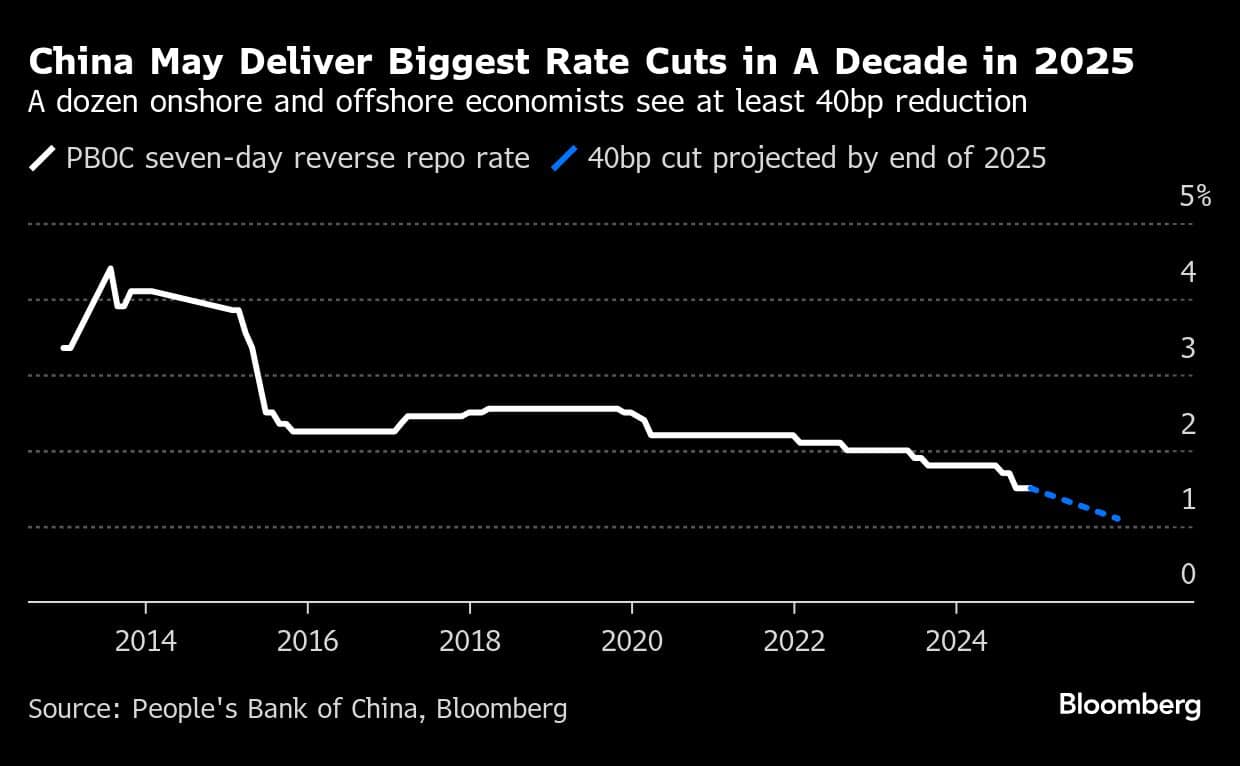
Economists had been anticipating a cut to the RRR — which will free up money for banks to lend and invest — by the end of this year, as signaled by the central bank earlier. Forecasts generally see rate cuts as early as next year.
Some expect the People’s Bank of China to make the deepest rate cuts in a decade with at least 40 basis points of reduction, a cycle that risks putting pressure on the yuan to depreciate
“I take the messages from this conference and the Politburo meeting positively,” said Zhiwei Zhang, President at Pinpoint Asset Management. “The shift of policy this week is clearly more significant than what took place in the last week of September.”
Discover the latest Business News, Sensex, and Nifty updates. Obtain Personal Finance insights, tax queries, and expert opinions on Moneycontrol or download the Moneycontrol App to stay updated!
Find the best of Al News in one place, specially curated for you every weekend.
Stay on top of the latest tech trends and biggest startup news.