




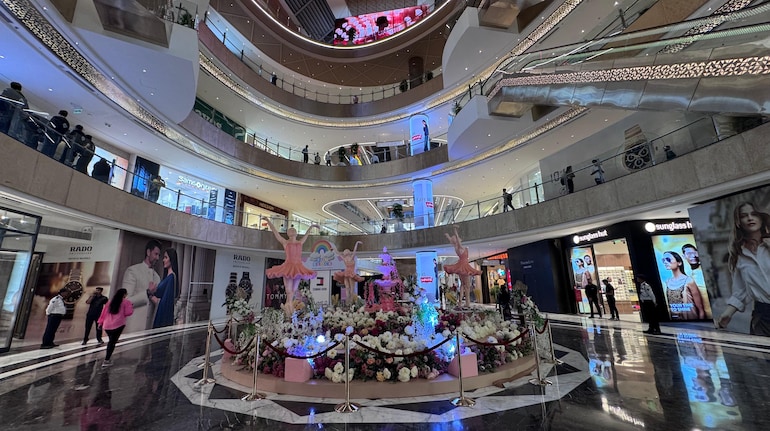
Blackstone-backed shopping mall operator Nexus Select Trust said that despite continuing global economic uncertainty, discretionary spending driven by the festive season remained on a strong footing this year. According to the management, the growth in sales across its portfolio, both during the festive season and during the July-September quarter.
Rajesh Deo, chief financial officer of the real estate investment trust (REIT), said that besides an increase in footfall, the trust has also seen an increase in spends per customer, at a time when urban consumption remains sluggish.
"The festive trading period this year was very encouraging, with tenant sales across our portfolio growing 13 percent year-on-year. In Q2 specifically, we recorded 16 percent year-on-year growth, reflecting broad-based consumption across categories. This growth is not merely footfall-driven; we are seeing double-digit growth in spends per footfalls suggesting that consumption is both volume- and value-accretive," Deo said, in an interaction with Moneycontrol.
Deo added that while malls in the larger cities, such as Mumbai, Chandigarh, Bengaluru, and Delhi are showing "high single digit" growth, the same for malls in Tier-II cities such as Ludhiana, Mysuru, and Mangaluru were in double-digits, with growth across categories such as fashion, jewellery, electronics, and entertainment.
In fashion, Deo added that both the value and premium segments have shown growth, at a time when premiumisation is the name of the game for retailers in malls and high streets. Retailers in the value segments, however, are increasing throughput by focusing on larger stores, as well as fashion accessories.
"Value fashion continues to expand through increased penetration and larger store formats. They are allocating up to 20% of store space to beauty products and newer brands like OWND by Pantaloons wanting more space. Fashion brands are looking for larger stores in Tier 1 cities with count expansion being planned in Tier 2 markets," Deo said. He added that jewellery brands, as well as those in the beauty category, such as Nykaa and Tira, continue to do well, including in the festive season.
Even as most categories showed improvement in the consumer spending category, quick-service restaurants (QSR) continue to face pressure in terms of revenue, with efforts to provide "value" offerings and price wars impacting balance sheets. Devyani International, the operator of the KFC and Pizza Hut chains in India, posted a net loss for Q2, under pressure from local restaurants, cloud kitchens, and food delivery apps such as Zomato and Swiggy.
In the face of declining demand, Deo said that QSR operators are now consolidating outlets under Grade-A malls, to improve productivity. Also evolving, Deo added, are the formats of QSR outlets, with more casual dining experiences than just being order-and-go formats.
"We are seeing strategic optimisation rather than contraction. Some QSR operators are consolidating smaller or underperforming outlets largely on the high streets and Grade B/ C malls into larger flagship formats within high-performing Grade A malls, which improves tenant productivity per square foot. We are also seeing a gradual evolution in formats, operators are experimenting with hybrid dining models, combining QSR with café or casual dining experiences, which helps capture multiple consumption occasions and enhances dwell time," said Deo.
Nexus, which owns 19 malls across 15 cities, is exploring further additions to the portfolio, Deo added, with a pipeline of ten potential assets. He informed that of the ten, three are undergoing due diligence. Assets from the sponsors Blackstone, such as the South City Mall in Kolkata, are expected to be added to the Nexus portfolio as well.
Discover the latest Business News, Sensex, and Nifty updates. Obtain Personal Finance insights, tax queries, and expert opinions on Moneycontrol or download the Moneycontrol App to stay updated!

Find the best of Al News in one place, specially curated for you every weekend.
Stay on top of the latest tech trends and biggest startup news.




