Kerala and Punjab, two states that run some of India’s largest lottery systems, are staring at fiscal uncertainty with the government’s goods and services tax (GST) rationalisation proposal. The proposal to increase lotteries to a 40 percent rate would disadvantage many such schemes.
For Kerala, which accounts for nearly 97 percent of the total lottery revenues in the country, the shift would be significant. The state, currently taxing its state lotteries at 28 percent, could see the rate climb to 40 percent if the reform goes through.
“A jump to 40 percent would be fiscally unsustainable,” said Saurabh Agarwal, Tax Partner at EY. Kerala had budgeted over Rs 14,000 crore in revenue from state lotteries for FY26, highlighting the scale of potential disruption.
Punjab, another key lottery state, faces a similar risk. While its revenues are far smaller than Kerala’s, the state has recorded one of the fastest increases in collections. A Moneycontrol analysis shows that Punjab’s lottery revenues have surged nearly fourfold in the past decade, making it increasingly reliant on the sector.
Lottery revenues account for 2 percent of non-tax revenues for Punjab and 0.7 percent for Kerala.
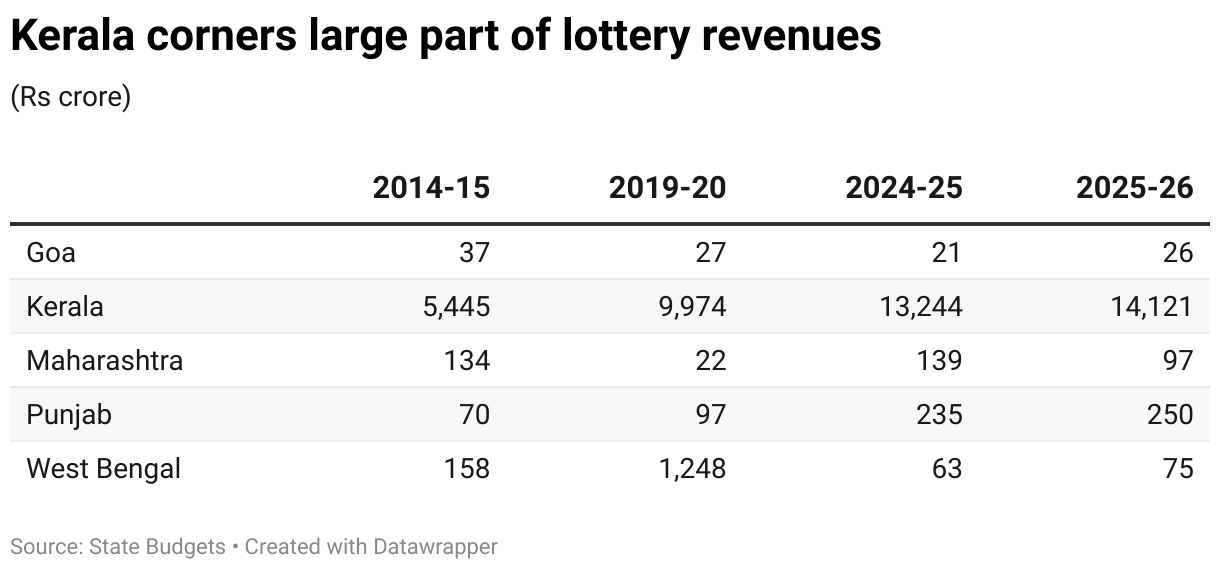
Over the past decade, lottery revenues of India’s five largest states have nearly tripled. Kerala remains the dominant player, with receipts rising from Rs 5,445 crore in 2014–15 to over Rs 14,100 crore projected for 2025–26. Punjab’s revenues rose from just Rs 70 crore in 2014–15 to Rs 250 crore in 2025–26, while West Bengal posted a modest increase to Rs 75 crore. Maharashtra, however, has seen volatile trends, with receipts falling to under Rs 100 crore in recent years. Goa’s revenues remain small, projected at about Rs 26 crore in FY26.
“There are reports of a proposal to increase the rate to 40 percent, with certain States commissioning a study on the revenue impact of such a change. Ultimately, the GST Council will take a call on the tax front, but it must be noted that lotteries are not demand-driven goods and consumption remains largely unaffected by rate changes,” Brijesh Kothary, partner, Khaitan & Co.
Moreover, this would mark the second increase in lottery revenues for the state-run lottery system. While the earlier system had envisaged a lower 12 percent rate for state-run lotteries, private or state-authorised lotteries faced a 28 percent GST. A uniform 28 percent rate was introduced after the 38th GST council meeting removed the distinction between the two.
Online real-money gaming under pressure too
The tax overhaul is not limited to lotteries. The online real-gaming industry, already taxed at 28 percent, could also face a sharp escalation if the rates rise to 40 percent.
“The online gaming industry's growth could be stunted by an excessive tax burden. The industry is poised for growth and innovation, but this requires a tax environment that is predictable and fair,” Gupta added.
UPI data released earlier this month showed that gaming transactions, which includes online real-money gaming, were a major category in June, with users spending Rs 10,000 crore in July. Games accounted for 1.4 percent of total UPI transactions and nearly 3 percent of top-category volumes.
Discover the latest Business News, Sensex, and Nifty updates. Obtain Personal Finance insights, tax queries, and expert opinions on Moneycontrol or download the Moneycontrol App to stay updated!
Find the best of Al News in one place, specially curated for you every weekend.
Stay on top of the latest tech trends and biggest startup news.