How has the composition of the food plate changed in India over the years? Specifically, what are Indians eating more now, on a relative basis, as compared to two decades ago? How has this trend changed over the years? Importantly, what do Indians eat?
The Household Consumption and Expenditure Survey 2022-23, (HCES) has thrown up some very interesting data that will enable more focussed policymaking.
Sample this.
Of every Rs 100 that a rural household spends, Rs 46.38 is spent on food. This has fallen from Rs 59.40 in 1999-2000, to Rs 53.11 in 2004-05, grew again to Rs 56.98 in 2009-10, fell to Rs 52.90 in 2011-12 and further to Rs 46.38 in 2022-23.
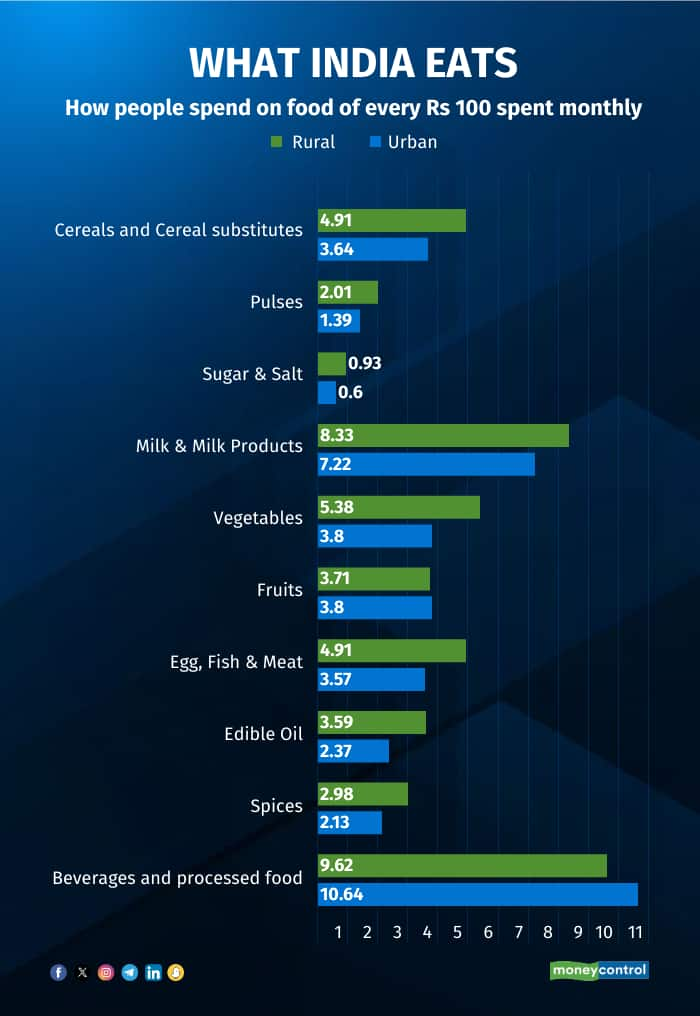
The spend pattern on the platter mix has also undergone a significant change. Rural households, on an average, now spend 4.89 per cent of their total spending on cereals, 0.02 on cereal substitutes, 0.24 on gram, 1.77 on pulses, 0.93 on sugar and salt, 8.33 on milk and milk products, 5.38 on vegetables, 2.54 on fresh fruits, 1.17 on dry fruits, 4.91 on eggs, meat and fish, 3.59 on edible oil, 2.98 on spices, and 9.62 on beverages and processed foods.
Urban household spending broadly mirrors similar trends. They now spend, on an average, 3.62 per cent on cereals, 0.02 per cent on cereal substitutes, 0.18 on gram, 1.21 on pulses, 0.60 on sugar and salt, 7.22 on milk and milk products, 3.80 on vegetables, 2.50 on fresh fruits, 1.31 on dry fruits, 3.57 on egg, fish and meat, 2.37 on edible oil, 2.13 on spices, and 10.64 per cent on beverages and processed foods.
Such families spend, on an average, 39.17 per cent of their total spending on food items.
A few pieces of statistics stand out in the comparison of rural and urban households on their food spends.
One, rural households, on a proportional basis, spend significantly more on milk, pulses, egg, meat and fish, compared to their urban counterparts. This, broadly, could be symptomatic of a better affordability towards buying more nutritious and protein-rich foods.
Two, rural households now spend nearly as much, on a relative basis, as their urban equivalents on beverage and processed foods. A household in a village spends nearly a tenth (9.62 per cent) of their total spending on such items. This has sharply jumped from 4.91 per cent in 1999-2000 and 7.90 per cent in 2011-12. This could be a sign of better affordability too.
Their spending on these kinds of food items is barely a percentage point lower than what urban households spend (10.64 per cent), which has also grown from 6.35 per cent in 1999-2000 to 8.98 per cent in 2011-12.
Discover the latest Business News, Sensex, and Nifty updates. Obtain Personal Finance insights, tax queries, and expert opinions on Moneycontrol or download the Moneycontrol App to stay updated!
Find the best of Al News in one place, specially curated for you every weekend.
Stay on top of the latest tech trends and biggest startup news.