A section of textile exporters is exploring ways to reach the American markets by reducing the Make-in-India component in their products and shifting production to neighbouring countries that have been levied significantly lower tariffs, such as Sri Lanka and Bangladesh.
“By reorienting production strategies, some exporters are looking at Bangladesh and Sri Lanka to tackle Trump’s tariffs. This means redirecting US-bound exports via these countries, as they benefit from lower tariffs and therefore can be used as a base for exports to America,” one member of a textile association said on condition of anonymity.
While the United States has imposed a 50 percent tariff on most Indian goods, doubling the levy from August 27, Sri Lanka and Bangladesh face lower duties at 20 percent.
“This will mean shipping mostly raw materials to India’s neighbours in a bid to ensure the flow of textile exports to the US,” the person cited above said.
“With new orders to the US becoming unviable at the present tariff rates applicable to India, some exporters are working on reorientation strategies to new markets, domestic markets or some changes in supply chain that can help in reducing the tariff incidence on the goods exported to the US. This may include considering production in one of the neighbouring countries which has lower tariffs for US-bound exports,” Chandrima Chatterjee, Secretary General of the Confederation of Indian Textile Industry (CITI) said.
However, only financially well-off exporters will able to embark on this strategy, given the costs associated with shifting production to raw materials from ready-made garments. Yet, they may still face the risk of penalties associated with transshipping of goods.
Kumar Duraiswamy, joint secretary of the Tiruppur Exporters Association - India’s largest knitwear hub - points out that reorienting exports is not an easy task.
“Only a small margin of financially well-off textile exporters may be able to reorient shipments to the US through Bangladesh or Sri Lanka. Given that most in this sector are MSMEs, they would not have the margins to reorient exports,” Duraiswamy said.
He further explained that the practice of exporting to the US through other nations risks additional levies due to transshipment - or routing goods through a third country - often with minimal processing to evade higher tariffs.
“Any transshipment could face additional transshipment tariffs if a certain percentage of the garment isn't produced in the originating country. Now if Only CMT (Cut, Make, Trim, and Packing) is say done in Sri Lanka that’s a value-addition of only 10-15 percent, and therefore may attract transshipment tax,” Duraiswamy added.
Though not explicitly stated if individual nations will face additional duties on transshipped goods, a White House executive order from July 31 by puts the rate at 40 percent.
Past president of the Clothing Manufacturers Association of India (CMAI), Rahul Mehta too said that rerouting of Indian textiles through third countries comes with the risk of penalties, unless one entirely shifts to producing raw materials, instead of garments.
“Officially, it will be very, very difficult because there are fairly strict rules of origin in place. And, no one wants to take the chance of risking transshipment levies. One possibility is, you can convert your business into raw materials rather than garments. The big ones can set up such a system. But it is a long-term strategy and given the uncertainty of the US administration’s behaviour, if they see an influx of goods coming in through a third country, there could be more penalties. There are also additional costs in reducing the make-in-India component and rerouting goods through third countries,” Mehta said.
Textile exports worth as much as $11 billion to the US are facing a near embargo after President Trump’s punitive duties on India.
Read More: “At 50%, it can’t go on”: Trump’s punitive tariffs put Indian textile exports and jobs at risk
Almost 28 percent of India's textile and apparel exports go to the US, accounting for nearly 2 percent of the country's GDP. Above all, it is one of the biggest source of jobs and livelihoods here.
In fact, ahead of steeper tariffs, Indian textile and apparel exporters rushed shipments to the US, taking the shipment to the US higher by 9.1 percent on year in July 2025, and up 12 percent on a sequential basis, as per the Office of Textiles and Apparel (OTEXA), part of the US International Trade Administration.
Alternate Markets
India’s textile exporters are also looking to offset the steep Trump tariffs by shipping some of their goods to other markets including the United Kingdom and Europe.
While with the United Kingdom, Indian textiles will enjoy zero-tariff entry once the trade agreement is in effect, potentially by the end of the year, with Europe, exporters are hoping for support from the government to expedite shipments.
“We can increase textile exports to Europe, if the government announces measures to subsume the cost differential of 10 percent versus Bangladesh. Cost of Indian garments are around 10 percent higher than Bangladesh for European clients. If that is addressed, we can take more orders from Europe. It will however take at least six months to a year to take the volume of US business elsewhere,” Duraiswamy said.
India is also negotiating a trade agreement with the European Union, which is expected to be signed by the end of 2025.
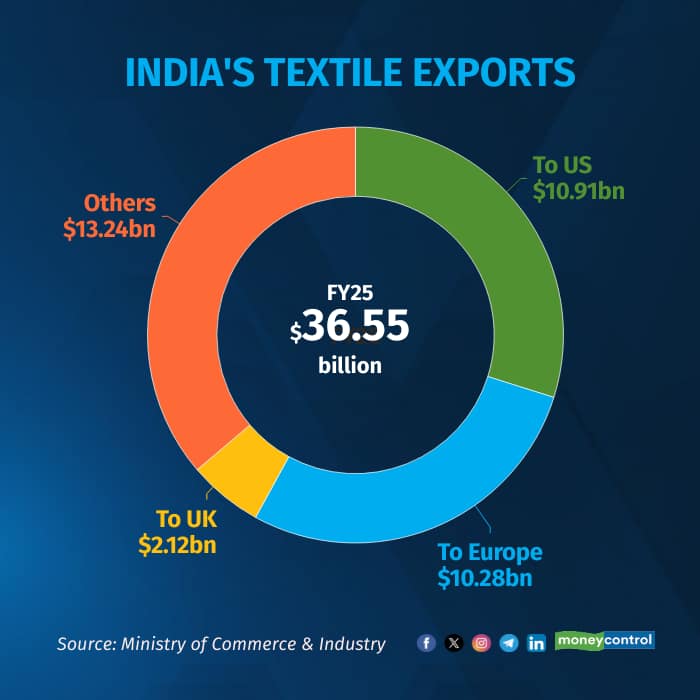
The value of total exports in the textile category - including ready-made garments - stood at $36.55 billion in FY25, out of which $10.91 billion were shipped to the US, $10.28 billion to Europe, and $2.12 billion to the UK.
The reforms in goods and services tax, especially around reducing compliances for Micro, Small and Medium Enterprises (MSMEs) too are expected to help lower the burden of costs for textile exporters and partially ease the burden of steeper tariffs.
SC Ralhan President, FIEO said that the GST Council’s decision to release export refunds within seven days based on risk analysis, along with provisional refunds under the inverted duty structure for sectors such as textiles will reduce working capital blockages and provide timely relief to exporters. Read More
“Compliances are costly for MSMEs. The procedural simplification under GST 2.0 means less blockages in input tax credit as also time saving on compliance processes. This may hopefully help exporters indirectly through lower cost of working capital and less time spent on procedural compliances,” CITI’s Chatterjee said.
However, Duraiswamy has cautioned that reorienting exports will not entirely compensate the impact of steeper tariffs imposed by the largest importer of Indian goods, and a trade agreement between India and the US is key for the majority of the textile exporters.
Read More: Post PM Modi visit, textiles now weaving stronger ties in China
Finance Minister Nirmala Sitharaman on September 5 told Moneycontrol in an interview that the Centre is looking at a package for exporters to help them tide over the impact of steeper tariffs imposed by the US.
“Exporters are knocking on every door from the government to the Reserve Bank of India and we are hopeful that there will be help. As of now, we are totally helpless and clueless, we are praying something happens and the finance minister announces a relief package soon,” Duraiswamy said.
Discover the latest Business News, Sensex, and Nifty updates. Obtain Personal Finance insights, tax queries, and expert opinions on Moneycontrol or download the Moneycontrol App to stay updated!

Find the best of Al News in one place, specially curated for you every weekend.
Stay on top of the latest tech trends and biggest startup news.