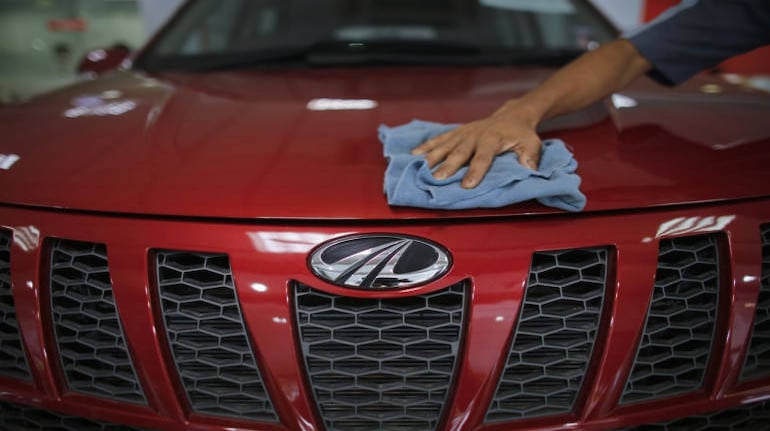
The rise in input costs for auto major Mahindra & Mahindra could likely result in an increase in the prices of vehicles it manufactures, thus impacting the buyer.
Given the robust growth and increase in input prices, there could be a surge in prices for the cars to that extent going forward, according to Mahindra & Mahindra's Group Chief Financial Officer V S Parthasarathy.
“There is a co-relation between input material costs and price. If you look at input costs, they seem to be firming up and globally this has been going up…A pass on that will be required. If the input prices go up, the output prices will also go up. We have to see by how much and what numbers,” Parthasarathy told Moneycontrol.
The Mumbai-based tractor market leader Mahindra & Mahindra witnessed a 50 percent growth in its tractor business, while heavy commercial vehicles grew by 140 percent. Parathasarathy says that the auto major has already increased its capital expenditure (capex) plans by 20 percent this year to Rs 12,000 crore (from Rs 10,000 crore in the last two years-cycle) to invest in product developments.
 Group Chief Financial Officer V S Parthasarathy
He said, “Despite capacity not growing, if we are increasing capex by 20 percent, if we see volumes growing, the capacity can further increase and there would be even more upside to it…If things go well, we will be happy to invest more.”
Although the growth in the country has been sluggish for the June quarter at a 3-year low of 5.7 percent post demonetisation and implementation of Goods and Services Tax (GST), Parathasarathy is optimistic about the country’s long-term economic growth.
“With GST coming, agreed there has been certain bit of slowness but we can’t take that quarter as a measure because this I would say is preparing for a better tomorrow and that’s why we should look with hope and not worry too much about what has happened. But in September we have seen growth coming, also with GST collections, it will show a better quarter,” he said.
However, the Mahindra executive feels that an interest rate cut of at least 50 basis points (bps) or 0.50 percentage points would be a good enabler to push growth.
“For the industry, if the topline (revenues) is growth by 2 percent and there is inflation as well, it is almost flat growth. We need more growth on the demand side and we have seen first green shoots of growth in September, for our company at least. Broadly, in big projects where old debt is stuck, something needs to be done by unlocking blocked money, capitalisation, etc…Hence, certainly, there is room to cut rates…From an industry perspective there is room for 50 bps cut,” he said, adding that despite the rate hike cycle in the western world, India’s interest rates still has enough headroom to cut rates given the growth potential and stable inflation.
Last week, the Reserve Bank of India announced the monetary policy committee’s (MPC) decision to to keep key policy rate unchanged at 6 percent.
According to Parathasarathy, while a part of the industries like us (auto) are investing, real estate, steel and banking need to get out of the logjam before they start investing. “I think investment is a function of how the demand is functioning in goods and services. This is the right season with rural market coming into play and urban market being steady, and with MPC and government playing its part will see the right push. “Inspite of all the negatives, we have seen 6 percent growth. There is still pent up demand in tractors so rural, agriculture, auto and finance should do well for us,” he added.
With the government mulling a stimulus package of nearly Rs 50,000 crore to revive the muted economic growth in the current financial year, Parathasarathy said that the government can look at any capital formation like investing in major projects. “It’s the most positive stimulus. Second, speeding up asset formation on the projects, in terms of roads, etc...to push those projects. Third: increase in projects in the rural areas.”
In the last week’s monetary policy, RBI Governor Urjit Patel said, “higher fiscal deficit per se can lead to an increase in inflation expectations and actual inflation".
For Mahindra, September has given a good festival boost in growth and despite slowdown post demonetisation and GST, “overall all things around MSP (minimum support price), there is a steady flow of cash and overall it is a positive; the four-wheeler (particularly tractor) growth which was subdued (past two years) has seen growth…So the cues I see are positive and there should be something that can lead to a start,” Parathasarathy concludes.


Discover the latest Business News, Sensex, and Nifty updates. Obtain Personal Finance insights, tax queries, and expert opinions on Moneycontrol or download the Moneycontrol App to stay updated!
Find the best of Al News in one place, specially curated for you every weekend.
Stay on top of the latest tech trends and biggest startup news.