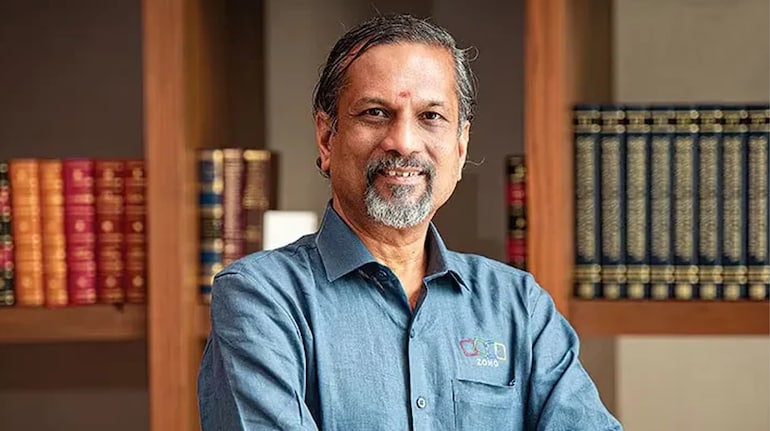

Zoho founder and Chief Scientist Sridhar Vembu has cautioned India against trying to compete head-on with massive Large Language Models (LLMs) that dominate the global artificial intelligence landscape, arguing that the country should instead focus on smaller, more energy-efficient AI approaches.
In an interview with PTI, Sridhar Vembu said India should avoid entering what he described as a capital- and energy-intensive race dominated by Big Tech, and instead leverage its intellectual strengths to pursue alternative AI strategies.
The remarks come as India prepares to host the India AI Impact Summit later this month, amid heightened interest in artificial intelligence and its role in economic growth.
Vembu’s views echo the recent Economic Survey, which noted that India’s limited access to cutting-edge compute infrastructure and capital makes building large foundational models a “challenging” proposition. The Survey advocated a bottom-up approach to AI development that aligns better with India’s realities.
Referring to the dominance of large models, Vembu said the current AI ecosystem is heavily skewed.
“If you look at AI today, the big tech...the big LLMs dominate. That is three or four well-known names... the Chinese are in the game from an open source model perspective...But if you look at the domination, it is from the big LLMs,” he said.
Highlighting the enormous costs involved, Vembu pointed to the USD 50–100 billion price tag and high energy requirements of such models.
“I don't think we should take that (large LLM model) head-on right now, because this is a USD 50 billion, 100 billion game...the GPUs are in short supply, and are expensive. And the energy intensity of this, the electricity prices are going up rapidly in the US,” he said. He added that India should be pragmatic in its approach.
“So I don't believe we should simply emulate that right now. Sometimes, staying a little bit behind is a good idea,” Vembu noted. Rather than focusing on energy-hungry models, he argued that India should invest in research and development that prioritises efficiency.
“There are other approaches to AI that don't involve this type of large language model approach. Those all are promising, and we are pursuing some other directions. We have to invest in that, we have to apply our brain power, rather than energy which is scarce,” he said.
Vembu said Zoho itself is actively exploring smaller models and alternative AI approaches that are less capital- and energy-intensive.
The debate comes as India gears up to host the India AI Impact Summit, billed as the largest of the four major global AI gatherings so far, following similar summits in the UK, South Korea and France.
According to an official release, the Summit has already seen over 35,000 registrations, with participation expected from more than 100 countries. The event is likely to host 15–20 Heads of Government, over 50 Ministers, and representatives from more than 40 global and Indian companies.
Around 500 leaders from the global AI ecosystem, including innovators, researchers and Chief Technology Officers, are expected to attend, alongside a showcase of more than 500 AI startups and about 500 sessions.
Several influential figures shaping global AI discourse are slated to participate, including NVIDIA founder and CEO Jensen Huang, Anthropic CEO Dario Amodei, Microsoft President and Vice Chair Brad Smith, Google DeepMind CEO Demis Hassabis, and Accenture Chair and CEO Julie Sweet.
*With Agency InputsDiscover the latest Business News, Sensex, and Nifty updates. Obtain Personal Finance insights, tax queries, and expert opinions on Moneycontrol or download the Moneycontrol App to stay updated!
Find the best of Al News in one place, specially curated for you every weekend.
Stay on top of the latest tech trends and biggest startup news.