






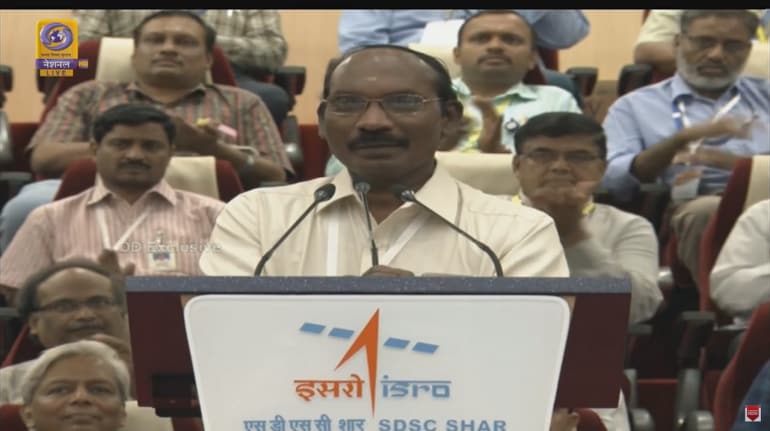
Former chairman of the Indian Space Research Organisation (ISRO) K. Sivan, who was at the helm of the national space agency when India launched Chandrayaan-2 to the Moon, disagrees with the categorisation of Chandrayaan-3 as a "failure-based design." He says that it improves and expands on the parameters of its predecessor.
Recently, current ISRO chairman S Somanath had said that Chandrayaan-3, which on August 24 made a historic soft landing near the Moon's south pole, is a "failure-based design that has been programmed to foresee possible failures and do the corrections required".
In a failure-based design approach, the focus is on anticipating and mitigating potential failures, challenges, and negative outcomes in systems, processes, and products.
"Chandrayaan-3 does not incorporate anything new. Not only this, every space system is based on similar characteristics. Chandrayaan-3 addresses the errors of Chandrayaan 2 and improves on its various parameters," Sivan told Moneycontrol.
Apart from addressing Chandrayaan-2's errors, Sivan said, "Wherever design margins were less in Chandrayaan-2, they have now been increased -- which means that it has been designed to work for wider dispersion band."
"Lastly, it brings in more redundancies (if one sensor stops working then other sensors will take over). These were part of the design, and all these things were there in Chandrayaan-2 also," he added.
Despite providing valuable data regarding the Moon from its orbiters, Chandrayaan-2 failed to achieve its objective of making a soft landing on the Moon's South Pole in 2019. This mission was preceded by Chandrayaan-1, which discovered the presence of frozen water molecules in the same lunar area in 2008.
The crash of Chandrayaan-2 on the lunar surface broke the hearts of millions of Indians, including that of Sivan, whose pictures of breaking down in the arms of Prime Minister Narendra Modi after the crash were widely circulated.
"(During such missions) Somebody has to face a tough time. I faced a tough time. And based on the difficulties we had, which have now been corrected, we are enjoying its fruits now," he said.
After the Chandrayaan-3 Vikram lander touched down on the Moon's surface on August 24, the Pragyan rover was deployed. Both the lander and the rover are equipped with payloads capable of carrying out scientific experiments.
On August 27, ISRO released the first reading of one such payload: a graph of the temperature variation on the lunar surface.
"Here are the first observations from the ChaSTE payload onboard Vikram Lander. ChaSTE (Chandra's Surface Thermophysical Experiment) measures the temperature profile of the lunar topsoil around the pole to understand the thermal behaviour of the moon's surface," ISRO said in an update on social media platform 'X'.
Discover the latest Business News, Sensex, and Nifty updates. Obtain Personal Finance insights, tax queries, and expert opinions on Moneycontrol or download the Moneycontrol App to stay updated!

Find the best of Al News in one place, specially curated for you every weekend.
Stay on top of the latest tech trends and biggest startup news.




