




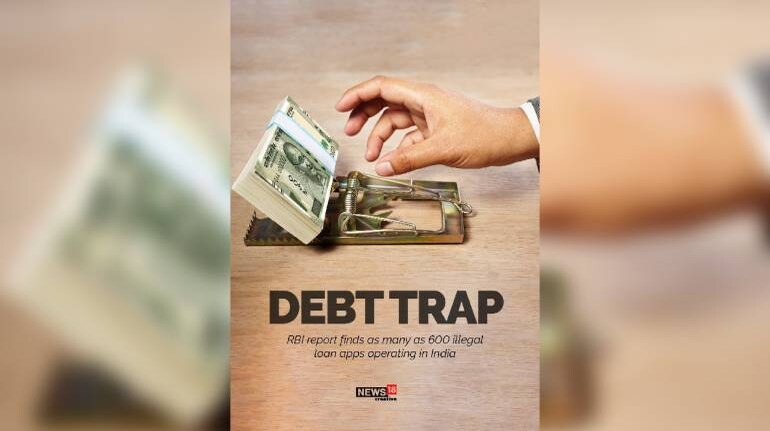
An entire family of a couple and their two children allegedly committed suicide in Kerala a few days ago. The local media cited harassment by a loan app company as the reason why the family took the ultimate step. The app company reportedly sent morphed naked images of the victims to their contacts to pressure repayment of the loan.
This is just another instance that shows a deeper problem in India’s unregulated small loan market.
Money lending is a lucrative business. There are RBI-regulated banks and NBFCs, cooperative banks, microfinance companies, credit societies, and then, illegal moneylenders in this trade. In this age of technology, the last category is the faceless rioter. They are everywhere around you, but you often don’t know who the people operating behind are. The key attraction that lures gullible borrowers to these apps is little or no documentation for the loan process.

Most borrowers, who fall prey to such lenders, are usually people with irregular income and low credit ratings. The credit barrier at bigger lenders are higher and the processing time is longer. For poor-quality borrowers, therefore, the easy-to-go loan apps are the most logical option. Little does the borrower realise that they are walking into death traps from where there is no return.
It’s easy to identify the threat if you spare a minute to think about the usurious rate of interest and recovery practices before drawing the money. Such apps typically don’t have any specific rule book or trained staff to manage credit operations. On default of a payment instalment, the harassment begins by shaming the borrower in front of his family members and friends. Such harassment tactics often end up in cases of extreme distress in these families.
Let's see how the illegal financial apps work.
These entities source money from somewhere (mostly unknown individuals) to on-lend to borrowers at usurious rates of interest for a very short tenure, starting from seven days to 15 days and, in some case, may extend up to a year. The average loan amount varies from Rs 3,000 to Rs 50,000.
The interest rate charged can vary from 60 percent to 100 percent as against a regular microfinance loan where lending rate is typically in the range of 22-25 percent and a bank loan with 7-12 percent lending rate.
One must realise that these entities are no different from loan sharks who have been operating in India for ages and typically lend against land or gold ornaments to low-income groups. They, too, like typical moneylenders, engage in coercive lending practices to get their money back. Naming and shaming the borrower among his/her contacts is common. The only difference is that the new crop of money lenders use technology to canvass loans especially to the young customer segment for consumption-related purposes.
With small finance banks, NBFCs and MFIs now expanding operations, small borrowers don’t need to walk into the death traps of illegal loan apps for fund requirements.
The Kerala incident is just one among hundreds of such cases.
Even as the government and the Reserve Bank of India has been cracking down on illegal digital lending apps over the last couple of years, the number of complaints against such apps have more than doubled to 1,062 in FY 23, the finance ministry has told the Lok Sabha. The numbers of FY22 are not strictly comparable with those of FY23, as the data is available only from November 2021 and the number of complaints stood at 263.
Late last year, the RBI had come up with the digital lending guidelines (DLG) under which only regulated entities (RE) could lend to customers and it added that the relationship should be directly between the lender and the borrower.
As per the National Crime Records Bureau (NCRB), the total number of cyber fraud cases, which includes frauds committed through online apps, stood at 14,007 in 2021, which is the latest available data. A sizable number of such financial frauds are never registered with either the police or the RBI.
What you should do to avoid such traps?
The first step is to stay away from any lenders that are not regulated by the Reserve Bank of India (RBI). The regulator has a list of legal loan apps which it has shared with the government. Second, borrowers must report instances of harassment without delay before things take a turn for worse. Growing awareness among customers in rural centres is even more critical to prevent such cases. Stay away from such death traps.
The RBI has asked Google and Apple to stop the digital lending apps from accessing the customers' photos as well as contacts for personal loans from May 31 , 2023.
Banking Central is a weekly column that keeps a close watch and connects the dots about the sector's most important events for readers.
Discover the latest Business News, Sensex, and Nifty updates. Obtain Personal Finance insights, tax queries, and expert opinions on Moneycontrol or download the Moneycontrol App to stay updated!
Find the best of Al News in one place, specially curated for you every weekend.
Stay on top of the latest tech trends and biggest startup news.