






What happens when India’s most ambitious airport project converges with a once-in-a-generation urban planning vision? Navi Mumbai today is offering that answer in real time. With the Navi Mumbai International Airport (NMIA) set to commence operations from 25 December 2025, the region is rapidly evolving from a satellite city into one of India’s most consequential real estate and economic growth corridors.
This transformation is the result of long-term infrastructure planning, policy-driven development under the Navi Mumbai Airport Influence Notified Area (NAINA), and early participation by developers such as The Wadhwa Group who understood the scale of opportunity well before the runway lights were switched on.
NMIA defining India’s Aviation-Led Growth Model
NMIA is positioned to be India’s first fully digital airport, designed to handle passenger volumes with advanced automation, seamless mobility, and technology-led operations. More than being a transport hub, the airport is the anchor of a larger aerotropolis-style ecosystem, one that integrates logistics, commercial zones, hospitality, and residential development within a tightly planned urban framework.
Historically, global experience shows that large airports catalyse new cities around them. Navi Mumbai is now following the same trajectory, with NMIA emerging as the epicentre of a new economic geography for the MMR. Anticipating this shift, The Wadhwa Group has focused on creating the first-ever integrated, future-ready townships and developments that align with the larger framework of NAINA.
Infrastructure as the Growth Multiplier
Connectivity has become the region’s biggest advantage. The Atal Setu (Mumbai Trans Harbour Link) has already cut travel time between Sewri and Chirle to just 20 minutes, bringing South Mumbai within easy reach of Navi Mumbai. This single infrastructure intervention has altered buyer perception, investor sentiment, and commute economics overnight.
What lies ahead strengthens this shift further. The Alibaug - Virar Multimodal Corridor is expected to integrate multiple growth nodes across the western coastline, while Navi Mumbai Metro Line 8 will directly link NMIA with Chhatrapati Shivaji Maharaj International Airport, creating a dual-airport metro corridor unique in India. The Panvel–Karjat suburban rail line will extend connectivity deeper into the hinterland, unlocking new residential and industrial clusters.
Panvel: From Peripheral Suburb to Growth Nucleus
Among all the micro-markets influenced by NMIA and NAINA, Panvel stands out as the biggest beneficiary. Once viewed as peripheral, Panvel is now emerging as a preferred destination for integrated townships and self-sustained communities. Its strategic location at the intersection of highways, rail corridors, metro lines, and the upcoming airport has transformed it into a residential and commercial epicentre.
Market indicators clearly reflect this shift. Over the past year, real estate prices across Navi Mumbai and its peripheries have appreciated by 10–15%, even before NMIA becomes operational. Industry expectations suggest that quality residential assets could see an additional 20–25% appreciation within a year of airport operations. Panvel and Ulwe are currently leading this appreciation curve, followed by Taloja, Roadpali, Karanjade and Karjat.
Wadhwa Wise City as an Urban Milestone
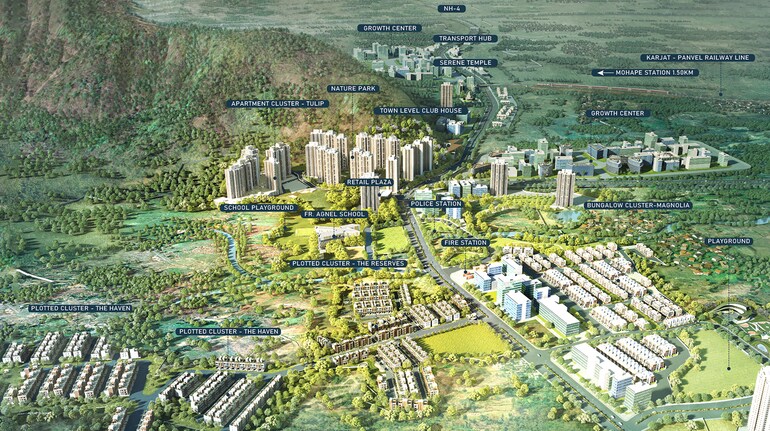
Long before NMIA reached its final construction stages, The Wadhwa Group identified Panvel and the NAINA belt as the next frontier of Mumbai’s growth story. Acting as a visionary early mover, the Group has focused on creating vibrant and holistic townships spanning apartments, luxury bungalows and villas, plotted developments, retail spaces, a school, and a temple—showcasing ecosystem-led urban living in Panvel.
This long-term vision takes shape at Wadhwa Wise City in Panvel, an integrated township spread across 200+ acres, plans to accommodate diverse housing formats while embedding social and civic infrastructure within a single, cohesive framework. Within this larger canvas, the Group’s residential project Tulip exemplify modern apartment living through efficient layouts and everyday convenience. Next in line, Magnolia offers luxurious bungalow living, blending contemporary architecture with privacy and serenity. Reserves and The Haven, a plotted development, caters to buyers seeking flexibility and tranquillity amidst the urban life. Underpinning these developments is The Wadhwa Group’s distinctive VENTILIT design philosophy, which emphasises the seamless harmony of air, light, and height, ensuring superior ventilation and abundant natural illumination. Together, these offerings mirror the diverse aspirations of a region transitioning into a mature and futuristic urban destination.
Moreover, the Navi Mumbai Airport operator is also in the process of leasing some residential flats at Wadhwa Wise City to accommodate airport staff and their families, thereby an early indicator of how organised, well-planned housing is beginning to support the region’s growth from day one.
For early residents, investors, and developers like The Wadhwa Group, this is not merely a participation in the growth cycle but also a chance to shape the trajectory of India’s next great urban powerhouse.
Moneycontrol Journalists are not involved in creation of this article.
Discover the latest Business News, Sensex, and Nifty updates. Obtain Personal Finance insights, tax queries, and expert opinions on Moneycontrol or download the Moneycontrol App to stay updated!



