






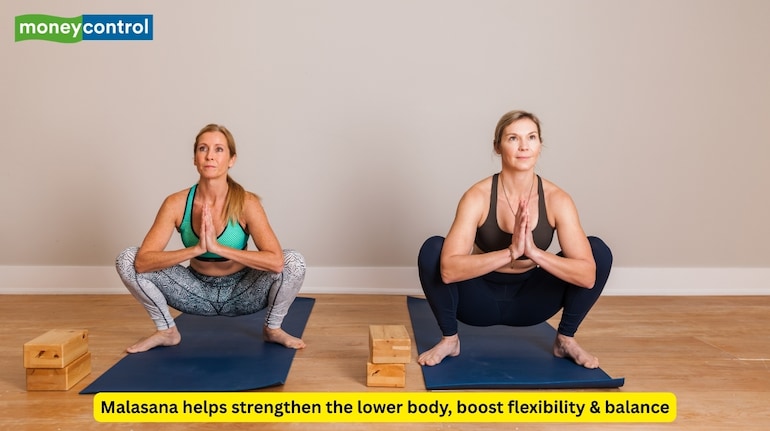
Want to push ageing? Try practicing natural motions of daily life, like, squatting to rest, lift, or simply reach the floor. The deep squat, a staple in strength and conditioning programs, is now being recognised not just for athletic performance, but as a secret hack in the battle against ageing.
You scroll through social media and come across reels that talk about healthy ageing. It may make you wonder what if there were a single daily movement that could keep you strong, flexible, and youthful. According to mobility coach @stretchy.bendy on Instagram, the malasana squat with a forward fold and overhead stretch does exactly that. In a video she explains, “It helps keep your hips mobile, helps you touch your toes (tie shoe laces) and maintains upright posture, all the things that you tend to lose with age.” By combining deep hip flexion with a gentle spinal stretch, the malasana not only strengthens the lower body but also nurtures flexibility, balance, and functional independence, qualities that support graceful ageing.
Additionally, research also highlights how squatting deeply, hips below the knees with a straight spine, recruits the quadriceps, glutes, hamstrings, core, and stabilising muscles of the ankles and calves simultaneously. This promotes strength, coordination, balance, and endurance. For those approaching midlife and beyond, this movement could help maintain independence and agility.
Also read: Long walk Vs short walks: Apollo Neurologist says latter are better; Here's why
According to the International Journal of Sports, Health and Physical Education (2025), deep squats encourage flexibility in the hips, knees, and ankles while improving joint stability. The so-called “wrapping effect” distributes pressure across the knee, reducing compressive stress and making the movement safer than often assumed. Over time, this can support mobility that many lose with age, like bending to tie shoes or crouching comfortably.
The same study suggests that deep squats foster adaptive responses in tendons and muscles, particularly the femoral-tendon complex. Unlike half or quarter squats that may require heavier loads, properly executed deep squats promote balanced strength and resilience without overloading joints, crucial for preventing age-related degeneration.
Deep squats replicate everyday motions, helping preserve practical abilities like lifting objects, rising from a seated position, or maintaining upright posture. Research shows that squatting with control also boosts core stability, proprioception, and neuromuscular coordination, all of which decline with age.
1. Are deep squats better than regular squats?
Yes. Deep squats increase muscle activation in the glutes, hamstrings, and quads more than partial squats.
2. Do deep squats improve flexibility?
They help improve hip, ankle, and knee mobility by working the joints through a full range of motion.
3. Can deep squats strengthen the core?
Absolutely—deep squats engage the core muscles to stabilise the body, improving overall strength and posture.
4. Do deep squats burn more calories?
Yes. They recruit more muscle groups, which increases calorie burn and overall workout efficiency.
5. Are deep squats safe for the knees?
When done with proper form and control, deep squats are safe and may even strengthen the knees over time.
Disclaimer: This article, including health and fitness advice, only provides generic information. Don’t treat it as a substitute for qualified medical opinion. Always consult a specialist for specific health diagnosis.
Discover the latest Business News, Sensex, and Nifty updates. Obtain Personal Finance insights, tax queries, and expert opinions on Moneycontrol or download the Moneycontrol App to stay updated!
Find the best of Al News in one place, specially curated for you every weekend.
Stay on top of the latest tech trends and biggest startup news.









