



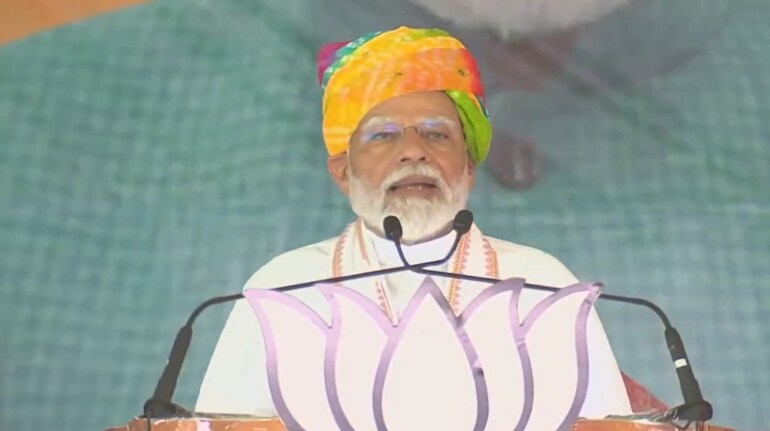
Varanasi, the spiritual capital of India, has been a stronghold of the Bharatiya Janata Party (BJP) from 1991, with the likes of former party president Murli Manohar Joshi and Prime Minister Narendra Modi representing the constituency in Parliament.
The oldest living city dating to the 11th century B.C., Varanasi, once known for its crumbling ghats and littered narrow lanes, has undergone a makeover, especially in the last decade.
The ambitious Kashi Vishwanath (KV) Corridor Project, pegged at Rs 900 crore, took two years to be completed.
It was built to facilitate access to the KV temple, earlier hindered by congested and narrow streets.
ALSO READ: PM Modi to unveil Rs 13,000-cr projects in Varanasi
Now, the KV corridor, with a slew of infrastructure projects, has transformed Varanasi’s economy, translating into higher earnings for artisans, boosting local businesses and the area’s handicraft economy.
Economic profile: Key growth drivers
Varanasi’s GDP stands at Rs 18,727 crore according to invest.up.gov.in. Its Net District Domestic Product per capita in 2020 was Rs 62,418.579, compared to Rs 28,212.825 in 2012, according to ceicdata.com. The literacy rate stands around 75 percent approximately, according to Varanasi.nic.in.
The constituency has had a remarkable journey from just two GI (geographical indicator) tags in 2014 to 32 certified products today -- the highest from a single geographical area.
A GI is a sign used on products that have a specific geographical origin and possess qualities or a reputation that are due to that origin.
GI tags have a story to tell
Before 2014, only the Varanasi saree and the Badohi carpet carried the GI tag recognition. Now, the gulabi meenakari, wooden toys, black pottery, wood carving, jail work, zardoji, langda mango, thandai and table are among the products that carry this tag.
ALSO READ: Travel 2024: A trip to Varanasi transports you back through layers of time
In 2014, after assuming office as Prime Minister, during his visit to Varanasi, Narendra Modi was presented with an angavastram crafted by the skilled hands of weaver Bachche Lal Maurya.
What set this angavastram apart was the inclusion of a 'doha' (couplet) by Sant Kabir, intricately engraved upon it. This seemingly simple exchange laid the foundation for an extraordinary transformation in the realm of GI in Varanasi, GI expert and Padma Shri awardee, Rajni Kant, serving as the General Secretary of the Human Welfare Association, told Moneycontrol on telephone from Varanasi.
“They encompass a diverse array of crafts, including Meenakari, wooden carving, stone craft, and the celebrated Chunar sandstone and hand-blocking technique. Such an extensive array of GI recognitions from 2 to 32 is unparalleled globally, underscoring Varanasi's status as a beacon of heritage and craftsmanship,” Kant said.
Prime Minister Modi presented the Gulabi Meenakari to US President Joe Biden at the G7 meeting in 2022, which propelled this GI-tagged art form onto the global stage.
The surge in demand for Varanasi's famed crafts, such as the exquisite Gulabi Meenakari, once on the brink of obscurity, now enjoys widespread popularity, moving from niche to mainstream markets.
The GI designations have propelled Varanasi's traditional industries, particularly handloom and handicrafts, to unprecedented growth, transforming its cultural and economic landscape.
This resurgence has breathed a new life into the livelihoods of artisans and weavers, who form the backbone of Varanasi's rich cultural tapestry. Estimates suggest that the GI revolution has benefited about 20 lakh people and has led to an increase in the collective turnover of these products to Rs 30,000 crore from Rs 15,000 crore about a decade back.
“The economic impact of this GI revolution is witnessing a staggering surge, with an estimated annual turnover exceeding Rs 30,000 crore, benefiting approximately 20 lakh individuals in these industries. Before 2014, the estimated turnover in the handicraft industry in Varanasi was anything between Rs 15,000-Rs 18,000 crore,” Kant said.
Increase in wages
Notably, the wages of artisans and weavers have surged, and there are tangible improvements in their quality of life . Earlier, a handloom weaver used to earn Rs 200-250 per day. Now, the rates range from Rs 400-600 daily, artisan Bachche Lal Maurya told Moneycontrol.
“Similarly, wooden craft artisans have seen their earnings soar from Rs 80-150 per day to a substantial Rs 300-500 crore annually, thanks to an increase in demand for wooden toys,” he said.
Tourism
The influx of tourists into Varanasi has been on a steady rise, as corroborated by government statistics. This indicates that over 5.50 crore tourists, including 13,700 foreign nationals, visited the city in 2023. In 2021, this figure was only 80 lakh. In 2022, after the construction of the KV corridor, 7.35 crore tourists visited the city, Himangshu Nagpal, Chief Development Officer, Varanasi, told Moneycontrol.
The once-quiet gullies (alleys) of Varanasi have sprung to life, with a surge in economic activities, ushering in a wave of financial prosperity that has swept through the city over the past few years. The hospitality and tourism sectors, particularly over the last decade, have witnessed a significant upswing, Gokul Sharma, President of the Varanasi Hotel Association, told Moneycontrol.
Sharma said that the hospitality sector revenue has almost doubled after the creation of the Kashi Vishwanath Dham (KVD).
“Hotels in the organised sector collectively clocked revenue exceeding Rs 2,000 crore in the previous year alone. Room rents have increased by 10-20 percent, depending on festival season. This figure may not be entirely accurate due to the absence of official data compilation for dharamshalas (religious guesthouses) and homestays. The actual revenue would be considerably higher. Prior to KVD, revenue was anything between Rs 500-700 crore,” he said. To capitalise on the burgeoning tourist footfall, many residents along the banks of the Ganges, offer homestays.
The surge in tourist arrivals has not only catalysed the economic growth of the region but has also paved the way for the creation of numerous employment opportunities in Varanasi.
Ramesh Kumar Singh, a local resident, said that the KV corridor is a transformative project that has changed the face of the city. “This mall-like corridor for the temple has revived the economy of the roadside shops,” he said.
Ganga Swachchta Abhiyan, the mega cleanliness drive which was launched in 2014 to remove waste material from water surface and ghats, has given a fillip to tourism.
Infrastructure boost
Varanasi inaugurated India's first multi-modal terminal on the Ganga river, cruise tourism and cargo movement in 2018, to promote inland waterways, which is cheaper and environment-friendly.
“Over Rs 45,000 crore has been pumped into Varanasi in the last 10 years, a good portion of which has gone into infrastructure development, like construction of flyovers, roads, ring roads, and KV Dham, and giving a new look to the railway stations of Varanasi as well as Madudih,” Varanasi Commissioner Kaushal Raj Sharma told Moneycontrol.
In November last year, Modi inaugurated two roads – the 16.55-km-long Varanasi Ring Road Phase-I and the four-laning of the Babatput-Varanasi road on NH-56 – with a total length of 34 km and built at a cost of Rs 1,571.95 crore.
In 2021, the foundation stones for multiple development projects worth more than Rs 1,500 crore at the IIT-BHU ground and 143 rural projects under the Jal Jeevan Mission, worth Rs 839 crore, were laid.
In the same year, Modi inaugurated the International Cooperation and Convention Centre – ‘Rudrakash’ – constructed with Japanese assistance, a multi-level parking facility at Godauliya and a three-lane flyover bridge on the Varanasi-Ghazipur highway. Chief Minister Yogi Adityanath flagged off consignments from mango and vegetable-integrated packhouses in Karkhiyaon, constructed in 2023.
In February this year, Modi inaugurated Amul's Banas Kashi Sankul milk- processing unit in Varanasi, the largest plant of Amul in the city, whose foundation was laid in 2021.
The Ganjari Stadium, whose foundation was laid in 2023, is expected to be completed by 2025.
Ramesh Kundnani, a resident of Varanasi, said that the biggest gift to Varanasi has been the Homi Bhabha Cancer Hospital, run by the Tata Memorial Trust. It was completed in 2019.
Real estate
There has been a surge in demand for flats, primarily because of the ongoing infrastructure expansion in the vicinity of the city, Abhinav Pandey, President of the Varanasi Builders and Developers Association, said.
The land rates in Varanasi have escalated significantly, rising from Rs 1,200-1,500 per square feet to Rs 3,000-4,000 per sq ft within the city, following the construction of KV Dham in 2021.
Likewise, in rural areas, land prices have surged from Rs 400 per sq ft to Rs 1,000 per sq ft over the past three years, Sanjeev Mishra, section officer in Varanasi Development Authority, told Moneycontrol.

Discover the latest Business News, Sensex, and Nifty updates. Obtain Personal Finance insights, tax queries, and expert opinions on Moneycontrol or download the Moneycontrol App to stay updated!
Find the best of Al News in one place, specially curated for you every weekend.
Stay on top of the latest tech trends and biggest startup news.