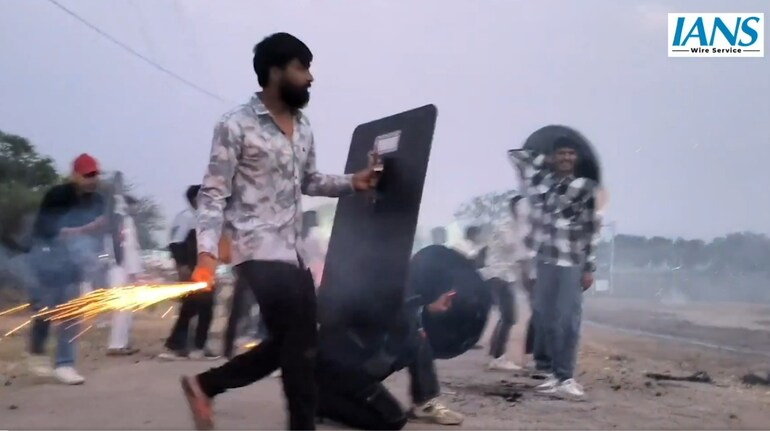
At least 35 people were injured on Tuesday in the annual Hingot Yuddh, or Hingot Battle, held a day after Diwali, in Indore’s Gautampura.
The injured were rushed to hospitals after receiving first aid at the site. Despite precautions, the fiery spectacle once again highlighted the dangerous side of this centuries-old ritual.
What is Hingot Yuddh (Hingot Battle)?
Hingot Yuddh is observed on Dhok Padwa, the day following Diwali, in Gautampura near Indore. The ritual pits villagers from Gautampura (Turra team) against those from nearby Runji (Kalangi team) in a symbolic battle using burning ‘hingots’, dried, hollow fruits packed with gunpowder and sealed with clay.
Warriors carry shields and don traditional attire as they fling these fiery projectiles across a battlefield that spans roughly 100-200 feet. The spectacle is accompanied by deafening drums, smoke, and thousands of cheering spectators.
The Hingot itself is a wild fruit with a tough outer shell. Once dried, its pulp is removed, gunpowder is packed inside, and it is sealed with clay.
How did the Hingot Yuddh start?
The Hingot battle is believed to trace back around 200 years to ancient guerrilla warfare tactics in the Chambal region.
Legend holds that Maratha soldiers used hollowed-out fruits filled with gunpowder as makeshift grenades against Mughal invaders. Over time, the practice evolved from a wartime tactic into a ritual celebration of bravery, and community identity.
Today, participating in the Hingot Yuddh is a matter of pride for many young men in Gautampura and surrounding villages.
This year’s battle
The 2025 edition began near the Devnarayan Temple, with both teams taking positions about 200 feet apart. Bamboo sticks were ignited, and flaming hingots flew through the air as warriors clashed in the age-old spectacle.
Despite deployment of fire brigades, ambulances, and police, the intensity led to multiple injuries. The event, usually continuing into dusk, was halted half an hour early this year due to safety concerns. One participant is in serious condition and has been referred to a hospital in Indore.
Injuries are common each year. In 2017, a young man died during the event, which also led to calls to ban it. A petition filed in the Madhya Pradesh High Court described the tradition as ‘inhuman and life-threatening,’ though the case is still pending.
Villagers defend the practice as a centuries-old symbol of heritage, courage, and communal pride, keeping the ritual alive despite the risks.
Discover the latest Business News, Sensex, and Nifty updates. Obtain Personal Finance insights, tax queries, and expert opinions on Moneycontrol or download the Moneycontrol App to stay updated!
Find the best of Al News in one place, specially curated for you every weekend.
Stay on top of the latest tech trends and biggest startup news.