




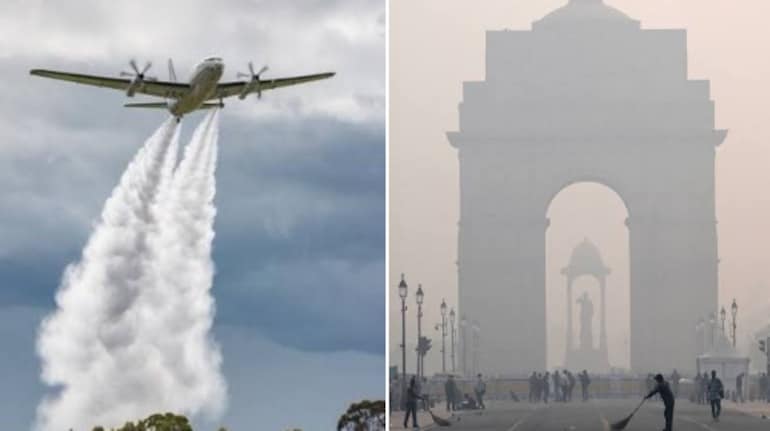
In an attempt to combat the rising air pollution, Delhi recently experimented cloud seeding, a weather modification technique that aims to artificially induce rainfall.
The experiment, supported by top Indian research institutions, was the latest attempt by authorities to find short-term relief from smog that chokes the city each winter. The Ministry of Environment and the Delhi government coordinated the process, hoping that even light rainfall could bring down pollution levels.
Cloud seeding involves dispersing chemicals such as silver iodide or sodium chloride into specific types of clouds. These substances act as nuclei around which water droplets can form, eventually leading to rain. However, the process only works with a particular class of clouds, known as hygroscopic or warm-rain clouds, that contain enough moisture to respond effectively to the seeding agents.
Challenges of cloud seeding in winter
The main challenge lies in the type and timing of clouds. Hygroscopic clouds are uncommon during Delhi’s peak pollution season, which typically spans from November to January. These clouds mostly appear during the pre-monsoon and monsoon months when atmospheric moisture is higher. According to scientists, the likelihood of such clouds forming in winter is just 5-10%, compared to over 50% during the monsoon.
This seasonal limitation significantly reduces the chances of success. “While some may argue for the technique as a solution to drought (which has its flaws, too), deploying it against pollution is a different story, because the specific clouds must be present on the very days when the Air Quality Index (AQI) spikes. The combination of these factors makes the chances of success razor-thin,” Gufran Beig, Chair Professor, National Institute of Advanced Studies, IISC-Campus, was quoted by The Indian Express as saying.
Limited impact on air pollution
Following the experiment, officials claimed that the AQI in some parts of Delhi improved from the “Very Poor” category to “Poor.” However, air quality experts pointed out that levels of PM2.5, the fine particulate matter responsible for much of Delhi’s pollution, remained dangerously above safe limits.
Moreover, even if the seeding produced light rain, it was not enough to wash out pollutants. Substantial rainfall is required to clear the air effectively. Light drizzles, particularly under cooler temperatures, can actually worsen pollution by encouraging fine particles to clump together, forming new aerosols that raise PM levels again.
The temporary improvement fades quickly because emissions from vehicles, construction, and industries continue nonstop. Within hours or a day, the pollution levels return to their earlier state, rendering the experiment a short-lived solution.
Experts believe the exercise, while scientifically interesting, will mainly help clarify whether such methods hold any real promise for the future, similar to Delhi’s earlier smog tower experiments that ended quietly after initial enthusiasm.
Long-term path to cleaner air
Delhi’s air pollution is still a complex, recurring issue that cannot be solved through quick fixes like cloud seeding. The real challenge lies in tackling the systemic sources of pollution. Studies by the System of Air Quality and Weather Forecasting and Research (SAFAR) show that vehicular emissions contribute over 40% of Delhi’s PM2.5 levels. The growing number of vehicles and poor traffic management have largely offset gains from cleaner technologies and policies.
Experts suggest adopting an ‘airshed approach’, which means looking beyond city boundaries to include surrounding regions that share the same air system. The National Air Quality Resource Framework of India (NARFI) promotes this model, which calls for coordinated action across states.
Ultimately, reducing Delhi’s pollution will require sustained year-round measures such as improving public transport, accelerating the shift to electric vehicles, enforcing industrial emission controls, and reducing dependence on fossil fuels.
Discover the latest Business News, Sensex, and Nifty updates. Obtain Personal Finance insights, tax queries, and expert opinions on Moneycontrol or download the Moneycontrol App to stay updated!
Find the best of Al News in one place, specially curated for you every weekend.
Stay on top of the latest tech trends and biggest startup news.