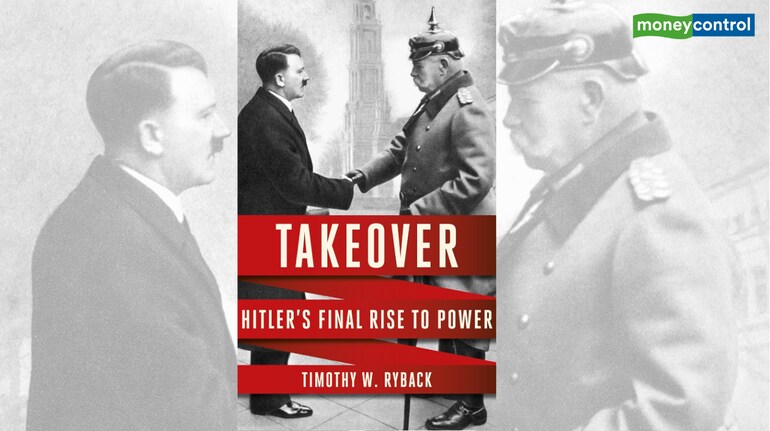
Excerpted with permission from the publishers
Takeover: Hitler’s Final Rise To Power
Timothy W. Ryback, published by Headline Publishing Group / Hachette India.
The world’s greatest poker game is being played here.
—Frederick T. Birchall, The New York Times,
Dateline Berlin, August 10, 1932
On a cloudless Tuesday night in mid-August 1932, Adolf Hitler sat on the veranda of Haus Wachenfeld, his alpine retreat on the Obersalzberg, just above the Bavarian town of Berchtesgaden, stargazing with Joseph Goebbels.
The previous week had seen winds and rain of apocalyptic proportions. Hillsides collapsed, burying roads and railway lines with as much as four feet of mud. Some 50 percent of the Mosel Valley wine harvest was destroyed by hail. Brandenburg lost 75 percent of its cherry crop. The tobacco fields in Schwedt were obliterated. In Posen, a farmer and a female laborer were killed by lightning, and a woman and child hospitalized. The German newspaper Vorwärts reported in a headline, “Death Descends from the Clouds.” Then the skies began to clear.
“With Hitler on the Obersalzberg. Wonderful sunshine,” Goebbels wrote in his diary that Sunday. “Spirits high. And why not?”
If all went according to plan, by week’s end, Paul von Hindenburg, the Reich president, would have appointed Hitler as Reich chancellor. In the Reichstag elections on July 31, 1932, the National Socialists had claimed thirteen million votes, more than 37 percent of the electorate, with 230 seats in the 600-member Reichstag, doubling their legislative mandate.
“We have won a great victory!” Hitler proclaimed on election night. “There has never been anything like this in the history of our people.”
Ten days later, Hitler and Goebbels sat beneath the star-studded sky on the Obersalzberg talking, planning, reminiscing, as Hitler was wont to do in close company. The previous evening, Hitler had strategized with Goebbels until four o’clock in the morning on their seemingly imminent “seizure of power.”
Goebbels was to serve as minister of culture and education.
“I am getting schools, universities, film, radio, theatre, propaganda,” he later wrote in his diary. “A vast portfolio. Enough to fill a lifetime.”
Goebbels vowed never to surrender power.
He wrote, “They will have to drag us out as corpses.”
Now on this mid-August Tuesday evening, Hitler and Goebbels mused, in a more subdued mood, on their respective childhoods. As a mid-level customs officer, Hitler’s father, frustrated when sober and brutal when drunk, had demanded that his son follow in his own inglorious footsteps and pursue a career in the civil service. Hitler, as is known, wanted to be an artist. Not even the severest canings could deter his ambition.
“My father refused to abandon his ‘Never,’ and I responded in kind,” Hitler wrote in Mein Kampf.
Hitler emerged from one thrashing proudly telling his mother, “Father beat me thirty-two times!” On another occasion, Hitler was beaten unconscious. His mother dragged him to safety, despite her husband’s unrelenting blows.
“Hitler had almost the same childhood as I did,” Goebbels wrote in his diary. “The father a tyrant, the mother a source of goodness and love.”
Hitler’s artistic ambition eventually flagged then failed, but his tenacity, whether inherited or beaten into him by his father, remained as blinkered and unrelenting as ever. Following his failed bid for the Reich presidency in April 1932, Hitler went to court to have the election results annulled.
“Hitler to Contest Validity of Election,” The New York Times announced in a headline.
The court dismissed the Hitler suit. Observing that Hindenburg had beaten Hitler by 5,941,582 votes, the court upheld the election results, ruling that the disparity was “so significant that it would make no sense for a national recount of the ballots.” Hitler nevertheless declared victory, noting that his party had gained two million votes at the polls.
“That is a feat that has never been equaled, and I have done this despite the unconstitutional ban placed on my broadcasting election appeals,” Hitler said, denouncing the flood of “lies and slanders spread about me in the election campaign of the ten parties opposed to my candidature.”
Hitler looked ahead to the next Reichstag elections with equally fierce determination in his effort to destroy democracy through democratic process. Echoing Georges-Jacques Danton’s revolutionary call for unrestrained and audacious action—“l’audace, encore l’audace, toujours l’audace”—that preceded and precipitated the first bloodshed of the Great Terror in France, Hitler offered his own triadic call to arms against his country’s constitutional republic:
“I shall continue as I have begun, I shall attack, attack, and attack again.”
For thirteen years, since his first encounter with a handful of men in the back room of a Munich beer hall, in September 1919, Hitler had been driven by a single ambition: to destroy the political system that he held responsible for the myriad ills plaguing the German people. He vowed revenge on the politicians who “stabbed” the frontline soldiers in the back with the armistice, on the “traitors” who signed the Treaty of Versailles, saddling the German people with “war guilt” and crushing reparation payments.
He said “heads will roll.” He vowed to dismantle the multiparty political system that, he claimed, had fractured and polarized the German nation, pitting “individual against individual, city against the countryside, laborers against factory workers, Bavaria against Prussia, Catholics against Protestants, and Protestants against Catholics,” as he said that July in advance of the Reichstag elections.
Hitler’s words are preserved on a two-disk recording titled “Appeal to the Nation.” Hitler speaks with his distinctive cadence and stridency, but in a notably moderated tone. There is no ranting, no raving, no storms of applause, no Sieg heil choruses. One can hear, through the hissing and occasional snap of the shellac disks, traces of Bavarian and Austrian inflections—the Rs are rolled and the Ts are softer than the crisper, clipped consonants in the north. It is the sound of Hitler positioning himself as a political leader rather than as a revolutionary. As suggested by the brown record label, emblazoned with a swastika that spins into blur at seventy-eight revolutions per minute, this is an “appeal,” not a tirade.
Harry Kessler, the son of a Hamburg banker and a British aristocrat, was a former diplomat, a pedestrian in national politics and peripatetic in lifestyle—Berlin, London, Paris, Cannes—who was one of the era’s most astute observers of contemporary politics.
While many observers saw Hitler as indecisive, fanatic, and occasionally unhinged, Kessler sensed that Hitler knew exactly what he was doing. Hitler’s oratory style at political rallies—“trivial and bombastic rhetoric”—served to distract attention, Kessler argued, from Hitler’s calculated and calibrated manipulation of the moment. What made Hitler so dangerous, Kessler believed, was his bluster, behind which lay “his intuition, lightning-fast ability to assess a situation, and ability to react with astonishing speed and effectiveness.”
Hans Prinzhorn was a psychiatrist who wrote on art and politics. His landmark study on insanity and artistic expression remains a reference point for art historians. Prinzhorn had attended a Hitler rally in Weimar in spring 1930 and was struck by Hitler’s mesmerizing effect on his listeners. Hitler raised his voice to a “demagogic register,” then suddenly fell silent for a moment and continued in a “subdued” tone, “as if nothing had happened.”
Prinzhorn also noted that Hitler limited himself to a handful of tropes that he repeated over and over. “Jewish influence” and the “treason of Versailles” were favored phrases, as was “heads will roll.” Prinzhorn suggested that listeners responded to Hitler’s rhetoric devices—volume, rhythm, modulation, repetition—emotionally rather than rationally, which rendered him impervious to attack by political opponents.
“They keep thinking they’ve hit on a crucial point when they say Hitler’s speeches are meaningless and empty,” Prinzhorn wrote. “But intellectual judgments of the Hitler experience—Hitler-Erlebnis—miss the point entirely.”
With Hitler, the medium was the message. Bella Fromm, a journalist for the venerable Vossische Zeitung, observed, “Hitler knows his game.”
One senses this same calculation and calibration in Hitler’s “Appeal to the Nation,” which was designed to reach beyond his fanatically loyal base and embrace the general voting public. Hitler dispenses with his most incendiary tropes. There is no threat that once he and his party are in power the heads of the signatories of the Versailles Treaty “will roll.” There is no talk of vengeance on political enemies, no extended exegeses about Jewish conspiracies.
In fact, Hitler makes no mention of Jews. Instead, he talks about the astonishing rise of his political movement.
“I began to work on reuniting Germans thirteen years ago with seven men, and today there are thirteen million in our ranks,” Hitler says.
At the time, the National Socialists were “mocked and ridiculed,” Hitler recalls.
“No one is laughing now.”
Hitler enumerates the failings of representational democracy and multiparty rule. He talks about inflation and unemployment. Farmers have been “plunged into misery.” The middle classes “ruined.” One of every three working men and women is without a job. “The hopes of millions have been shattered.”
The government, at the federal, state, and municipal levels, is bankrupt. “The coffers are empty.” One hears, as Prinzhorn noted, Hitler’s uncanny ability “to hammer away” on a few key issues in a way “that the common man can comprehend and remember.”
In anticipation of the July 31 Reichstag elections Hitler is clearly positioning himself as a future chancellor, reaching out to the nation, seeking to bridge divides of class and conscience, socialism and nationalism, with a special appeal to the large Catholic and Protestant voting constituencies that usually cast their ballots for the conservative centrist parties.
“The Almighty who permitted a movement that began thirteen years ago with seven men to grow into thirteen million will further grant us the day when Germans again become a unified people,” Hitler says to conclude his address.
“If the nation fulfills its duty”—which meant voting National Socialist—“the day will come when we will again be granted a Reich of honor and freedom, work and bread.”
Timothy W. Ryback
Takeover: Hitler’s Final Rise To Power
Headline Publishing Group / Hachette India, 2024. Pb. Pp. 386
From the internationally acclaimed author of Hitler’s Private Library, a dramatic recounting of the six critical months before Adolf Hitler seized power, when the Nazi leader teetered between triumph and ruin.
In the summer of 1932, the Weimar Republic was on the verge of collapse. One in three Germans was unemployed. Violence was rampant. Hitler’s National Socialists surged at the polls. Paul von Hindenburg, an aging war hero and avowed monarchist, was a reluctant president bound by oath to uphold the constitution.
The November elections offered Hitler the prospect of a Reichstag majority and the path to political power. But instead, the Nazis lost two million votes. As membership hemorrhaged and financial backers withdrew, the Nazi Party threatened to fracture. Hitler talked of suicide. The New York Times declared he was finished. Yet somehow, in a few brief weeks, he was chancellor of Germany.
In fascinating detail and with previously un-accessed archival materials, Timothy W. Ryback tells the remarkable story of Hitler’s dismantling of democracy through democratic process. He provides fresh perspective and insights into Hitler’s personal and professional lives in these months, in all their complexity and uncertainty—backroom deals, unlikely alliances, stunning betrayals, an ill-timed tax audit, and a fateful weekend that changed our world forever.
Above all, Ryback details why a wearied Hindenburg, who disdained the “Bohemian corporal,” ultimately decided to appoint Hitler chancellor in January 1933. Within weeks, Germany was no longer a democracy.
The excerpt that has been published has been taken from the opening pages. But this book is truly worth reading. Here are some excerpts of the reviews that it has received:
One of Foreign Affairs' "Best Books of 2024"
2025 Prose Award Winner, Government and Politics
“How does a flawed republic become something entirely different? We know how the Nazi regime ended, but think too little about how it began. This admirable account shows us how fragile and avoidable were those beginnings, and helps us to reflect upon our own predicaments.”
—Timothy Snyder, author of On Tyranny
“An expert account of the dizzying months when Hitler solidified his power in Germany... A masterfully narrated story of how a democracy committed suicide, with lessons for today.”
—Kirkus Reviews, starred review
“Timothy W. Ryback's choice to make his new book, Takeover... an aggressively specific chronicle of a single year, 1932, seems a wise, even an inspired one... Democracy doesn't die in darkness. It dies in bright midafternoon light.”
—Adam Gopnik, The New Yorker
“[A] riveting blow-by-blow account... a chilling climax. It's a dire and remarkably astute depiction of how fickle and contingent the forces of history can be.”
—Publisher's Weekly, starred review
“Takeover is startlingly relevant history, well-wrought and splendidly researched, that reveals how democracies can die democratically.”
—Peggy Kurkowski, Shelf Awareness
“Timothy Ryback has written an engrossing clock-ticker of a narrative... The relevance to authoritarianism today is urgent and unmistakable.”
—Margaret Talbot, The New Yorker
“If you ever thought that history is only moved by big, sweeping forces... think again.”
—Max Rodenbeck, The Economist
“Refreshingly candid... Ryback admirably capture[s] the shifting moods... Ryback's narrative and his portraits of major figures are riveting.”
—New York Review of Books
“Tim Ryback tells a grippingly important tale... Will the tragic failure of civil courage and political will be repeated—Germany, 1933, America 2024? It's hard not to imagine.”
—Philippe Sands, author of East West Street
Discover the latest Business News, Sensex, and Nifty updates. Obtain Personal Finance insights, tax queries, and expert opinions on Moneycontrol or download the Moneycontrol App to stay updated!
Find the best of Al News in one place, specially curated for you every weekend.
Stay on top of the latest tech trends and biggest startup news.