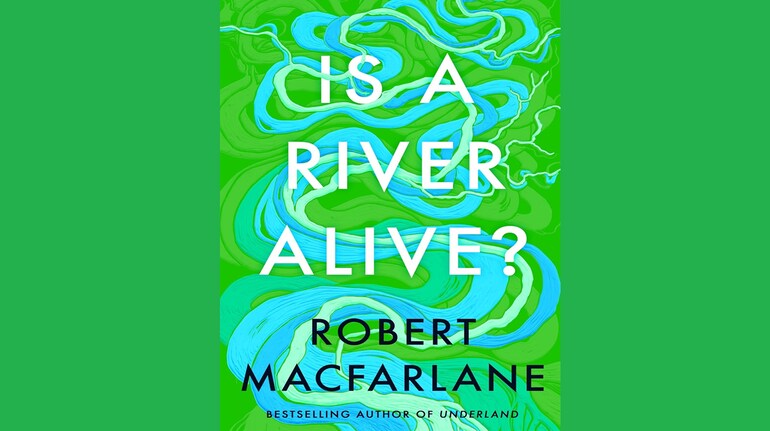
Book Extract
Excerpted with permission from the publisher Is a River Alive?, Robert Macfarlane, published by Hamish Hamilton / Penguin Random House India.
*******
This book is a journey into an idea that changes the world – the idea that a river is alive.
It explores the histories, people, places and futures of that idea and others in its family: that a forest might think, for instance, or a mountain remember. It asks what happens if we take seriously the idea of a river’s aliveness. What does such a recognition mean for perception, law and politics? It is an attempt to imagine water otherwise.
Is a River Alive? unfolds across three main landscapes. First, an Ecuadorian cloud-forest named Los Cedros, the ‘Forest of the Cedars’, home to the headwaters of the Río Los Cedros, the ‘River of the Cedars’. Second, the wounded creeks, lagoons and estuaries of the watery city of Chennai in south-east India. And third, the wild interior of Nitassinan, homeland of the Innu people, through which runs the Mutehekau Shipu, also known as the Magpie River, who makes sea-fall at the Gulf of St Lawrence, six hundred miles north-east of Montreal.
Each of these places has become a focus for revolutionary thinking about what the philosopher Michel Serres called ‘the natural contract’. Each is a place where rivers are understood in some fundamental way to be alive – and in each place, too, the survival of rivers is under severe threat: in Ecuador from mining, in India from pollution and in Nitassinan from dams.
‘Water is speaking,’ noted the Scottish writer Nan Shepherd. But what is it saying? Everywhere I travelled, I asked people the same question: what is the river saying? This is an ¬old-¬growth question; it has been around a long time. The answers I received were beautiful, cryptic, troubling and illuminating. What all share is a recognition that we live in a polyphonic world, but also one in which the majority of Earth’s inhabitants – human and other-than-human – are denied voice. To be silenced is not the same as to be silent; to go unheard is not the same as to be speechless. No landscape speaks with a single tongue.
…
The language of hydrological governance refers to rivers, streams and lakes as ‘waterbodies’. To the forty thousand recognized waterbodies in England, Wales and Scotland should be added another 65 million or so – for every human is, of course, a waterbody. Water flows in and through us. Running, we are rivers. Seated, we are pools. Our brains and hearts are ¬three-¬quarters water, our skin is ¬two-¬thirds water; even our bones are watery. We were swimmers before we were walkers, slow-turning like breath-divers in the dark flotation tank of the womb.
Urban planners speak of ‘daylighting’ streams and rivers. This is the practice of un-¬-burying the watercourses over which many cities have been built, and which have been confined to drains and tunnels, flowing invisibly down in darkness. These imprisoned watercourses are sometimes known as ‘ghost rivers’: their voices are heard at street level, if at all, as whispers drifting from manhole covers or drain grilles.
….
‘Daylighting’ lets the water of buried streams meet the sun again. It is a means of bringing river ghosts back to life in towns and cities, of re-¬encountering rivers as friends and fellow citizens. In cities where daylighting has occurred, the results have often been socially transformative. In Seoul the Cheonggyecheon Stream was freed from the highway that had encased it: the public park created along its banks now draws ninety thousand pedestrians on an average day. Summer temperatures at the waterside can be five degrees cooler than surrounding areas, and air pollution levels along the stream’s corridor have dropped by more than a third. In Seattle, Yonkers, Singapore, San Antonio and many other cities worldwide, daylighting projects have helped resuscitate rivers and revitalize neighbourhoods. When, in a visionary act of urban redesign, Munich freed the ¬blue-¬watered River Isar from the canalized flood channels into which it had been confined, and instead let the river wander across a wider bed, the city too was changed. Grayling now fin in ¬shallow-¬water shoals in the shadow of willows. Meadows slope down to the shifting, shingled edge of the Isar, where people come to sit, talk, walk, sunbathe, sleep, swim and dream. It is not that the city has bestowed life upon the river; rather that the river has enlivened the city.
In the pages that follow, I want to daylight ¬long-¬buried ways of feeling about water, both in history and in us – and to see what transformations occur when rivers are recognized as both alive and killable.
**********
Robert Macfarlane, Is a River Alive?, Hamish Hamilton / Penguin Random House India, 2025. Hb. Pp. 384
From celebrated nature writer and academic Robert Macfarlane comes this brilliant, perspective-shifting new book – which answers a resounding yes to the question of its title.
At its heart is a single, transformative idea: that rivers are not mere matter for human use, but living beings – who should be recognized as such in both imagination and law. Is a River Alive? takes the reader on an exhilarating exploration of the past, present and futures of this ancient, urgent concept.
The book flows first to northern Ecuador, where a miraculous cloud-forest and its rivers are threatened by goldmining.
Then, to the wounded rivers, creeks and lagoons of southern India, where a desperate battle to save the lives of these waterbodies is under way.
And finally, to north-eastern Quebec, where a spectacular wild river – the Mutehekau or Magpie – is being defended from death by damming in a river-rights campaign.
At once Macfarlane’s most personal and most political book to date, Is a River Alive? will open hearts, spark debates and lead us to the revelation that our fate flows with that of rivers – and always has.
Is A River Alive? is a beautifully written, poetic testament to the vitality of the Earth and the forms of politics that can be based upon that premise -- Amitav Ghosh
A rich and visionary work of immense beauty. Macfarlane is a memory keeper. What is broken in our societies, he mends with words. Rarely does a book hold such power, passion, and poetry in its exploration of nature. Read this to feel inspired, moved, and ultimately, alive -- Elif Shafak
This book is a beautiful, wild exploration of an ancient idea: that rivers are living participants in a living world. Robert Macfarlane’s astonishing telling of the lives of three rivers reveals how these vital flow forms have the power not only to shape and reshape the planet, but also our thoughts, feelings, and worldviews. Is a River Alive? is a breathtaking work that speaks powerfully to this moment of crisis and transformation -- Merlin Sheldrake
This book is itself a river of poetic prose, an invitation to get onboard and float through the rapids of encounters with places and people, the eddies of ideas, to navigate the resurgence of Indigenous worldviews through three extraordinary journeys recounted with a vividness that lifts readers out of themselves and into these waterscapes. Read it for pleasure, read it for illumination, read it for confirmation that our world is changing in wonderful as well as terrible ways -- Rebecca Solnit
Robert Macfarlane is a once-in-a-generation virtuoso, and I don’t know when his kaleidoscopic language and world-expanding scholarship have been used to more potent effect than in this impassioned, resounding affirmative to the title’s urgent question -- John Vaillant
Is a River Alive? is one of the best books I’ve read in a very long time―exciting, brilliantly comprehensive, mind-altering. In one of its many stunning moments, Macfarlane describes the myriad rivers trapped and buried under the concrete of our cities. “Daylighting” occurs on those rare occasions when these ghost-rivers are dug out & released to the surface to feel the sun, to expand―majestic creatures―and spread life once again. To read this book is to feel your ghosted soul undergo such “daylighting”―metaphysical, political, emotional, linguistic. Any soul going dormant, any citizen going numb, will be revivified and propelled back to their essential core, where rage, wonder, and imagination intertwine, and a powerful hope for the earth arises. A spellbinding, life-changing work -- Jorie Graham
Robert Macfarlane is internationally renowned for his writing on nature, people and place. His bestselling books include Underland, Landmarks, The Old Ways, The Wild Places and Mountains of the Mind, as well as a book-length prose-poem, Ness. His work has been translated into more than thirty languages, won prizes around the world, and been widely adapted for film, music, theatre, radio and dance. He has also written operas, plays, and films including River and Mountain, both narrated by Willem Dafoe. He has collaborated closely with artists including Olafur Eliasson and Stanley Donwood, and with the artist Jackie Morris he co-created the internationally bestselling books of nature-poetry and art, The Lost Words and The Lost Spells. As a lyricist and performer, he has written albums and songs with musicians including Cosmo Sheldrake, Karine Polwart and Johnny Flynn, with whom he has released two albums, Lost In The Cedar Wood (2021) and The Moon Also Rises (2023). In 2017, the American Academy of Arts and Letters awarded him the E.M. Forster Prize for Literature, and in 2022 in Toronto he was the inaugural winner of the Weston International Award for a body of work in the field of non-fiction. The latter is worth CA $75,000. He is a Fellow of Emmanuel College, Cambridge, and is currently completing his third book with Jackie Morris: The Lost Birds.
Discover the latest Business News, Sensex, and Nifty updates. Obtain Personal Finance insights, tax queries, and expert opinions on Moneycontrol or download the Moneycontrol App to stay updated!





Find the best of Al News in one place, specially curated for you every weekend.
Stay on top of the latest tech trends and biggest startup news.