Book Extract
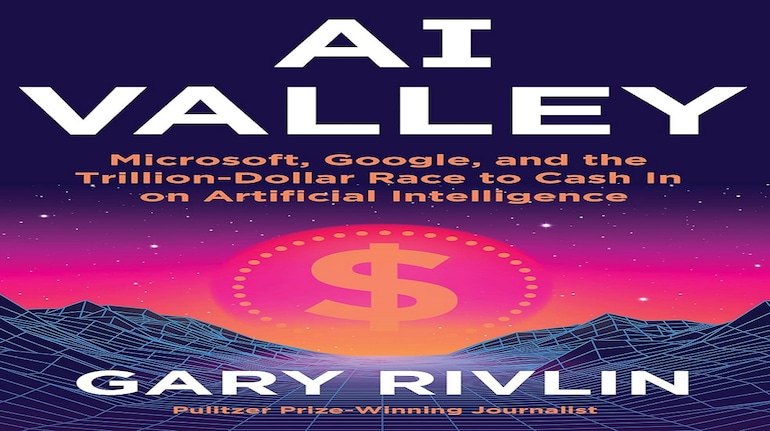
Excerpted with permission from AI Valley: Microsoft, Google, and the Trillion-Dollar Race to Cash In on Artificial Intelligence by Gary Rivlin, published by Harper Business/ Harper Collins India.
DeepMind
Mustafa Suleyman was feeling lost in 2010. He had recently stepped away from an intense job as a conflict-resolution mediator that had left him feeling cynical about the wider world and was casting about for what he might do next. “I was rather passionate about poker,” he said. For a time, he let himself get hooked on the multi- table player games made possible by its migration online. He would play eight games simultaneously and consistently win. He was also a regular at “the Vic,” as locals call the Victoria Casino in London, which held regular poker tournaments. The stakes were never very high—a prize of maybe 250 pounds—but Suleyman relished the chance to best the hundred or so players who typically showed up for one of the Vic’s midweek tournaments.
Somehow it seems appropriate that AI’s first truly successful startup, DeepMind, was born in a casino. The cards were not falling for Suleyman on a spring night in 2010, and he was bumped early from a tournament at the Vic. Another regular tournament player, Demis Hassabis, had also been knocked out early. Both Hassabis and Suleyman had grown up in North London, where Suleyman was best friends with Hassabis’s younger brother George. The two retired to the Vic’s restaurant to commiserate. “We’re sitting there eating chocolate cake and vanilla ice cream and Diet Cokes. Obviously, we’re super- cool,” Suleyman said in a plummy British accent.
Suleyman is a slim six-footer with a head of black curly hair, brown eyes, and a watchful, laid-back demeanor. Back then, he wore a scruffy dark beard and a small earring in one ear. Over their cake and Diet Cokes, they began “whinging about our bad bets,” Suleyman said— complaining about the hands that knocked them out—but soon fell into a conversation about robots and the future. Robots seemed a long way away, both agreed, but Hassabis, who had a PhD in cognitive neuroscience, made the case that the world seemed tantalizingly close to machines that could learn. “Like surely a machine could learn to play poker, a machine could learn a set of heuristics and then produce those patterns,” Suleyman said. Not that many months later, Suleyman, Hassabis, and a third man, Shane Legg, formed DeepMind.
“It all seems kind of insane looking back, talking about machines that learn in 2010,” Suleyman said. “It certainly felt pretty far out at the time.” Said Hassabis: “Most people thought we were completely mad to be embarking on this journey.”
SULEYMAN’S FATHER WAS born in Syria but fled the repressive regime in power then to avoid a mandatory three-year stint in the military. He was a living in Pakistan and studying to be an engineer when he met his future wife, a young Brit who was touring southern Asia and the Middle East. His father never finished his engineering degree, Suley- man said, “because they became pregnant with me in Pakistan.” The couple didn’t want to raise a family in Islamabad, so they moved to London, where they had two more children over the next three years. Suleyman’s father drove a taxi, but not the iconic black London cab. He drove what locals called minicabs. “My father was basically an illegal taxi driver,” Suleyman said. His mother worked as a nurse with the British National Health System. Suleyman grew up in North London in a high-rise cement block that in the U.S. would be called public housing but in the U.K. is a council estate. “It was basically one
of the roughest neighborhoods in London,” Suleyman said.
His mother had converted to Islam even before meeting his father,and religion was central in the Suleyman household. The family went to weekly prayer each Friday and built their social life around the local mosque. “It was super strict growing up,” Suleyman said. “I didn’t get on with it very much.” In Arabic, the name Mustafa means the chosen one. “My dad would always remind me of that: ‘Don’t forget, you are the chosen one,’” Suleyman said. When he was growing up, the name felt like a burden.
Suleyman was eleven when he gained entrance to Queen Eliza- beth’s School for Boys, a highly selective public school, called a state school, north of London and founded in 1573. The family moved to a suburb to be nearer to this school that emphasized math and science. “It changed my life,” Suleyman said.
Suleyman’s first foray as entrepreneur dates back to QE Boys, as the school is known. He was maybe twelve years old when he and a friend bought boxes of candy bars and other sweets in bulk with the idea of selling them individually on the playground. As their enterprise scaled, they paid fellow students to rent locker space to store inventory and hired them to sell their product during recess. “It got pretty big before the teachers shut it down,” Suleyman said. A few summers later, Suleyman and several others used a borrowed wheelchair to visit restaurants and sights around London. They published an eighty-page guide to the city for young disabled people. At eighteen, he tried sell- ing digital point-of-sales systems and networking equipment to local businesses. But this was in 2002, long before the popularity of iPads or other user-friendly tablets.
“Ever since I was a kid, I was always starting small businesses and dreaming they would one day grow like crazy,” he said.
Suleyman’s mother was against her son attending college. “She was kind of adamant that I drop out of school at sixteen and get a trade. ‘Become a plumber.’ ‘Become a carpenter.’ ‘Everyone’s always going to need an electrician.’ That was just long-term reliable,” Suleyman said. He instead matriculated to Oxford, where he read philosophy and the- ology. “There was no judgment there for being a bit obsessive or a bit nerdy or really overpassionate about stuff, whereas earlier in life that was a bit more tricky,” he said.
SULEYMAN WAS IN his second year at Oxford when he joined several fellow students who were starting a telephone hotline for young British Muslims. The year was 2003, and anti-Muslim sentiments were still high after September 11th. Yet Suleyman and many young people he knew felt alienated from the mosque, which taught that premarital sex is wrong and homosexuality a sin. At Oxford, he declared himself an atheist. “I guess I was restless and angry at what I saw as such wide- spread injustice and inequality, and I felt compelled to do something to help people directly in the wider world,” he said. Suleyman dropped out before the end of his second year to work full-time on what he described as “a nonjudgmental, nondirectional, secular support service” that was the first of its kind in England. He spent three years working on the hotline.
“It was basically my first real startup experience,” Suleyman said. “I had to persuade people to give us money. We had to persuade people to come work for us for free and we had to keep the service up and running, twelve hours a day, seven days a week, three hundred sixty- five days a year on a shoestring budget.” He expressed regret about leaving Oxford before finishing his studies but in explaining himself, he sounded like his future cofounder, Reid Hoffman.
“A degree from Oxford was very theoretical and very abstract when I wanted to have an impact on the real world,” Suleyman said, adding, “I was genuinely one of those kids . . . whose primary goal was to make the world a better place. It sounds super cheesy and trite, but that was what I was setting off to do.”
•••
WHILE STILL WORKING on the hotline, Suleyman started work- ing a couple of days a week as a human rights policy officer for Ken Livingstone, the firebrand London mayor dubbed “Red Ken” by the tabloids because of his left-wing politics. That’s how Suleyman met several more experienced negotiation experts who had been involved in the truth-and-reconciliation process in post-apartheid South Africa. He was just twenty-two when they invited him to join a conflict- resolution firm that they were starting. For the next three years, he worked as a negotiator and facilitator for a variety of clients, including the United Nations. He spent time in Cyprus. He traveled the Middle East on behalf of the Dutch government. At the end of 2009, he was among the hundreds who gathered in Copenhagen to hammer out an international agreement for mitigating climate change.
Copenhagen served as the pinnacle of his career in conflict resolu- tion and also marked its end. Suleyman served as a facilitator brought in by the United Nations to help negotiate limits on deforestation as part of a bigger emissions reduction agreement. There had been great optimism ahead of Copenhagen with the recent election of Barack Obama, who as a candidate for president had stated his support for meaningful climate action. Yet then Obama, the Chinese premier, and other world leaders bigfooted the negotiating process, brokering their own accords and sidelining the work of hundreds of participants from around the world. “That proved a very frustrating moment,” Suleyman said. He resigned from his job not long afterward and set about figur- ing out what he would do next.
SULEYMAN CAN’T EXPLAIN his sudden interest in technology except to say it was tied to his preoccupation with having an impact on the world. He saw the influence Bill and Melinda Gates were having on everything from health to education to poverty through their mega- foundation. “I remember thinking that making money in order to give it away seemed a good way of thinking about it,” Suleyman said. He was less enamored by Mark Zuckerberg than Gates, but he couldn’t deny the impact Zuckerberg was having on the world through Face- book, which had crossed 600 million users by 2010.
“At that point, I was reaching out to anyone I knew who had any- thing to do with tech,” Suleyman said. Demis Hassabis was one of those Suleyman contacted, even before their chance encounter at the Vic. Hassabis had graduated from high school at twelve. At thirteen, he ranked second in the world among junior chess players. He was accepted at Cambridge University, but the administration made him wait until his sixteenth birthday to start his studies. After graduating there with a degree in computer science, he founded his own gaming company, which at its peak employed sixty people. The business was foundering, and an increasing reliance on rudimentary AI in the gaming world caused Hassabis to realize he needed to better understand the workings of the human brain if he were to more fully take advantage of the technology. In his late twenties, he went to University College London to work on a PhD in cognitive neuroscience, which he was awarded in 2005. That was followed by postdocs at Harvard and MIT and recognition by Science magazine that his research into memory and the imagination was one of the top scientific breakthroughs of 2008. When Suleyman and Hassabis happened upon one another at the Vic in 2010, Hassabis was finishing up a research fellowship at the University College London’s Gatsby Computational Neuroscience Unit, which Geoff Hinton had cofounded a dozen years earlier to explore the possibilities of neuro- science and AI.
Hassabis had long been fascinated by the idea that the brain offered the most sensible path to a true superintelligence. A couple of decades earlier, a noted British neuroscientist had suggested that those study- ing the brain break the organ into three components: computational, algorithmic, and implementation. “We should be focusing on the al- gorithmic level of the brain,” Hassabis told Suleyman. That was the middle layer focused on how the brain carries out a computation and then translates that into action.
“Step one, solve intelligence,” Hassabis said. “Step two, use it to solve everything else.”
Hassabis invited Suleyman to join him at the “lunch and learns” that the Gatsby hosted for neuroscientists wanting to present their work. “Demis would basically smuggle me in the back door so I could just listen to what was going on in the field,” Suleyman said. There, Hassabis introduced Suleyman to Shane Legg, another researcher at Gatsby. “The three of us spent months talking through the possibili- ties,” Suleyman said.
Legg was well-known among AI researchers for speaking openly about artificial general intelligence, or AGI—a superintelligence that could do everything a human brain could do, only better. “If you talked to anybody about general AI, you would be considered at best eccen- tric, at worst some kind of delusional, nonscientific character,” said Legg, who is from New Zealand. Peers were struggling to teach a computer to read a children’s book or to reliably distinguish a horse from a cow. Yet to Legg, human-level intelligence was inevitable given the exponential growth in both the power of computers and the data digital devices generated. He publicly stated that he believed there was a fifty-fifty chance AGI would be a reality by 2028.
Hassabis, Legg, and Suleyman founded DeepMind in September 2010. The first line of the pitch deck the trio shared with potential founders expressly stated their goal of achieving AGI. “When we started DeepMind,” Legg said, “we got an astonishing amount of eye- rolling at conferences.” Hassabis assumed the CEO’s role, and Legg gave himself the title of chief scientist. Suleyman took the title of chief product officer, though their three-person startup was a long way away from having anything remotely resembling a product.
The trio raised 350,000 pounds (roughly $540,000 based on the exchange rates at the time) from a group of British angel investors and moved into an attic office in central London, overlooking Russell Square. With its dark wood paneling, tall windows, and ornate mold- ings, the suite invoked early nineteenth-century Europe. The place was cramped, especially once they started adding people, but the magis- terial and historic quarters seemed a perfect match for their outsized ambitions.
Years later, after the two partners had split, Suleyman and Hassabis would be included in any listing of AI’s most influential executives. By 2024, the two leading consumer AI labs on the planet were run by one or the other, spurring feature articles about the former partners who became fierce foes. Suleyman, for his part, would describe Hassabis as a friend with whom he occasionally still shared a meal. Hassabis was more dismissive of his longtime collaborator’s contributions to the cause. “Most of what he has learned about AI comes from working with me over all these years,” Hassabis snidely said of his cofounder.
But in the early 2010s, Suleyman was just another twenty some- thing suffering from imposter syndrome. In every way, Suleyman felt like the odd man out. The most obvious difference was his lack of a college degree. His two cofounders were doctorates who had been professional students into their thirties. Hassabis, a five-time World Games Champion, was the quintessential bespectacled computer geek. Shane Legg was quieter and preferred to maintain a low profile. By contrast, Suleyman was a vocal liberal activist who lived in a trendy London neighborhood with his artist girlfriend. Back then he went by the nickname “Moose,” dressed stylishly, and knew the best nightspots in town.
Yet none of them were strong computer programmers. Hassabis was a neuroscientist who never worked as a software engineer, despite an undergraduate degree in computer science. Legg was a mathemati- cian who worked on the theoretical end of the field. In some sense, all three were winging it in their quest to solve for intelligence.
“What I came to realize after the fact is that I had very different skills that were complementary in our three-way dynamic,” Suleyman said.
****
Gary Rivlin AI Valley: Microsoft, Google, and the Trillion-Dollar Race to Cash In on Artificial Intelligence Harper Business/ Harper Collins India, 2025. Pb. Pp.320
Artificial Intelligence has been “just around the corner” for decades, continually disappointing those who long believed in its potential. But now, with the emergence and growing use of ChatGPT, Gemini, and a rapidly multiplying number of other AI tools, many are wondering: Has AI’s moment finally arrived?
In AI Valley, Pulitzer Prize-winning journalist Gary Rivlin brings us deep into the world of AI development in Silicon Valley. Over the course of more than a year, Rivlin closely follows founders and venture capitalists trying to capitalize on this AI moment. That includes LinkedIn founder Reid Hoffman, the legendary investor whom the Wall Street Journal once called, “the most connected person in Silicon Valley.”
Through Hoffman, Rivlin is granted access to a number of companies on the cutting-edge of AI research, such as Inflection AI, the company Hoffman cofounded in 2022, and OpenAI, the San Francisco-based startup that sparked it all with its release at the end of that year of ChatGPT. In addition to Hoffman, Rivlin introduces us to other AI experts, including OpenAI cofounder Sam Altman and Mustafa Suleyman, the co-founder of DeepMind, an early AI startup that Google bought for $650 million in 2014. Rivlin also brings readers inside Microsoft, Meta, Google and other tech giants scrambling to keep pace.
On this vast frontier, no one knows which of these companies will hit it big–or which will flame out spectacularly. In this riveting narrative marbled with familiar names such as Musk, Zuckerberg, and Gates, Rivlin chronicles breakthroughs as they happen, giving us a deep understanding of what’s around the corner in AI development. An adventure story full of drama and unforgettable personalities, AI Valley promises to be the definitive story for anyone seeking to understand the latest phase of world changing discoveries and the minds behind them.
Fun fact. Geof Hinton who co-founded the University College London’s Gatsby Computational Neuroscience Unit where Demis Hassibis had a research fellowship on the possibilities of neuroscience and AI was awarded the Nobel Prize for Physics 2024. It was awarded for “for foundational discoveries and inventions that enable machine learning with artificial neural networks”. The same year, Demis Hassibis was awarded the Nobel Prize for Chemistry for “for protein structure prediction”. Interesting coincidence.
Meanwhile, as the book extract suggests, Demis Hassibis, CEO and co-founder of Google DeepMind and Mustafa Suleyman is CEO of Microsoft AI. Both of them were earlier co-founders of DeepMind, an AI company acquired by Google.
Gary Rivlin is a Pulitzer Prize–winning investigative reporter who has been writing about technology since the mid-1990s and the rise of the internet. He is the author of nine books, including Saving Main Street and Katrina: After the Flood. His work has appeared in the New York Times, Newsweek, Fortune, GQ, and Wired, among other publications. He is a two-time Gerald Loeb Award winner and former reporter for the New York Times. He lives in New York with his wife, theater director Daisy Walker, and two sons.
Gary Rivlin AI Valley: Microsoft, Google, and the Trillion-Dollar Race to Cash In on Artificial Intelligence Harper Business/ Harper Collins India, 2025. Pb. Pp.320
Artificial Intelligence has been “just around the corner” for decades, continually disappointing those who long believed in its potential. But now, with the emergence and growing use of ChatGPT, Gemini, and a rapidly multiplying number of other AI tools, many are wondering: Has AI’s moment finally arrived?
In AI Valley, Pulitzer Prize-winning journalist Gary Rivlin brings us deep into the world of AI development in Silicon Valley. Over the course of more than a year, Rivlin closely follows founders and venture capitalists trying to capitalize on this AI moment. That includes LinkedIn founder Reid Hoffman, the legendary investor whom the Wall Street Journal once called, “the most connected person in Silicon Valley.”
Through Hoffman, Rivlin is granted access to a number of companies on the cutting-edge of AI research, such as Inflection AI, the company Hoffman cofounded in 2022, and OpenAI, the San Francisco-based startup that sparked it all with its release at the end of that year of ChatGPT. In addition to Hoffman, Rivlin introduces us to other AI experts, including OpenAI cofounder Sam Altman and Mustafa Suleyman, the co-founder of DeepMind, an early AI startup that Google bought for $650 million in 2014. Rivlin also brings readers inside Microsoft, Meta, Google and other tech giants scrambling to keep pace.
On this vast frontier, no one knows which of these companies will hit it big–or which will flame out spectacularly. In this riveting narrative marbled with familiar names such as Musk, Zuckerberg, and Gates, Rivlin chronicles breakthroughs as they happen, giving us a deep understanding of what’s around the corner in AI development. An adventure story full of drama and unforgettable personalities, AI Valley promises to be the definitive story for anyone seeking to understand the latest phase of world changing discoveries and the minds behind them.
Fun fact. Geof Hinton who co-founded the University College London’s Gatsby Computational Neuroscience Unit where Demis Hassibis had a research fellowship on the possibilities of neuroscience and AI was awarded the Nobel Prize for Physics 2024. It was awarded for “for foundational discoveries and inventions that enable machine learning with artificial neural networks”. The same year, Demis Hassibis was awarded the Nobel Prize for Chemistry for “for protein structure prediction”. Interesting coincidence.
Meanwhile, as the book extract suggests, Demis Hassibis, CEO and co-founder of Google DeepMind and Mustafa Suleyman is CEO of Microsoft AI. Both of them were earlier co-founders of DeepMind, an AI company acquired by Google.
Gary Rivlin is a Pulitzer Prize–winning investigative reporter who has been writing about technology since the mid-1990s and the rise of the internet. He is the author of nine books, including Saving Main Street and Katrina: After the Flood. His work has appeared in the New York Times, Newsweek, Fortune, GQ, and Wired, among other publications. He is a two-time Gerald Loeb Award winner and former reporter for the New York Times. He lives in New York with his wife, theater director Daisy Walker, and two sons.
Discover the latest Business News, Sensex, and Nifty updates. Obtain Personal Finance insights, tax queries, and expert opinions on Moneycontrol or download the Moneycontrol App to stay updated!
Find the best of Al News in one place, specially curated for you every weekend.
Stay on top of the latest tech trends and biggest startup news.