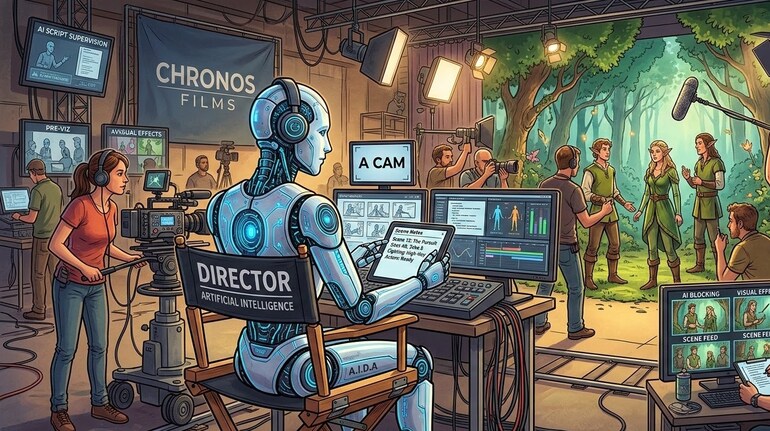

When filmmaker and entrepreneur M.S.N. Karthik set out to make his latest film Unmasked, he wasn’t assembling a traditional crew of dozens of technicians, camera operators and visual effects (VFX) artists. Instead, the eight-minute supernatural thriller was largely created by a single person working through a web of AI tools.
Channeling the spiritual intensity of Kantara, Unmasked centres on a skeptical Gen-Z vlogger trying to uncover the truth behind the fire ritual of a Theyyam dancer. What begins as an attempt to debunk a tradition turns into a journey that blurs the line between performance, faith, and divinity.
The film kept viewers hooked at the Delhi AI Film Festival, held alongside the India AI Summit, and won Karthik an award and $2,200 prize money.
Karthik’s experiment is part of a broader shift reshaping how films are produced.
According to Sanket Shah, founder and CEO of video AI platform InVideo, the first major transformation is happening in pre-visualisation.
Traditionally, directors relied on hand-drawn storyboards to imagine scenes. AI tools now allow filmmakers to simulate how a scene will look in precise detail, including time of day, camera angles, background elements and lighting.
The second shift lies in hybrid filmmaking.
Expensive scenes—such as car crashes or large-scale action sequences—can now be created digitally without shutting down roads or building physical sets.
The third—and perhaps most disruptive—impact is scale.
In animation, tasks that previously required 30 people working for two months can now potentially be executed by a single person within days, Shah said.
Behind the scenes of Unmasked, instead of a traditional production setup, Karthik built a custom AI pipeline combining multiple generative tools. The workflow stitched together five or six video models, image-generation systems, lip-sync tools and upscaling engines to maintain character consistency and improve visual quality to near-4K levels.
He generated over an hour of footage, even though the final film is just eight minutes long. Only about 5–10 percent of the generated footage made the final cut, highlighting the iterative nature of AI filmmaking.
“Production and editing now happen simultaneously,” he said. “You can generate a shot, edit it, and if it doesn’t work, regenerate it immediately. That flexibility never existed in traditional filmmaking.”
Specialised AI infra
As the technology matures, production houses are building specialised AI infrastructure for filmmaking.
At Collective Artists Network, Rahul Regulapati, partner at the company and CEO of its Galleri5 platform, says AI is becoming the production layer across the entire filmmaking pipeline.
Among the first movers, Collective produced the first AI series Mahabharat, now streaming on JioStar.
The company is building a proprietary AI cinematic operating system called Galleri5 AI Studio. The platform integrates diffusion models, LoRA-based character systems and AI-to-VFX pipelines within a secure production infrastructure.
LoRA or Low-rank adaptation is a technique used to adapt machine learning models to new contexts.
Rather than simply prompting, Regulapati describes the process as system-led orchestration.
“AI runs the heavy lifting and iteration at scale, while the director retains authorship,” he said.
The company is developing an ambitious slate of projects through its Historyverse banner, including films based on characters such as Hanuman, Krishna and Shivaji.
AI filmmaking tools
New AI filmmaking infrastructure is also emerging.
At Studio Blo, CEO Dipankar Mukherjee says the company’s philosophy is simple: “AI is the camera, not the person behind it.”
The studio has built an internal AI engine that can generate characters, environments and visual styles for a full film based on a creative brief.
Directors can then iterate multiple versions of scenes and maintain detailed control over shot composition.
Studio Blo is also working on digital cloning technology, allowing actors and celebrities to own and license their digital likeness while retaining control over how it is used.
The studio is currently developing a slate of seven feature films and episodic series slated for release by 2027.
Mukherjee added that the team uses multiple generative tools including Flux, WAN, Stable Diffusion, Kling and Nano Banana Pro to build their workflows.
Meanwhile, Eros Innovation has introduced its own AI infrastructure for filmmaking through Large Cultural Models (LCM)—trained on over 12,000 films and 1.5 trillion multimodal tokens from its entertainment archive.
The company has also launched PersonaAI, a system designed to preserve voice tone, emotion and performance across languages.
Cutting costs, faster production
Perhaps the most immediate impact of AI is the dramatic reduction in production time and cost.
Traditional filmmaking requires extensive resources—location scouting, physical sets, large crews and expensive visual effects. What used to take years can now be done in months.
AI workflows allow filmmakers to replace many of these processes with virtual environments and automated pipelines.
Karthik believes that large-scale films could eventually be produced at 1–2 percent of their traditional budgets using AI-driven production techniques.
Similarly, Shah estimates that AI could compress months of animation work into days. But he said, “What AI is good at is not bringing Rs 8 lakh down to Rs 1 lakh, but bringing Rs 2 crore down to Rs 8 lakh.”
That shift, he argued, allows ambitious genres like science fiction or large-scale animation — traditionally dependent on massive capital — to become viable within Indian market economics.
For independent filmmakers, this dramatically lowers the barrier to entry.
Historically, directors often had to secure backing from major studios or streaming platforms to produce a film. With AI tools, smaller creators may be able to produce and distribute projects independently through digital platforms.
New roles in AI filmmaking
As workflows evolve, the industry is also seeing the rise of entirely new creative roles.
Studios are hiring specialists like AI pipeline architects, AI-VFX supervisors, Identity system managers, AI platform wranglers, Model fine-tuning engineers, Hybrid previs artists.
According to Regulapati, these roles sit at the intersection of creative craft and computational infrastructure.
Traditional roles such as graphic designers and animators are also shifting toward decision-making roles rather than execution-heavy tasks.
Karthik believes future filmmakers may combine multiple responsibilities—writer, director, animator and visual designer—similar to animation directors who oversee entire creative pipelines.
New-gen of AI-driven films
Several upcoming projects suggest the technology may soon reach mainstream audiences.
Veteran filmmaker Shekhar Kapur is developing a science-fiction project titled Warlord, created entirely using generative AI in collaboration with Studio Blo.
Actor-producer Ajay Devgn has also announced Bal Tanhaji, an AI-driven prequel to the 2020 blockbuster Tanhaji: The Unsung Warrior.
The makers of popular series Breathe and films like Toilet Ek Prem Katha, Abundantia Entertainment under its AI division has a slate of six films under development that is going to be a combination of content driven by AI and fully generated by AI.
Experimental AI films are already being tested in theatres, for instance, Shatak that released in cinemas on February 20.
Karthik predicts that at least ten AI-assisted films could be released by the end of the year.
Within two years, he believes audiences may struggle to distinguish between traditional and AI-generated productions.
Disruption spreading beyond cinema
According to Prashant Khanna, Head of Production Services and Technology for Sports at JioStar, AI is already transforming how large-scale live broadcasts are produced.
Sports streaming platforms today often handle concurrency levels of 55–60 million viewers, making automation critical.
AI systems now process match data in real time, predicting which graphics, statistics or highlights might be required next. This allows production teams to anticipate events rather than reacting after they happen.
Automation is also reshaping content distribution.
“Today audiences consume sports in many formats,” Khanna said. “Some want a three-minute highlight, others a longer recap, and some prefer the full broadcast.”
AI systems can automatically generate multiple versions of the same content—horizontal broadcasts, vertical clips, short highlights—optimised for different platforms.
Filmmakers vs AI
Despite AI’s efficiencies in filmmaking, Shah insists that AI will remain a filmmaker’s tool rather than an engineer’s tool.
“You cannot have an engineer prompting a film,” Shah said. “It’s the filmmaker who understands camera angles, lenses, costume design and storytelling. The creative vision will always come from the human behind the machine.”
The risks
The film industry is abuzz with excitement with the use of AI but its rapid adoption raises significant concerns.
Regulapati warns that the biggest risks are not the technology itself but the lack of governance frameworks around it.
Issues such as intellectual property rights, training data ownership and job transitions remain unresolved.
“Technology itself isn’t the risk,” he said. “The real risk is unstructured adoption—prompt-driven workflows without continuity control, rights protection or pipeline governance.”
There are also concerns about the impact on certain roles within the film industry.
Mukherjee acknowledges that some non-creative production roles may decline, particularly in areas like advertising shoots where AI could reduce the need for physical production.
However, he believes the broader creative ecosystem will adapt rather than disappear.
“There is no threat,” Mukherjee said. “Only a reconfiguration of how creativity and business operate.”
For filmmakers like Karthik, the technology represents a fundamental shift in who gets to tell stories.
“In the end, AI is just a tool,” he said. “The story, the emotion and the imagination still come from the human being.”
And as AI moves deeper into filmmaking, that balance between machine efficiency and human creativity may determine the future of cinema itself.


Discover the latest Business News, Sensex, and Nifty updates. Obtain Personal Finance insights, tax queries, and expert opinions on Moneycontrol or download the Moneycontrol App to stay updated!
Find the best of Al News in one place, specially curated for you every weekend.
Stay on top of the latest tech trends and biggest startup news.