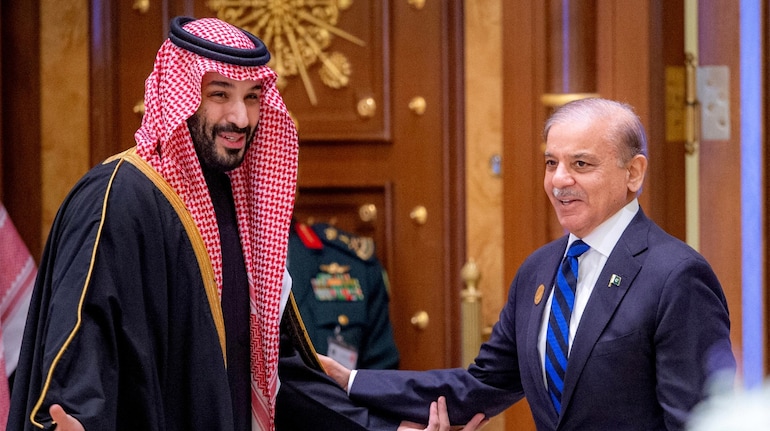

Will Pakistan rush to Saudi Arabia's aid if it seeks military support in the event of a wider escalation in the West Asia conflict? Pakistan prime minister Shehbaz Sharif pledged “full solidarity and support” for Saudi Arabia following a visit to the Middle Eastern kingdom last week.
The pledge was part of a mutual defence pact signed by Pakistan and Saudi Arabia last year which states that "any aggression against either country shall be considered an aggression against both".
The agreement complicates things for Pakistan, which is already facing a prolonged conflict with Afghanistan on its western border and a crippling energy crisis exacerbated by the Iran war.
Rashid Ahmad Khan, an international relations expert based in Lahore, told Bloomberg that it’s “highly unlikely” that Pakistan would attack Iran in retaliation for its strikes on Saudi Arabia
So the question remains: What if it's called upon to help?
Strategic affairs analyst Sushant Sareen said in an article in NDTV that the agreement could place Pakistan in a difficult position if the conflict widens and Saudi Arabia invokes the pact.
“When Pakistan signed the Strategic Mutual Defence Agreement (SMDA) with the Kingdom of Saudi Arabia in September last, its military-controlled regime never imagined that this agreement would soon become so onerous,” Sareen wrote.
According to Sareen, Pakistani leaders had expected the agreement to strengthen their strategic standing in the Middle East while ensuring continued financial and political backing from Riyadh.
“The way the Pakistanis sold this deal was that it was a recognition of their military prowess,” he wrote, adding that the arrangement was also seen as a way for Pakistan to expand its diplomatic influence in the region.
However, the dynamics changed after the current conflict began and Iran started targeting multiple Gulf states with missile and drone attacks, including Saudi Arabia and UAE.
On its part, Pakistan continues to assert that it will honour the pact no matter "what and when".
Shehbaz Sharif’s spokesman Mosharraf Zaidi said in an interview with Bloomberg TV that there was “no question” Pakistan would come to Saudi Arabia’s aid, “no matter what and no matter when.” “The real question is what is Pakistan doing to make sure things don’t come to a point where any of its closest partners are further embroiled in a conflict that could potentially undermine stability and prosperity in the region,” he added.
The second part of the statement suggests that while Pakistan is attempting to maintain an honourable posture, it is also wary of the conflict widening and appears keen to prevent further escalation in the region.
This was apparent when Sharif scrambled to Saudi Arabia last week and also held talks with Iran’s president Masoud Pezeshkian about the deteriorating situation in the Middle East.
Paksitan's powerful army chief, Field Marshal Asim Munir, was also present at the meeting. Munir also met Saudi Arabia's Defence Minister Prince Khalid bin Salman earlier this month, as the Kingdom witnessed missile and drone launches from Iran.
Caught in a bind
Sareen wrote in NDTV that Pakistan did not anticipate the possibility that the pact might force it into a confrontation with Iran, particularly at a time when Tehran and Riyadh had been attempting to improve ties.
“The Pakistanis, however, never imagined that their 'rent-for-hire' security services would be requisitioned against Iran,” he said.
The war has also come at a bad time for Pakistan, which is not only dealing with a hostile situation on the Afghanistan border but is also tackling insurgencies in Balochistan and Khyber-Pakhtunkhwa.
Pakistani officials have emphasised that the defence pact is meant for protecting Saudi Arabia rather than launching offensive operations against another country.
The uncertainty surrounding Pakistan’s role has intensified speculation about whether the country might eventually be compelled to open another front in the conflict if Saudi Arabia formally seeks military assistance. According to Sareen, such a move could carry significant risks for Pakistan.
“If Pakistan decides to follow Saudi orders, it can hope for financial rewards that will ease its economic pain. But the security and political fallout of such a move could actually prove more expensive than whatever mercenary payment Pakistan's for-hire Army hopes to earn for its services," he wrote in his NDTV column.
Discover the latest Business News, Sensex, and Nifty updates. Obtain Personal Finance insights, tax queries, and expert opinions on Moneycontrol or download the Moneycontrol App to stay updated!
Find the best of Al News in one place, specially curated for you every weekend.
Stay on top of the latest tech trends and biggest startup news.