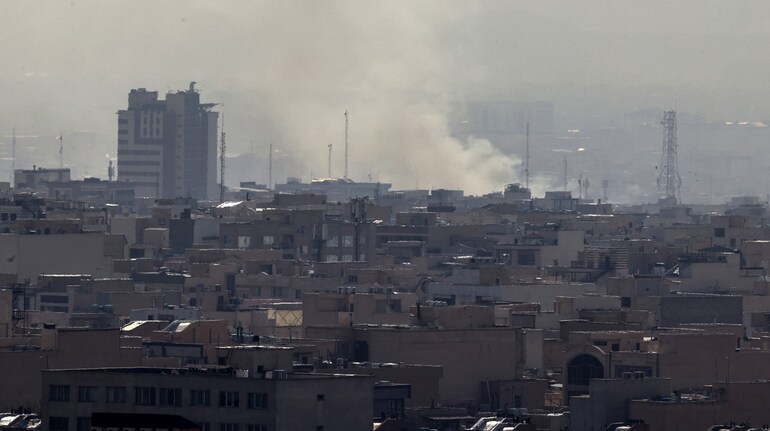

Tensions in the Middle East have flared up post US backed Israel strikes on Iran.
However, as bilateral trade between India and Iran is not substantial, and largely limited to drugs and fruits, the current tensions may not directly affect the commerce between the two countries much, or significantly impact India's economy.
US President Donald Trump on Saturday confirmed that the United States has launched a military campaign against Iran, describing the operation as “massive and ongoing” and aimed at neutralising what he called imminent threats from the Iranian regime.
India's bilateral trade with Iran in 2024-25 stood at $1.68 billion, way lower than $17.03 billion in 2018-19.
The $1.68 billion figure is 0.01 percent of India's total bilateral trade in 2024-25 -- that is, $1.74 trillion.
The key reason for this sharp decline is a significant reductions in crude oil imports from Iran in the past five years, thanks to US sanctions.
To be precise, in 2024-25, India's imports from Iran stood at $0.44 billion, while exports to the middle eastern country stood at $1.24 billion.
The major Indian exports to Iran includes basmati rice, tea, sugar, fresh fruits and drugs/pharmaceuticals where as major exports from Iran to India includes apples, pistachios, dates and kiwi.
The current tensions may, however, affect trade with Israel -- with which India's commerce has been steadily increasing.
India’s exports to Israel have grown 21 percent over the past decade, broadly driven by increase in defence and high-technology equipment shipments.
India’s imports of arms and ammunition from Israel have surged nearly 100-fold, rising from around $1 million in FY13 to $104 million in FY24. Imports of aircraft, spacecraft and related parts have also expanded sharply, increasing from $31.8 million to $193 million during the period, signalling deeper strategic cooperation even as overall trade volumes remain steady.
Beyond bilateral ties, broader regional instability poses risks to global shipping. Disruption in the Red Sea corridor, a critical route linking Asia and Europe, is expected to push freight and insurance costs elevated. Higher logistics costs could dampen India’s exports to Western markets and raise import bills, particularly for energy and intermediate goods.
According to analysts, India’s oil supplies face a renewed risk of disruption following the attack. The escalation raised concerns of a broader conflict that could disrupt the Strait of Hormuz, a key passage for India’s crude oil imports.
A blockade of the Strait of Hormuz will affect as much as 50% of India’s monthly total imports, they say.
Discover the latest Business News, Sensex, and Nifty updates. Obtain Personal Finance insights, tax queries, and expert opinions on Moneycontrol or download the Moneycontrol App to stay updated!
Find the best of Al News in one place, specially curated for you every weekend.
Stay on top of the latest tech trends and biggest startup news.