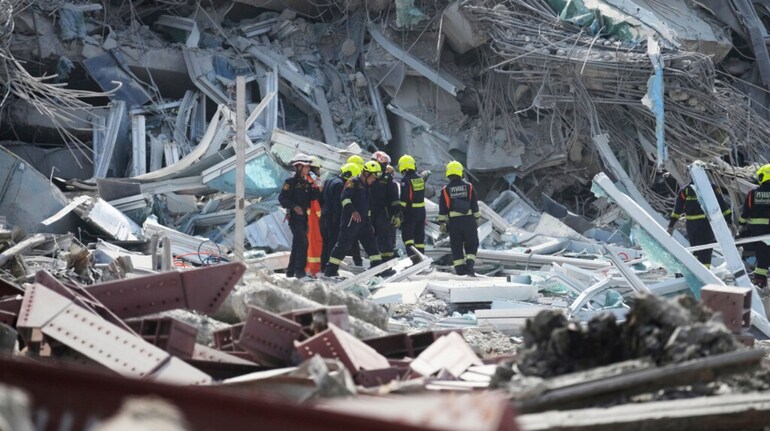
Myanmar was struck by a massive 7.7-magnitude earthquake, followed by another one of 6.4 on the Richter Scale today, which claimed several lives and toppled buildings, ruptured roads and collapsed the icnonic Ava Bridge. A 30-storey under-construction building collapsed in Bangkok, in which three workers were killed and 90 still trapped under the rubble.
Myanmar's military-run government declared a state of emergency in six regions and states including the capital Naypyitaw and Mandalay, but with the country in the midst of a prolonged bloody civil war, it was not clear how help would get to many regions.
The quake was felt across the region, with China, Cambodia, Bangladesh and India all reporting tremors.
Why earthquakes are common in Myanmar
Earthquakes are relatively common in Myanmar, where six strong quakes of 7.0 magnitude or more struck between 1930 and 1956 near the Sagaing Fault, which runs north to south through the centre of the country, according to the United States Geological Survey (USGS).
A powerful 6.8-magnitude earthquake in the ancient capital Bagan in central Myanmar killed three people in 2016, also toppling spires and crumbling temple walls at the tourist destination.
The country’s susceptibility to earthquakes is a consequence of its complex geological setting, which is characterised by active tectonic boundaries, major fault systems and ongoing seismic activity.
Tectonic setting
Myanmar is situated at the convergence of the Indian and Eurasian tectonic plates. The northward movement of the Indian Plate against the Eurasian Plate generates significant tectonic stress, leading to frequent seismic events. This interaction is a primary driver of Myanmar's seismicity.
Indian Plate’s subduction
The Indian Plate is moving northward at a rate of several centimetres per year, colliding with the Eurasian Plate. Notably, this collision isn't a simple head-on crash. Instead, the Indian Plate is subducting, or sliding, beneath the Eurasian Plate. This subduction process generates immense pressure and stress along the plate boundary.
The Sagaing Fault
One of the most significant geological features in Myanmar is the Sagaing Fault, a major strike-slip fault that runs roughly north-south through the country's central region. This fault is a result of the complex interactions between the Indian and Eurasian Plates.
Along strike-slip faults, the plates slide horizontally past each other, creating shear stress that can lead to powerful earthquakes. The Sagaing fault is considered a very active fault, and is responsible for many of the large earthquakes that occur in Myanmar.
Earthquakes in Myanmar can occur at varying depths. Shallow earthquakes, which occur closer to the surface, tend to cause more damage than deeper earthquakes. Today’s earthquakes are examples of shallow tremors. The 7.7-magnitude tremor hit northwest of the city of Sagaing, central Myanmar, and was followed minutes later by a 6.4-magnitude aftershock.
Discover the latest Business News, Sensex, and Nifty updates. Obtain Personal Finance insights, tax queries, and expert opinions on Moneycontrol or download the Moneycontrol App to stay updated!
Find the best of Al News in one place, specially curated for you every weekend.
Stay on top of the latest tech trends and biggest startup news.