




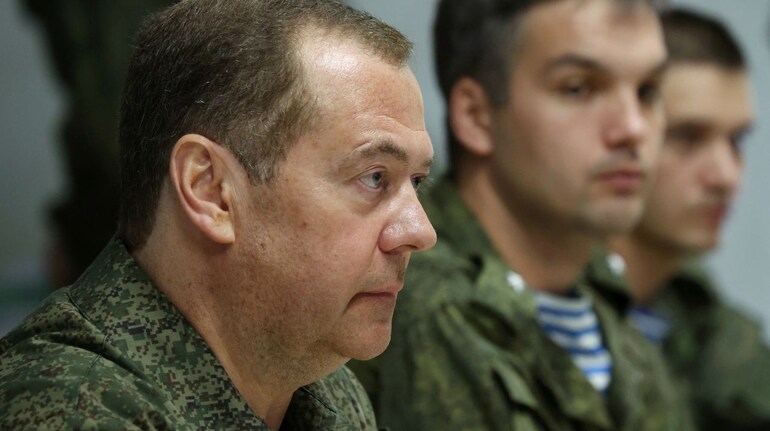
Dmitry Medvedev, Russia’s former president and current Deputy Chairman of the Security Council, has returned to the global spotlight, but not as the mild-mannered technocrat he once was.
Medvedev, who briefly led Russia between 2008 and 2012, is now making headlines for escalatory rhetoric, including nuclear threats, that recently triggered a rare public rebuke from US President Donald Trump. But why does his voice still matter, and what does it tell us about how power works inside Russia?
The Putin placeholder who briefly raised western hopes
Medvedev became president in 2008, stepping in when Vladimir Putin was constitutionally barred from a third consecutive term. At the time, many in the West hoped he might steer Russia toward reform.
He signed the New START treaty with President Obama.
He spoke of modernisation, legal reform, and civil society.
But his presidency also saw the 2008 war with Georgia, a reminder that Russia's foreign policy hadn't changed.
Ultimately, his time in office was widely seen as Putin-controlled, and the pair swapped roles again in 2012, with Putin returning as president and Medvedev sliding into the prime minister’s chair.
A decline and a reinvention
Medvedev remained prime minister until 2020, when he was replaced by Mikhail Mishustin. Pushed out of day-to-day policymaking, he was appointed Deputy Chairman of the Security Council, a post with real access to power but little formal influence.
Yet with Russia’s full-scale invasion of Ukraine in 2022, Medvedev re-emerged—not as a moderate voice but as one of Moscow’s most aggressive hardliners.
The war cheerleader: A new persona emerges
Since 2022, Medvedev has reinvented himself as a loud, unapologetic war hawk:
He has threatened nuclear retaliation repeatedly.
In 2024, he warned it would be a “fatal mistake” to think Russia wouldn't use tactical nukes in Ukraine.
He referred to Ukrainians as “cockroaches,” called Volodymyr Zelenskyy a drug addict and a freak, and mocked world leaders with crude, provocative language.
Critics at home call his statements "impotent rants." But Western officials note that Medvedev often says what Putin’s inner circle is thinking, without diplomatic filters.
Clash with Trump: Why it matters now
Medvedev’s latest headline moment came when he criticised U.S. airstrikes on Iran, claiming unnamed countries were prepared to supply Iran with nuclear warheads.
Trump fired back, accusing Medvedev of recklessly invoking nuclear threats and announced that two U.S. nuclear submarines had been moved to “appropriate regions.”
“Tell Medvedev, the failed former President of Russia… to watch his words. He’s entering very dangerous territory,” Trump warned.
Medvedev responded by calling Trump’s post a “nervous reaction,” saying it showed Russia was “on the right path.” He hasn’t posted since.
Why Medvedev’s voice still matters
While no longer at the top of the Kremlin hierarchy, Medvedev's institutional position, access to Putin, and role as public attack dog make him a figure worth watching.
He offers the world a window into the mindset of Russia’s hawkish elite, especially on nuclear threats and foreign policy. His words—though sometimes written off as theatrics, often echo Russia’s real red lines.
Discover the latest Business News, Sensex, and Nifty updates. Obtain Personal Finance insights, tax queries, and expert opinions on Moneycontrol or download the Moneycontrol App to stay updated!
Find the best of Al News in one place, specially curated for you every weekend.
Stay on top of the latest tech trends and biggest startup news.