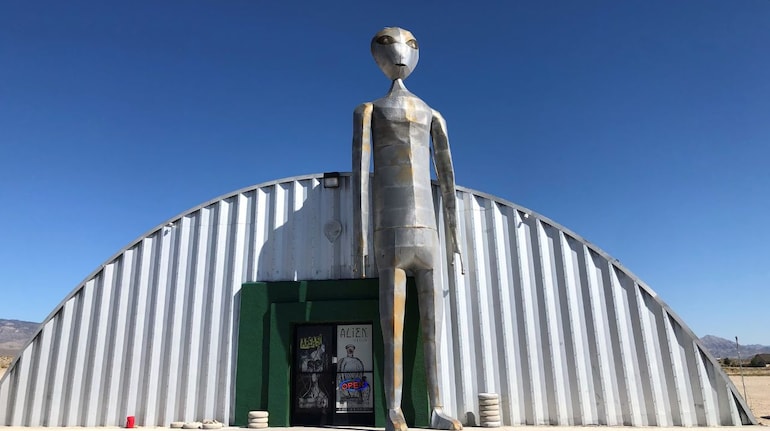

Area 51 has resurfaced in public conversation after US President Donald Trump ordered the release of government material linked to aliens and unidentified flying objects. Almost immediately, the announcement reignited a familiar narrative. The Nevada desert base is once again being cast as a warehouse for crashed spacecraft and hidden extraterrestrial remains.
That story has endured for decades, largely because the US government spent years refusing to even say the place existed.
The reality of Area 51 is less cinematic but far more revealing about how secrecy works in national security.
Area 51 sits deep inside the Nevada Test and Training Range and is operated by the United States Air Force. For much of the Cold War, its very name was absent from official maps. Employees were flown in on unmarked aircraft, projects were compartmentalised, and questions were met with silence. That vacuum of information did not stay empty for long.
When declassified documents were released in 2013, they confirmed what aviation historians had long suspected. Area 51 was a development and testing ground for aircraft that were supposed to be invisible, unreachable, or both. The U-2 spy plane was tested there in the 1950s, flying far higher than commercial or military aircraft of the time. Later came the A-12 and SR-71 Blackbird, capable of extreme speed and altitude, followed by early stealth programmes that eventually produced the F-117.
To civilians on the ground, these aircraft looked nothing like conventional planes. They moved differently, flew at unfamiliar heights, and appeared without explanation. Many UFO sightings from the period line up neatly with known test schedules and flight profiles that only became public decades later.
So why has the alien theory proved so durable?
Secrecy is part of it, but so is storytelling. In the 1980s and 1990s, claims from former contractors and self-described insiders added drama to an already mysterious place. Tales of alien autopsies and reverse-engineered
technology spread through television specials, books, and early internet forums. None were supported by verifiable evidence, but they filled the gap left by official silence.
Trump’s order to release UFO-related files does not focus on Area 51. Most of the documents concern unexplained aerial phenomena reported by pilots or detected on radar. In official language, “unidentified” means exactly that. It does not imply origin, intent, or intelligence. In many cases, later reviews have pointed to drones, sensor errors, or foreign surveillance platforms.
What has changed is tone. Governments no longer laugh off strange sightings. They now treat them as potential airspace or security issues, which lends them a seriousness that conspiracy theories quickly latch onto.
Area 51 remains closed to the public, and much of its work is still classified. That alone ensures speculation will continue. But history offers a strong clue about what is really happening there. When something strange appears over the Nevada desert, it is far more likely to be a human-built aircraft being tested in secret than evidence of visitors from another world.
The latest release of UFO files may fuel curiosity or confirm existing beliefs. What it does not do is rewrite the basic story of Area 51. Its importance lies in how the United States developed and hid advanced military technology, and how secrecy itself can create myths that last longer than the secrets they were built around.
Discover the latest Business News, Sensex, and Nifty updates. Obtain Personal Finance insights, tax queries, and expert opinions on Moneycontrol or download the Moneycontrol App to stay updated!
Find the best of Al News in one place, specially curated for you every weekend.
Stay on top of the latest tech trends and biggest startup news.